
The Signal Map: Following Your eSIM’s Journey Across 7 Countries in 7 Days

7 countries in 7 days signal map showing the journey of an eSIM across international boardersHow a Digital Passport Stamp Trail Keeps You Connected Across Borders

There’s a certain poetry in watching your phone light up with a new network the moment your train glides across an invisible line on the map. No customs booth. No plastic SIM tray. Just a soft click of connectivity, like a passport being stamped by satellites in the sky.

This is the story of a week on the move and the quiet companion that never left my side: an international travel eSIM. Seven countries. Seven days. One digital thread of signal tying it all together.

Welcome to the Signal Map.


Day 1: France — A Café, a Croissant, and Full Bars

The journey begins in Paris, where the morning smells like espresso and possibility. I step off the RER at Saint-Michel, and before I can even look up at Notre Dame, my phone vibrates.

Network connected.

No searching for a SIM shop. No fumbling with tiny metal pins. My eSIM simply slides into place, invisible and ready.

Maps load. Messages send. The first photo of the trip uploads before the croissant cools. It feels less like “getting connected” and more like never disconnecting at all.

This is what a modern travel eSIM promises: connectivity that moves as fast as you do.

Day 2: Belgium — Border Crossings Without the Buffering Wheel

The high-speed train hums north toward Brussels. Somewhere between the fields and the forests, the phone does its quiet magic again. One network fades. Another steps forward.

No alerts. No interruption.

I test it the only way that matters. I refresh my navigation app while standing under the glass ceiling of Brussels-Central. The blue dot doesn’t blink. It just keeps going.

For travelers who cross borders by train, car, or ferry, this is where eSIMs shine. They don’t wait for you to “arrive.” They travel with you, handing off connections like a relay runner passing the baton.

Day 3: Netherlands — Canals, Cloud Storage, and Constant Uptime

Amsterdam greets me with bicycles, boats, and an internet connection that feels as smooth as the water in the canals.

This is a day for photos. Lots of them.

I shoot, edit, and upload in real time. Cloud backups hum quietly in the background. There’s no mental math about how much data is left or whether I should wait for Wi-Fi. The city becomes a canvas, and my phone becomes a live broadcasting station.

For digital nomads and creators, this kind of always-on data isn’t a luxury. It’s infrastructure.

Day 4: Germany — From Autobahn to Underground Signal

Berlin is a city of layers. History above ground. Subways below.

I test the eSIM where most connections stumble: underground. On the U-Bahn platform, messages still send. A rideshare loads before I hit the street.

Behind the scenes, this is where multi-network support and intelligent routing matter. Your eSIM isn’t loyal to just one carrier. It looks for the strongest signal and takes it, like a traveler choosing the fastest line at airport security.

The result feels simple. The technology behind it is anything but.

Day 5: Austria — Mountains, Maps, and the Edge of Coverage

The train climbs into the Alps, and the scenery starts to outpace the infrastructure. Snow-capped peaks. Long tunnels. Small villages.

This is the real test.

At a mountain stop near Innsbruck, I step out and refresh my map. It loads. Slowly, but steadily.

This is where a travel eSIM becomes more than a convenience. It becomes a safety net. Navigation, translation, emergency calls, weather updates. In remote places, connection isn’t about posting photos. It’s about knowing where you are and how to get back.

Day 6: Italy — Roaming Without the Roaming Fees

Florence feels like walking into a painting. It also feels like walking into a tourist trap for expensive data roaming.

Except nothing changes.

I stream a short video overlooking the Arno. I book a last-minute museum ticket. I video call home from a crowded piazza.

The difference is invisible, but the impact is real. No surprise charges. No locked SIMs. Just a predictable, prepaid connection that behaves the same way it did in Paris.

Consistency is the real luxury of global connectivity.

Day 7: Switzerland — The Signal Becomes a Souvenir

The final stop is Zurich. Clean streets. Quiet trams. A phone that’s been connected longer than some travel companions.

I scroll back through the week’s photos and realize something: the eSIM has its own kind of travel diary. A trail of networks. A map of countries visited, not by stamps in a passport, but by silent handshakes between towers and satellites.

This is what travel looks like now. Not just where you go, but how seamlessly you stay in touch with everywhere else.


eSIM vs. Roaming vs. Local SIM: Quick Comparison

Option Setup Time Cost Predictability Best For
Travel eSIM Minutes High Multi-country trips, instant data
International Roaming Instant Low Short trips (with caution)
Local Physical SIM 30–90 minutes Medium Single-country stays

What This Journey Really Shows

Seven countries in seven days isn’t about speed. It’s about continuity.

A modern travel eSIM turns borders into soft edges instead of hard stops. It replaces the old ritual of hunting for local SIM cards, guessing at compatibility, and worrying about costs.

  • Instant activation before or after you land
  • Multi-country coverage under a single profile
  • No physical SIM swaps or lost trays
  • Predictable pricing without surprise roaming fees
  • Reliable performance in cities and remote areas alike

Turning Your Phone Into a Passport

Your passport gets stamped at borders. Your eSIM gets “stamped” by networks.

Each country leaves a trace. A different carrier. A different signal signature. A different backdrop for the same, steady connection.

The best travel technology doesn’t announce itself. It simply walks with you, country to country, day to day, like a shadow made of signal bars.


Ready to Draw Your Own Signal Map?

If you’re planning a multi-country journey, a travel eSIM can be the difference between managing your trip and enjoying it.

Instead of packing plastic SIM cards, paper instructions, and backup plans, pack one digital connection that moves as freely as you do.

Tip: Want to keep your primary number active? Most phones support dual SIM (physical SIM + eSIM), so you can keep calls/texts on your main line while using your eSIM for data abroad.

From Airports to Airbnbs: How eSIMs Make Spontaneous Travel Possible

eSIM makes travel simple when booking flights and short term rentals

Not every great trip starts with a spreadsheet.

Sometimes travel happens because a flight deal pops up at midnight, a friend texts “come visit,” or you decide at the boarding gate that you’ll stay a few extra days. Spontaneous travel used to come with a penalty: unreliable Wi-Fi, expensive roaming, or the hassle of finding a local SIM card in an unfamiliar place.

Today, eSIM technology has quietly removed one of the biggest barriers to last-minute travel: connectivity. From the moment you land at an airport to unlocking your Airbnb door, a travel eSIM keeps you connected without planning ahead or committing to rigid itineraries.

Here’s how eSIMs make modern, spontaneous travel not just possible — but easy.


The Old Problem With Spontaneous Travel

Before eSIMs, staying connected abroad required planning. A lot of it.

Travelers had to:

  • Pre-order physical SIM cards

  • Find airport kiosks after landing

  • Navigate language barriers

  • Swap SIMs and hope nothing broke

  • Pay surprise roaming fees if plans changed

For spontaneous travelers, these steps were deal-breakers. If you didn’t know how long you’d stay, where you’d go next, or which country you’d visit, connectivity became an obstacle instead of a tool.


Enter the eSIM: Connectivity Without Commitment

An eSIM (embedded SIM) is built directly into your phone. Instead of inserting a plastic card, you download a mobile plan digitally — often in minutes.

This shift changes everything for spontaneous travelers.

With a travel eSIM:

  • There’s no physical SIM to buy or carry

  • Plans can be activated instantly

  • Coverage can span multiple countries

  • You can change destinations without changing SIMs

  • Your phone works the moment you land

It’s connectivity that adapts to your plans — not the other way around.


At the Airport: Connected Before You Leave the Jet Bridge

Spontaneous trips often begin in motion. You land, turn off airplane mode, and immediately need your phone.

Think about what you use data for in the first 15 minutes:

  • Ride-hailing apps

  • Public transit directions

  • Messaging your host or travel companions

  • Mobile boarding passes or train tickets

  • Currency conversion and translation

With a travel eSIM installed before departure, your phone connects as soon as it finds a network. There’s no waiting for Wi-Fi, no SIM kiosk lines, and no scrambling for signal.

For travelers who don’t plan every step, this instant connection is critical.


️ Choosing Where to Go Next — on the Fly

Spontaneous travel isn’t just about the first destination. It’s about freedom once you arrive.

Maybe you:

  • Extend your stay by a few days

  • Book a train to a neighboring country

  • Change cities based on weather or recommendations

  • Say yes to a last-minute side trip

With traditional SIM cards, crossing borders often means losing service or starting over. With an eSIM, especially one designed for international travel, your connection can follow you across countries with no interruption.

You stay online while your itinerary evolves.


From Booking to Check-In: eSIMs and Airbnbs

Spontaneous travelers rely heavily on apps — especially for accommodations.

Airbnb and similar platforms require:

  • Fast data for browsing listings

  • Secure connections for payments

  • Messaging hosts in real time

  • Access to check-in details and door codes

Arriving without connectivity isn’t just inconvenient. It can be stressful.

A travel eSIM ensures you can:

  • Book an Airbnb minutes before arrival

  • Message hosts if plans change

  • Access directions, photos, and check-in instructions

  • Handle last-minute issues without Wi-Fi dependency

For travelers who decide where they’ll sleep the same day they arrive, this reliability is essential.


Safer, Smarter Travel Connectivity

Spontaneous travel often means connecting to unfamiliar Wi-Fi networks — cafés, stations, airports, rentals. That can introduce security risks.

Using mobile data through an eSIM is generally:

  • More secure than public Wi-Fi

  • Encrypted at the network level

  • Less vulnerable to “evil twin” hotspots

  • More reliable for payments and bookings

For digital nomads, remote workers, and anyone handling sensitive information on the road, eSIMs provide a safer default connection.


No SIM Swaps, No Commitment

One of the biggest advantages of eSIMs for spontaneous travel is flexibility.

You can:

  • Store multiple eSIM profiles

  • Switch plans without removing anything

  • Pause or disable plans when not needed

  • Keep your home SIM active for calls or SMS

This means you’re never locked into a single destination or data package.

Plans change. Your connectivity shouldn’t break when they do.


Why eSIMs Shine for Multi-Country Travel

Spontaneous trips often turn into multi-country adventures — especially in regions like Europe or Southeast Asia.

With a single travel eSIM, you can:

  • Take a train from Paris to Brussels

  • Fly from Thailand to Vietnam

  • Road-trip across Mexico

  • Island-hop without reconfiguring your phone

Your phone simply connects to the best available local network.

No new SIMs, no reactivation, no downtime.


Cost Control Without Planning Ahead

One reason travelers hesitate to be spontaneous is cost uncertainty — especially for mobile data.

Traditional roaming plans are unpredictable and expensive. Local SIM cards require upfront decisions. eSIMs strike a balance.

Travel eSIMs offer:

  • Transparent pricing

  • Pay-as-you-go or flexible data packages

  • No long-term contracts

  • Control over usage without commitment

You can start small, add data if needed, and stop when your trip ends.


Why OneSimCard Fits the Spontaneous Traveler

OneSimCard’s travel eSIMs are built for travelers who don’t follow rigid itineraries.

They offer:

  • Coverage in 200+ destinations

  • Multi-country connectivity with one eSIM

  • Fast QR-code activation

  • No contracts or subscriptions

  • Free incoming SMS

  • Optional voice calling with OneSimVoIP

Whether you’re booking flights last minute, extending your stay, or changing destinations entirely, OneSimCard lets your phone keep up with your decisions.


✨ The Freedom Factor

Spontaneous travel isn’t about chaos, it’s about choice.

It’s deciding where to go next over coffee instead of weeks in advance, it’s staying longer because a place feels right. It’s saying yes without worrying whether your phone will work.

eSIMs remove one of the final friction points that made spontaneous travel stressful. With instant connectivity from airports to Airbnbs, you can move freely, book confidently, and stay connected wherever the moment takes you.


Ready to Travel Without a Script?

If your best trips start with “why not?”, a travel eSIM is your perfect companion.

Activate a OneSimCard travel eSIM and keep your options open — wherever you land next.

The Complete eSIM Compatibility Guide for iPhone and Android

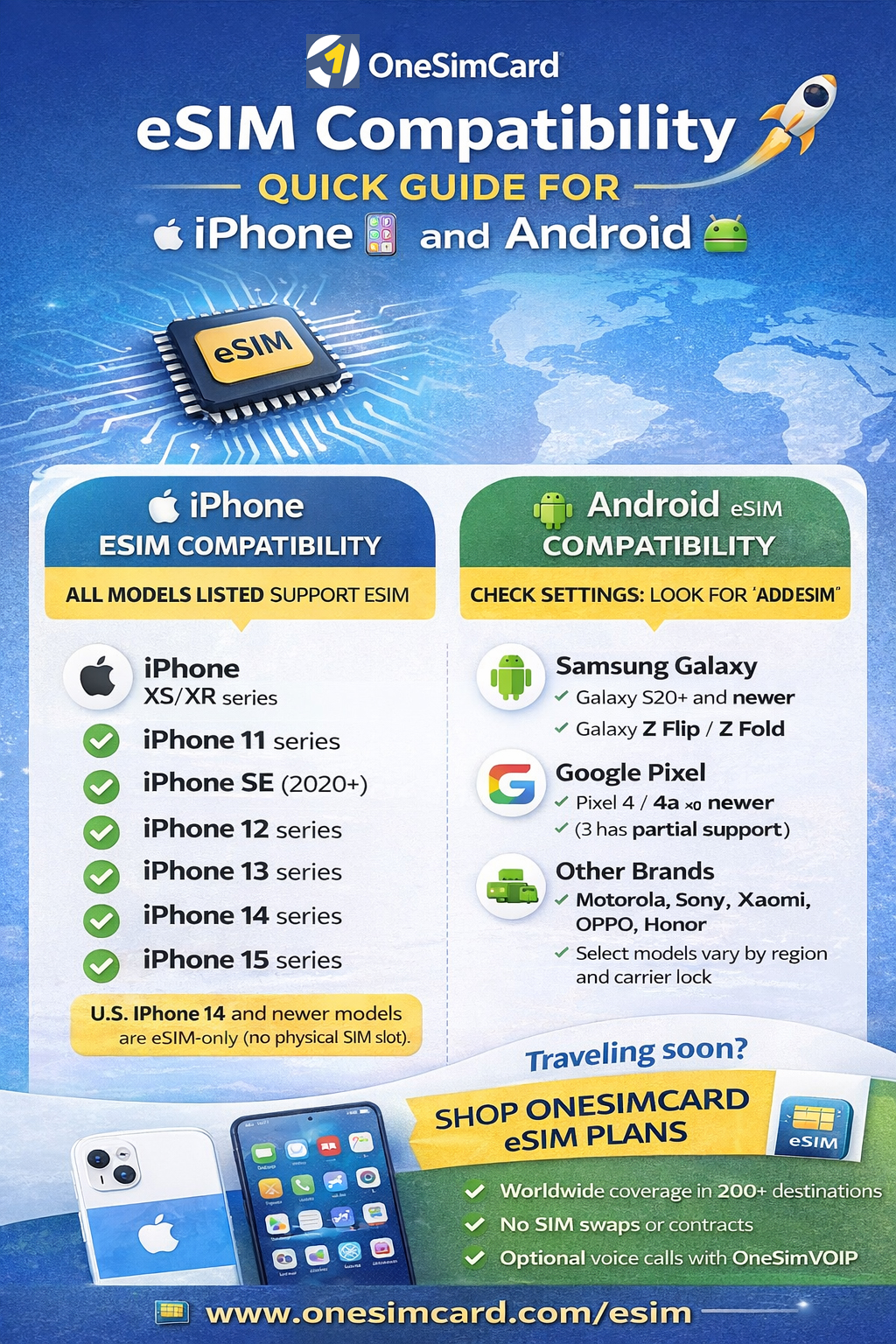
eSIM Compatible devices infographic

Covering major brands and models (and what travelers should check before they fly)

eSIM technology has moved from “nice-to-have” to “standard feature” on modern smartphones, especially for travelers.
If you’re planning to use a travel eSIM, the first question is simple:
Does your phone support eSIM?

This guide covers which iPhones and Android devices support eSIM, how to confirm compatibility in seconds,
and what to watch for with regional variants and carrier restrictions. If you’re traveling soon, you’ll also find setup tips
to help you connect quickly with a OneSimCard eSIM.

Traveler shortcut: If you see “Add eSIM” (iPhone) or “Add eSIM / SIM Manager” (Android) in Settings, your phone is almost certainly eSIM-compatible.

What Is eSIM and Why Compatibility Matters

An eSIM (embedded SIM) is a digital SIM built into your phone’s hardware. Instead of inserting a plastic SIM card,
you download a mobile plan using a QR code or activation link. For travelers, this means faster setup, easier switching between plans,
and no fragile SIM trays to deal with at 2 a.m. in an airport.

Compatibility matters because not every phone supports eSIM, and some models support it only in certain countries or carrier versions.
Confirming compatibility before purchase avoids the most common travel connectivity headache: “I bought a plan… but my phone can’t install it.”

Quick Comparison Table (At-a-Glance)

Device family eSIM support What travelers should know
iPhone (XS/XR and newer) Yes on modern models U.S. iPhone 14+ are eSIM-only. Most newer iPhones support dual SIM (physical + eSIM or dual eSIM).
Samsung Galaxy (S20+ and newer; Z Flip/Fold) Usually yes Some carrier-locked or regional variants may disable eSIM. Unlocked models are best for travel.
Google Pixel (Pixel 4 and newer) Yes Pixels are among the most travel-friendly for eSIM. Great for switching plans and quick activation.
Other Android brands (Motorola/Sony/Xiaomi/OPPO/Honor) Model & region dependent Check Settings for “Add eSIM” and verify your exact model variant (some regions omit eSIM).

iOS iPhone eSIM Compatibility Guide

Apple adopted eSIM early, and today nearly all modern iPhones support eSIM.
If you’re traveling with an iPhone XS/XR or newer, you’re in good shape.

✅ iPhones that support eSIM

  • iPhone XS / XS Max
  • iPhone XR
  • iPhone 11 / 11 Pro / 11 Pro Max
  • iPhone SE (2nd gen and newer)
  • iPhone 12 / mini / Pro / Pro Max
  • iPhone 13 / mini / Pro / Pro Max
  • iPhone 14 / Plus / Pro / Pro Max
  • iPhone 15 / Plus / Pro / Pro Max (and newer)

Key iPhone notes for travelers

  • U.S. iPhone 14+ models are eSIM-only (no physical SIM tray).
  • Most newer iPhones support dual SIM (physical + eSIM or dual eSIM, depending on model).
  • You can store multiple eSIM profiles and switch plans as needed.

Android Android eSIM Compatibility (Major Brands)

Samsung Galaxy eSIM support

Many Samsung flagship devices support eSIM, including the Galaxy S and Z series. Keep in mind that carrier-locked or region-specific variants can sometimes restrict eSIM functionality.

  • Galaxy S20 / S20+ / S20 Ultra (varies by region)
  • Galaxy S21 / S22 / S23 / S24 series
  • Galaxy Z Flip and Z Fold series (Flip3+ / Fold2+)

Google Pixel eSIM support

Pixel phones are among the most eSIM-friendly Android devices, making them excellent for international travel.

  • Pixel 4 and newer (including 4a/5/6/7/8 families)
  • Pixel 3/3 XL: partial support (model dependent)

Other Android brands (model dependent)

  • Motorola: select Razr and Edge models
  • Sony Xperia: select newer models
  • Xiaomi / OPPO / Honor: select flagships (regional availability varies)
  • Huawei: select models (note: Google services may be limited)

Regional Differences and Carrier Locks

Even if your phone model supports eSIM, regional variants can change what you actually get.
Some devices sold in certain markets may include dual physical SIM slots and no eSIM support.
Additionally, carrier-locked phones can restrict eSIM installation or block non-carrier profiles.

For the best travel experience, use an unlocked phone. If you’re unsure,
check with your carrier before you travel.

✅ How to Check eSIM Compatibility in Less than a Minute

iPhone

  1. Open Settings
  2. Tap Cellular (or Mobile Data)
  3. Look for Add eSIM or Add Cellular Plan

Android

  1. Open Settings
  2. Tap Network & Internet or Connections
  3. Look for SIM Manager / Add eSIM

Bonus check: On many Android phones, dial *#06#. If an EID is displayed, your device supports eSIM.

✈️ Best Practices Before You Travel

  • Install your eSIM on Wi-Fi before you depart.
  • Enable Data Roaming on the eSIM line when abroad (this is normal for travel eSIMs).
  • Keep your QR code/activation details saved securely (treat it like a password).
  • Update your phone OS to the latest version for best network performance and eSIM stability.

Why OneSimCard is Perfect for Travelers

Once you confirm compatibility, the next step is choosing a travel eSIM that fits your itinerary.
OneSimCard is built for international travelers who want simple activation and reliable global coverage.

  • Coverage in 200+ destinations
  • Flexible plans designed for travel (short trips to long stays)
  • Option to add voice via the OneSim VoIP app

Ready to get connected?

Shop OneSimCard eSIM plans
and activate in minutes.

Related reading: Travel eSIM tips & guides

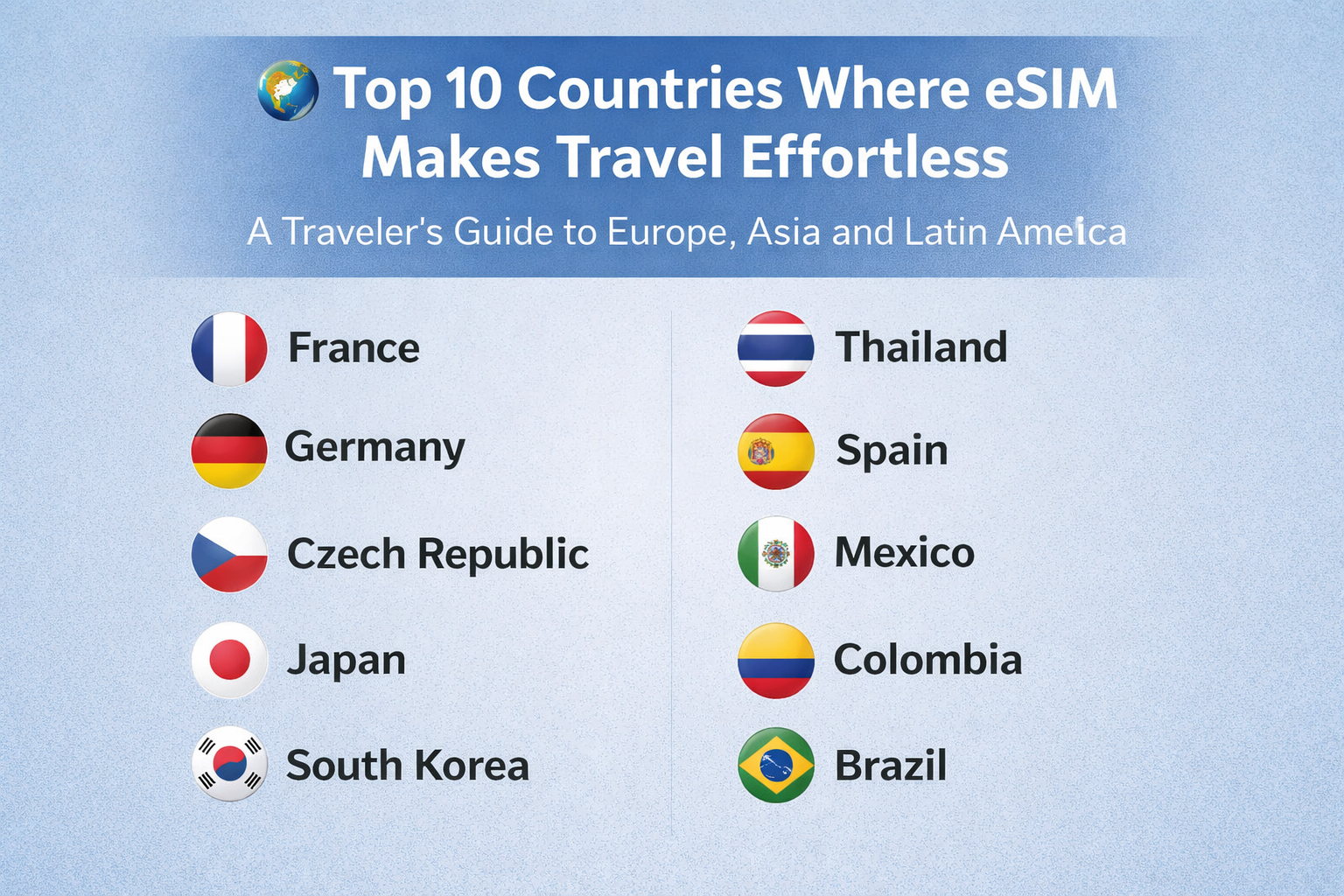
Top 10 Countries Where eSIM Makes Travel Effortless

eSIM Countries

A traveler’s guide to Europe, Asia, and Latin America

International travel used to come with a familiar ritual: land, scramble for Wi-Fi, hunt for a SIM kiosk, and hope the tiny plastic card doesn’t vanish into the airport carpet.
Today, a travel eSIM turns that whole routine into a quiet little magic trick: you activate digitally, connect instantly, and keep moving.

Not every destination feels equally “effortless,” though. The smoothest eSIM experiences tend to happen in countries with strong mobile infrastructure, multiple carrier partners, reliable 4G/5G coverage, and travel-friendly connectivity.
Below are 10 countries where eSIM travel feels particularly friction-free, with a focus on Europe, Asia, and Latin America.

Tip: For the smoothest start, install your eSIM before you fly (on Wi-Fi), then enable Data Roaming on the eSIM line when you arrive.

France flag1. France

Why it’s eSIM-friendly: Excellent nationwide coverage, fast LTE and 5G in major areas, and a travel-ready network environment.

France is the kind of destination where eSIM travel feels almost invisible. You can step off the plane in Paris, disable airplane mode, and immediately pull up transit routes,
reserve museum tickets, message your hotel, and navigate the city without bargaining with a SIM vendor. Connectivity stays reliable beyond the capital too, which is a big win
for travelers heading to the Loire Valley, Normandy, or the lavender-scented lanes of Provence.

Best for: City breaks, food-and-culture itineraries, rail travel.

Germany flag2. Germany

Why it’s eSIM-friendly: Strong infrastructure, multiple carrier options, and excellent connectivity along major transit routes.

Germany is built for movement: ICE trains, efficient city transit, and road trips that turn into spontaneous detours. A travel eSIM shines here because you can stay connected
through big hubs like Berlin, Munich, and Frankfurt while also keeping dependable data for navigation in smaller towns. If you’re crossing borders into Austria, the Czech Republic,
or beyond, eSIM convenience compounds fast: fewer plan changes, fewer “why isn’t this working” moments.

Best for: Multi-country trips, business travel, train-heavy itineraries.

Czech Republic flag3. Czech Republic

Why it’s eSIM-friendly: Excellent coverage in tourist areas, strong urban speeds, and easy connectivity for short stays.

The Czech Republic is compact, traveler-friendly, and wonderfully walkable, which makes it a perfect match for eSIM convenience. In Prague, you’ll likely use data constantly:
tram schedules, restaurant reservations, translation, tickets, and maps for wandering Old Town and beyond. With an eSIM, your phone stays reliably connected without requiring any
SIM swapping, even if your trip includes day trips or onward train travel into neighboring countries.

Best for: Weekend escapes, cultural tourism, rail routes from Western Europe into Central Europe.

Japan flag4. Japan

Why it’s eSIM-friendly: Advanced mobile networks, dense coverage, and eSIM convenience that avoids the “SIM counter puzzle” for visitors.

Japan is a dream for connected travel: precise transit, cashless options, and helpful apps for everything. It’s also a place where visitors often want data immediately to navigate
stations, translate menus, and coordinate reservations. A travel eSIM is ideal because you can install before departure and land with a working connection, no airport line required.
Whether you’re riding the Shinkansen, exploring Tokyo neighborhoods, or mapping out Kyoto temples, eSIM connectivity keeps the trip flowing.

Best for: First-time Asia travelers, solo travel, city exploration.

South Korea flag5. South Korea

Why it’s eSIM-friendly: Fast data speeds, strong coverage, and a tech-forward travel experience that depends on mobile connectivity.

South Korea makes “always connected” feel normal. Travelers use mobile data for navigation, translation, food delivery, ride-hailing, and on-the-fly planning. With a travel eSIM,
you can keep your trip moving smoothly from Seoul’s neighborhoods to coastal escapes like Busan. If you create content, you’ll appreciate the stability for uploads and messaging.
If you’re traveling for business, you’ll appreciate the reliability for calls and meetings.

Best for: Tech-forward travel, remote work, content creators.

Thailand flag6. Thailand

Why it’s eSIM-friendly: Strong networks in tourist corridors, reliable data in major cities, and a travel style that benefits from instant activation.

Thailand is a favorite for a reason: it’s welcoming, vibrant, and surprisingly connected. Whether you’re navigating Bangkok, booking ferries to islands, or working from Chiang Mai,
data is the backbone of a smooth trip. A travel eSIM helps you skip the airport SIM shuffle and keeps you connected as you hop between regions. It’s also perfect for travelers who
rely heavily on maps and messaging while moving day-to-day.

Best for: Backpackers, island hoppers, digital nomads.

Spain flag7. Spain

Why it’s eSIM-friendly: Strong 4G/5G coverage in major destinations, excellent transit connectivity, and effortless multi-city travel.

Spain is built for roaming the fun way: Barcelona to Madrid, Seville to Valencia, then maybe a last-minute coastal detour. With an eSIM, you don’t have to think about connectivity
every time you move cities. You can keep your maps and bookings live, share travel updates, and coordinate plans without hunting for local SIM solutions. If your trip extends across
borders (Portugal, France), an eSIM keeps the “same phone, same flow” experience going.

Best for: Multi-city vacations, festival travel, train routes.

Mexico flag8. Mexico

Why it’s eSIM-friendly: Strong coverage in cities and popular destinations, great value for travelers, and easy setup without in-person SIM purchases.

Mexico is one of the best Latin American countries for eSIM travel because it combines huge traveler demand with practical connectivity. In Mexico City, mobile data is essential for
navigation, ride-hailing, and restaurant planning. In beach regions like Cancún or Playa del Carmen, travelers often bounce between Wi-Fi and mobile data, making flexible eSIM access
especially handy. An eSIM is also useful for road trips where you want dependable navigation without depending on spotty public Wi-Fi.

Best for: Beach vacations, city breaks, road trips.

Colombia flag9. Colombia

Why it’s eSIM-friendly: Improving networks, excellent connectivity in major cities, and a growing digital-nomad scene.

Colombia has become a hotspot for travelers who want culture, scenery, and great long-stay value. In cities like Medellín and Bogotá, reliable data makes daily travel easier:
maps, messaging, translations, and work calls. A travel eSIM removes the need to navigate local SIM rules and keeps connectivity consistent as you explore different neighborhoods
or move between destinations.

Best for: Remote workers, city explorers, longer stays.

Brazil flag10. Brazil

Why it’s eSIM-friendly: Strong carrier competition in major cities and a travel style that benefits from consistent connectivity across large distances.

Brazil is big, bold, and sprawling, which makes SIM swapping especially annoying if your itinerary includes multiple cities. With an eSIM, you can move between major hubs like
São Paulo and Rio while keeping your navigation, plans, and communication stable. For travelers coordinating tours, transportation, or group plans, reliable data is the difference
between smooth logistics and frantic WhatsApp scrambling.

Best for: Multi-city trips, long-distance travel, business + leisure itineraries.

Why eSIMs Make Travel Effortless in These Countries

Across Europe, Asia, and Latin America, these destinations share a few important traits that make eSIM travel feel frictionless:

  • Strong mobile infrastructure with reliable 4G/5G service in key travel zones
  • Multiple carrier partners, giving your eSIM more options to connect
  • Travel-ready coverage across transit routes, city centers, and popular tourist regions
  • Easy cross-border movement (especially in Europe) where eSIMs avoid SIM swapping hassles

Why OneSimCard Is a Great Fit for Multi-Country Trips

If your itinerary includes more than one country, the convenience of an eSIM multiplies quickly. OneSimCard is designed for travelers who want dependable connectivity without the
usual logistics headache:

  • Coverage in 200+ destinations
  • One eSIM for multi-country travel (no swapping tiny plastic cards)
  • No contracts or subscriptions
  • Free incoming SMS
  • Optional voice calling with the OneSimVoIP app
  • Multi-network access to help maintain a strong connection on the move

✈️ Final Thoughts

The best trips are the ones where your phone quietly does its job in the background: maps load, tickets appear, translations work, messages go through, and you never have to
think about SIM trays or roaming surprises. In the 10 countries above, a travel eSIM is one of the simplest upgrades you can make for smoother travel.

Ready to stay connected effortlessly?

Activate your OneSimCard eSIM
and enjoy reliable data across borders with less hassle.

The Ultimate Beginner’s Guide to eSIM for International Travel

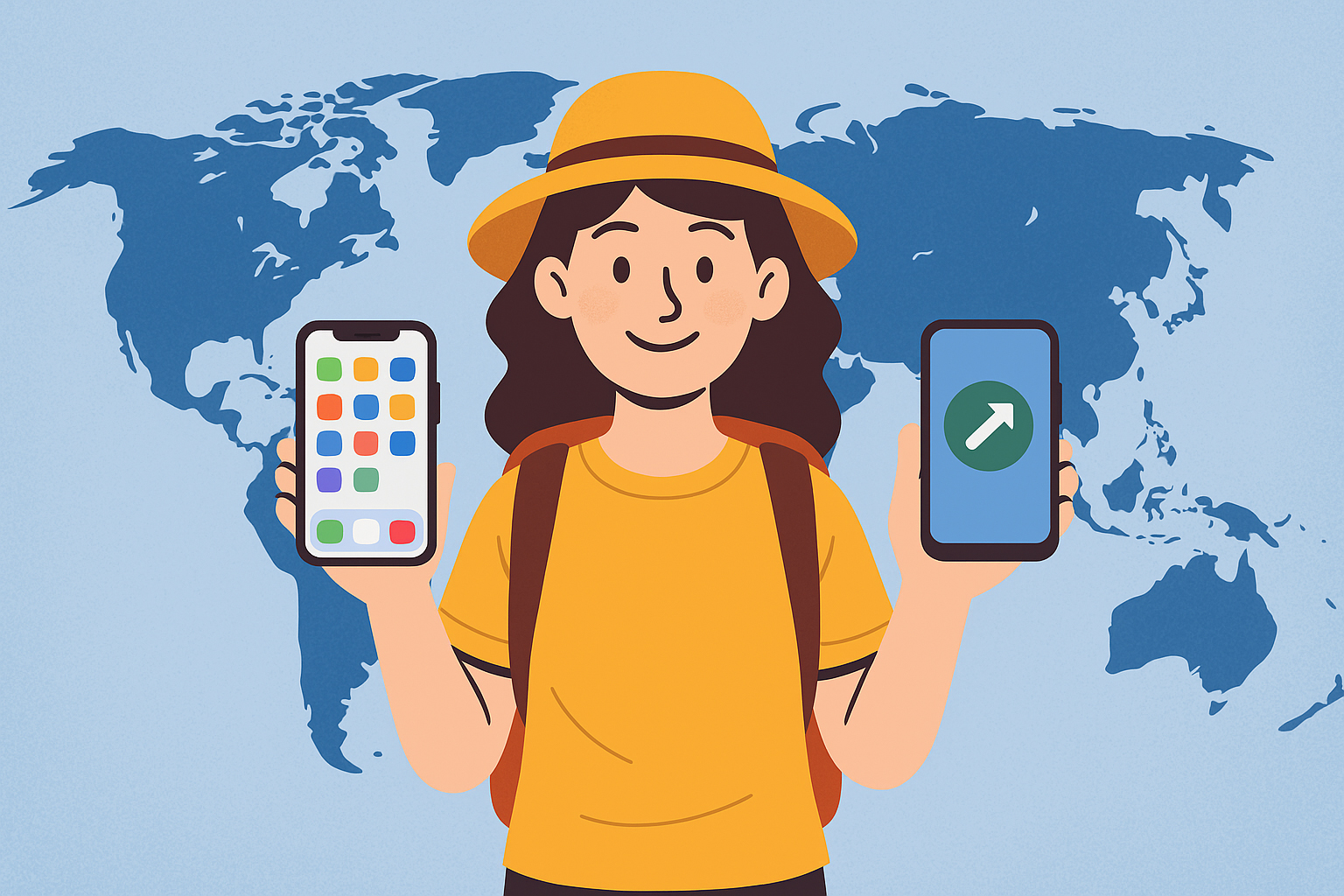
Woman holding smartphone with travel eSIM

How They Work, Setup Steps, and Why They Beat Physical SIM Cards

International travel has changed dramatically in the last few years — not because of cheaper flights or bigger suitcases, but because of a tiny technology built directly into your smartphone: the esim for international travel.

If you’ve ever landed in another country, turned off airplane mode, and immediately felt the sting of roaming fees, or scrambled to find a local SIM card vendor in a crowded airport, this guide is for you.

Whether you’re a first-time traveler, a digital nomad, or simply curious about how eSIMs work, this is the Ultimate Beginner’s Guide to Travel eSIMs — how they work, how to set them up, and why they’re replacing physical SIM cards for travelers worldwide.


What Exactly Is a Travel eSIM?

An eSIM (embedded SIM) is a digital version of the physical SIM card used to connect your phone to a mobile network. Instead of inserting a plastic chip, an eSIM is built into your device, and you activate it by scanning a QR code or entering a simple activation code.

Think of an eSIM as a downloadable phone plan.

With a travel eSIM from providers like OneSimCard, you can:

  • Activate international data instantly

  • Switch countries without swapping SIM cards

  • Avoid expensive roaming fees

  • Use multiple plans on a single device

  • Keep your home number active while using foreign data

It’s convenience, flexibility, and savings — all packed into one digital profile.


How Travel eSIMs Work (The Simple Version)

Here’s the basic idea:

  1. Every eSIM-enabled phone contains a secure chip inside.

  2. When you buy a travel eSIM plan, you receive a QR code or activation code.

  3. Your phone uses this code to download a mobile profile created by the provider.

  4. That profile tells your phone which network to connect to in each country.

There’s no shipping, no waiting, no physical installation, and no need to visit a store.

This is why eSIMs have become the new gold standard for international travel.


What Do You Need to Use an esim for international travel?

Most modern smartphones support eSIM technology.

iPhone:

  • XS, XR, 11, 12, 13, 14, 15 and newer
    (U.S. iPhone 14+ models are eSIM-only — no SIM tray at all!)

Android:

  • Google Pixel 4 and newer

  • Samsung Galaxy S20, S21, S22, S23

  • Samsung Z Flip / Fold

  • Many Motorola, Xiaomi, Oppo, and Huawei devices

If your phone is relatively new, there’s a good chance it supports eSIM.
To check, open:

Settings → Cellular → Add eSIM / Add Mobile Plan
If you see that option, you’re ready to go.


✈️ Why Travelers Are Switching to eSIMs

Before we get into setup steps, let’s talk about why eSIMs have become a traveler’s best friend.

1. Instant Activation

You can install a travel eSIM before you leave home, so your phone connects immediately when you land.

No more:

  • Hunting for airport kiosks

  • Dealing with language barriers

  • Swapping tiny SIM cards while jet-lagged

2. No Roaming Fees

Traditional carriers charge shocking roaming rates.
Travel eSIMs connect you to local networks at local prices — sometimes saving 80% or more.

3. Multiple Plans, Zero Hassle

Your phone can hold multiple eSIM profiles.
Want one for Europe and another for Asia? Easy.
Want a backup plan for emergencies? Done.

4. Keep Your Home Number Active

Because eSIMs free up your SIM tray (or eliminate the need entirely), you can continue receiving calls and texts on your regular number — while using your travel eSIM for data.

5. No Physical SIM to Lose

No more losing tiny SIM cards, misplacing ejector tools, or accidentally damaging your tray.

6. More Secure Than Physical SIMs

eSIMs can’t be cloned, swapped, or stolen like removable SIM cards.
This reduces the risk of SIM swapping attacks — a growing cybersecurity concern.


️ How to Set Up a Travel eSIM (Step-by-Step)

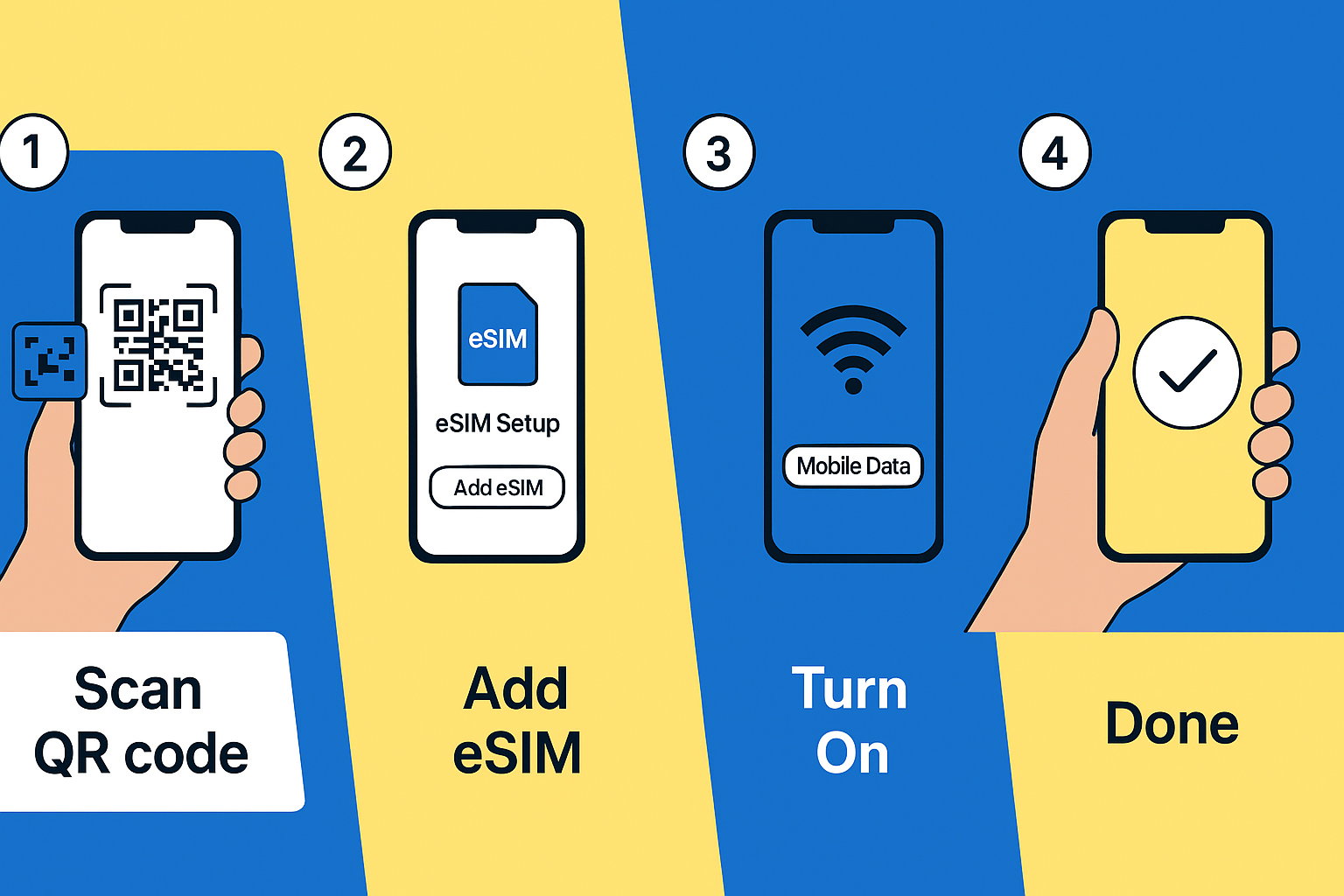
Step by step image of installing and activating travel eSIM

Setting up an eSIM is easier than setting up a new app.

Here’s the fastest method used by most travelers:

Step 1: Buy Your Travel eSIM Plan

Purchase from a trusted provider like OneSimCard.
You’ll receive:

  • A QR activation code

  • Manual activation details

  • Setup instructions

Step 2: Connect to Wi-Fi

This is important — eSIM installation requires internet access.

Step 3: Open Your Phone’s eSIM Menu

iPhone:
Settings → Cellular → Add eSIM (or Add Cellular Plan)

See a step-by-step video guide here: iPhone Installation Guide


Android:
Settings → Connections → SIM Manager → Add eSIM

See a step-by-step video guide here: Android Installation Guide

Step 4: Scan the QR Code

Hold your phone over the QR code.
Your device will begin downloading the eSIM profile.

Step 5: Turn on Your New Plan

Enable:

  • Turn On This Line

  • Data Roaming (required for travel eSIMs)

  • Set as Primary Data Line (optional)

Step 6: Test Your Connection

Once activated, you should see:

  • Signal bars

  • “LTE” or “5G”

  • Network name (depending on country)

You’re ready to go!


Advanced Users: Switching Between eSIM Profiles

One of the most underrated eSIM features is the ability to store multiple profiles (although with OneSimCard, you can just use our eSIM over and over for years because the eSIM doesn’t expire).

You can:

  • Turn eSIM profiles on/off

  • Name each plan (e.g., “Europe Trip”)

  • Switch between plans instantly

  • Leave inactive profiles installed for future trips

This makes eSIMs perfect for:

  • Frequent flyers

  • Digital nomads

  • Cross-border workers

  • Cruise travelers

  • Snowbirds

It’s like having several SIM cards in your pocket — without the clutter.


⚖️ eSIM vs. Physical SIM: Why eSIMs Win Every Time

Here’s a quick comparison:

Feature eSIM Physical SIM
Instant activation ✅ Yes ❌ Requires pickup/store
Can’t be lost ✅ Yes ❌ Easy to lose
Secure against SIM swaps ✅ Yes ❌ Vulnerable
Multiple plans ✅ Yes ❌ Only one at a time
No tiny card to handle ✅ Yes ❌ Requires tools
Remote provisioning ✅ Yes ❌ Must insert manually

When you compare point-by-point, it’s easy to see why the travel industry is moving quickly toward eSIM-only devices.


Why OneSimCard Is the Best Travel eSIM for Beginners

OneSimCard takes the guesswork out of travel connectivity:

  • Instant QR activation

  • Coverage in 200+ countries

  • Multi-network redundancy for stronger signal

  • No contracts or subscriptions

  • Affordable plans — from light usage to heavy data

  • Optional voice calling and SMS via OneSim VoIP

Whether you need a simple plan for a weekend trip or a reliable multi-country solution for a 6-month adventure, OneSimCard delivers.


Ready to Try a Travel eSIM?

Travel eSIMs are the future — and they’re already making international adventures cheaper, easier, and more secure.

You no longer need to juggle plastic SIM cards or fear roaming charges.
With a travel eSIM, your phone “just works” wherever you go.

Activate your OneSimCard Travel eSIM now and experience borderless connectivity.

How Secure Are eSIMs? What Every Traveler Should Know

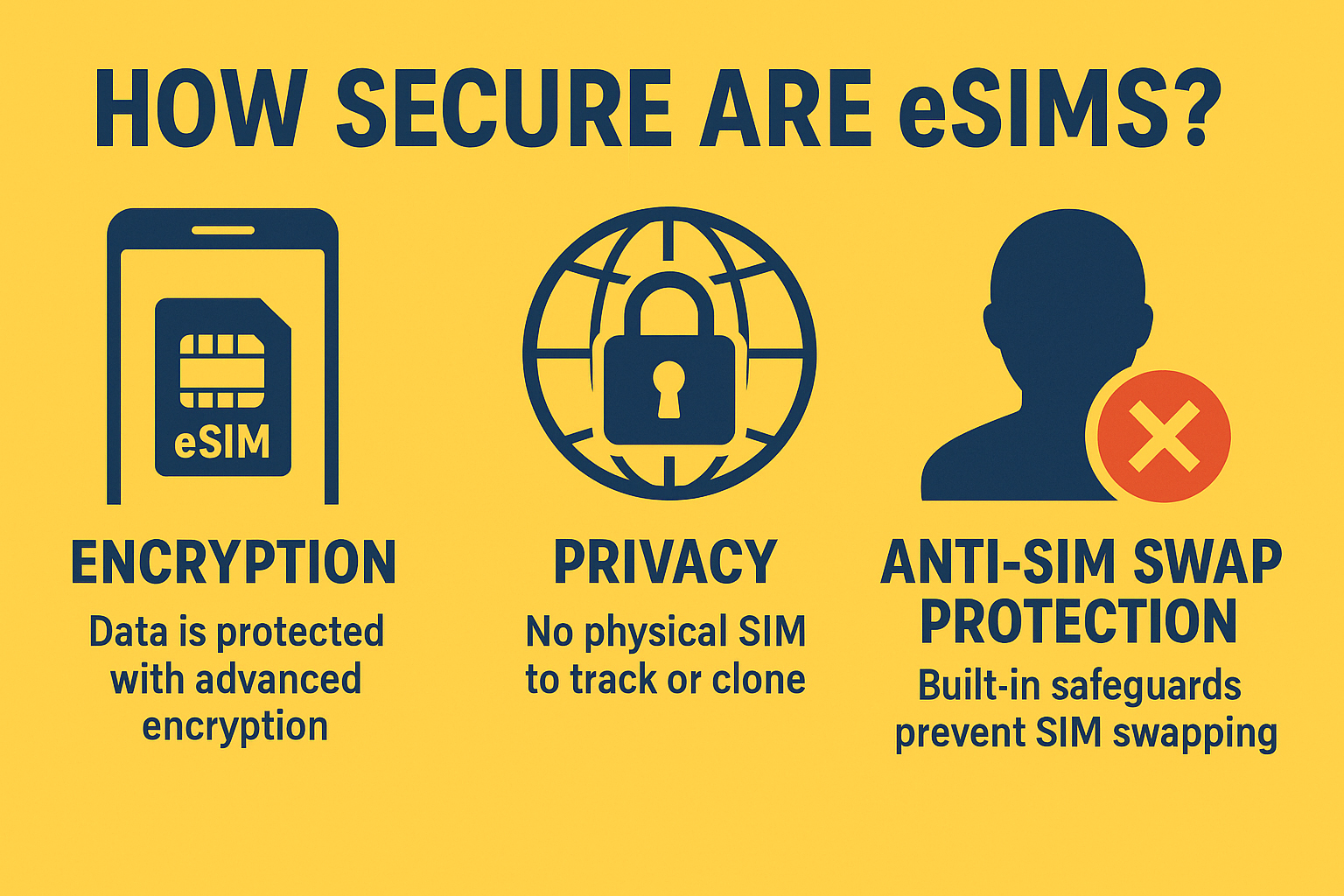
How secure are eSIMs?

Privacy, Encryption, and SIM Swapping Myths — Explained

As travelers continue switching from plastic SIM cards to digital eSIMs, one question comes up again and again: “Are eSIMs secure?”

The short answer: Yes — eSIMs are not only secure, they’re significantly safer than traditional SIM cards.

But like any digital tool, understanding how eSIM security works — and what threats to look out for — is essential, especially for travelers moving between countries, Wi-Fi networks, and mobile carriers.

This guide breaks down the privacy protections, encryption technology, and myths surrounding eSIMs so you can travel smarter and stay connected with confidence.


What Is an eSIM, and Why Is It More Secure?

An eSIM (embedded SIM) is a rewritable chip built directly into your smartphone, tablet, or IoT device. Unlike a removable SIM card, an eSIM can’t be physically swapped, stolen, or cloned without your knowledge.

Instead of inserting a chip, you download a secure digital profile from your carrier or provider — like OneSimCard — and activate it instantly.

Why That Matters for Security

  • No physical access: Thieves can’t remove or replace your eSIM like a traditional SIM.

  • Encrypted provisioning: Each eSIM profile is delivered over an encrypted connection, verified by the device’s secure element.

  • Tamper-resistant hardware: eSIMs live inside a protected chip that’s isolated from the operating system, reducing the risk of malware access.

  • Carrier-verified identities: Every eSIM profile comes with a digital signature that ensures authenticity.

Essentially, an eSIM eliminates the most common source of SIM fraud — physical manipulation.


Encryption: How eSIMs Keep Your Data Private

Every time your phone connects to a network, the eSIM uses advanced encryption and mutual authentication to verify both your device and the carrier’s system.

Here’s what that means in plain English:

  1. Mutual authentication ensures that only legitimate networks can communicate with your device — and vice versa.

  2. 128-bit or higher encryption scrambles your mobile identity and data so that it’s unreadable to outsiders.

  3. Remote profile management happens through secure carrier channels, protected by digital certificates.

So, even if you’re on a public airport Wi-Fi or connecting through roaming networks abroad, your mobile identity and data remain encrypted.


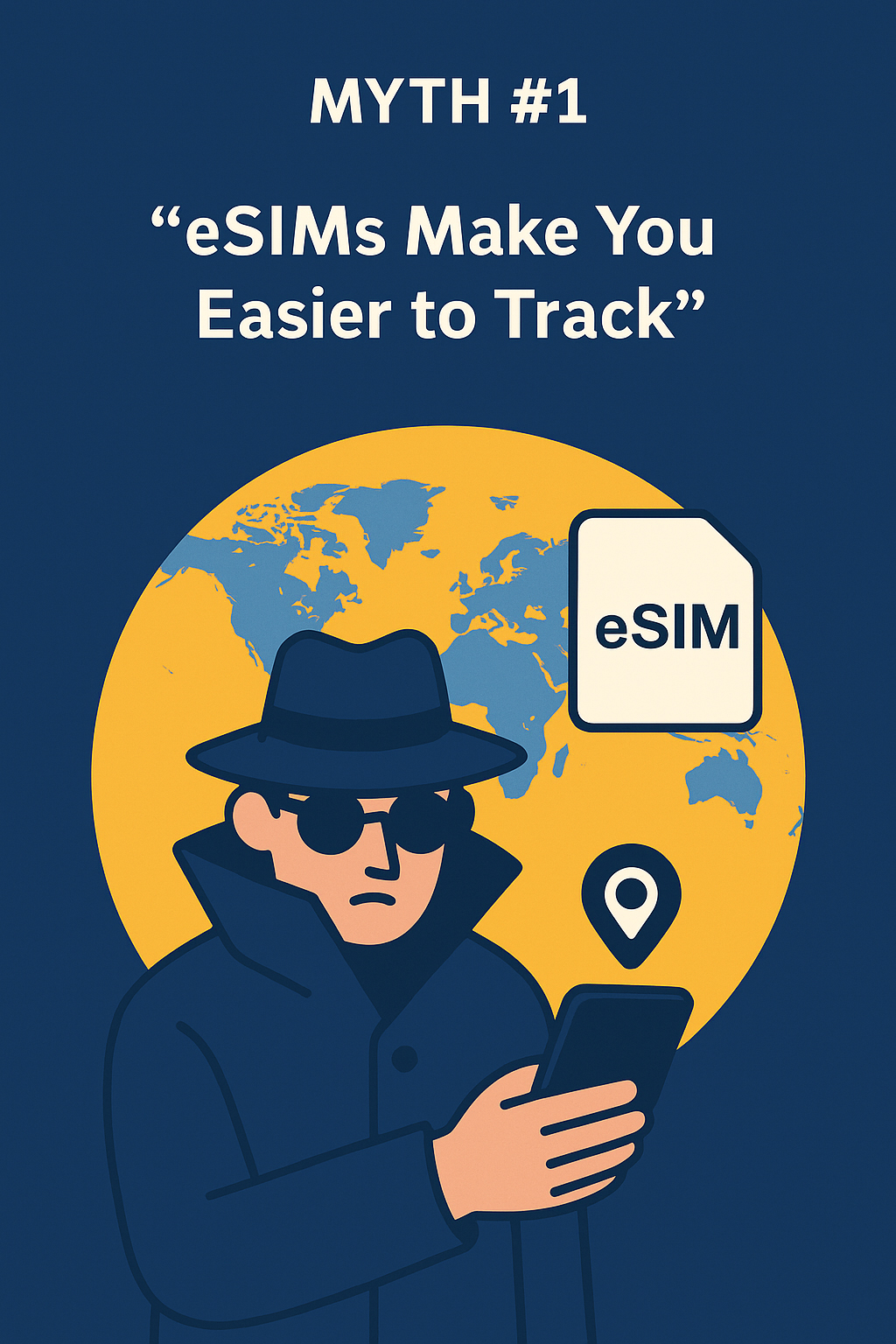
️‍ Myth #1: “eSIMs Make You Easier to Track”
This is a common misconception, but eSIMs do not make you more traceable than physical SIMs.

Mobile carriers always require an identifier (IMSI) to route calls and data — that’s true for both SIM and eSIM devices. What changes with eSIM is control:

  • You can switch providers instantly without disclosing new personal data to multiple stores or resellers.

  • OneSimCard’s eSIMs use multiple international identities, minimizing the sharing of your real number across borders.

  • Because there’s no physical SIM, third-party data brokers or thieves can’t clone or read your SIM details.

In fact, many privacy-focused travelers prefer eSIMs because they reduce the number of entities handling your data.


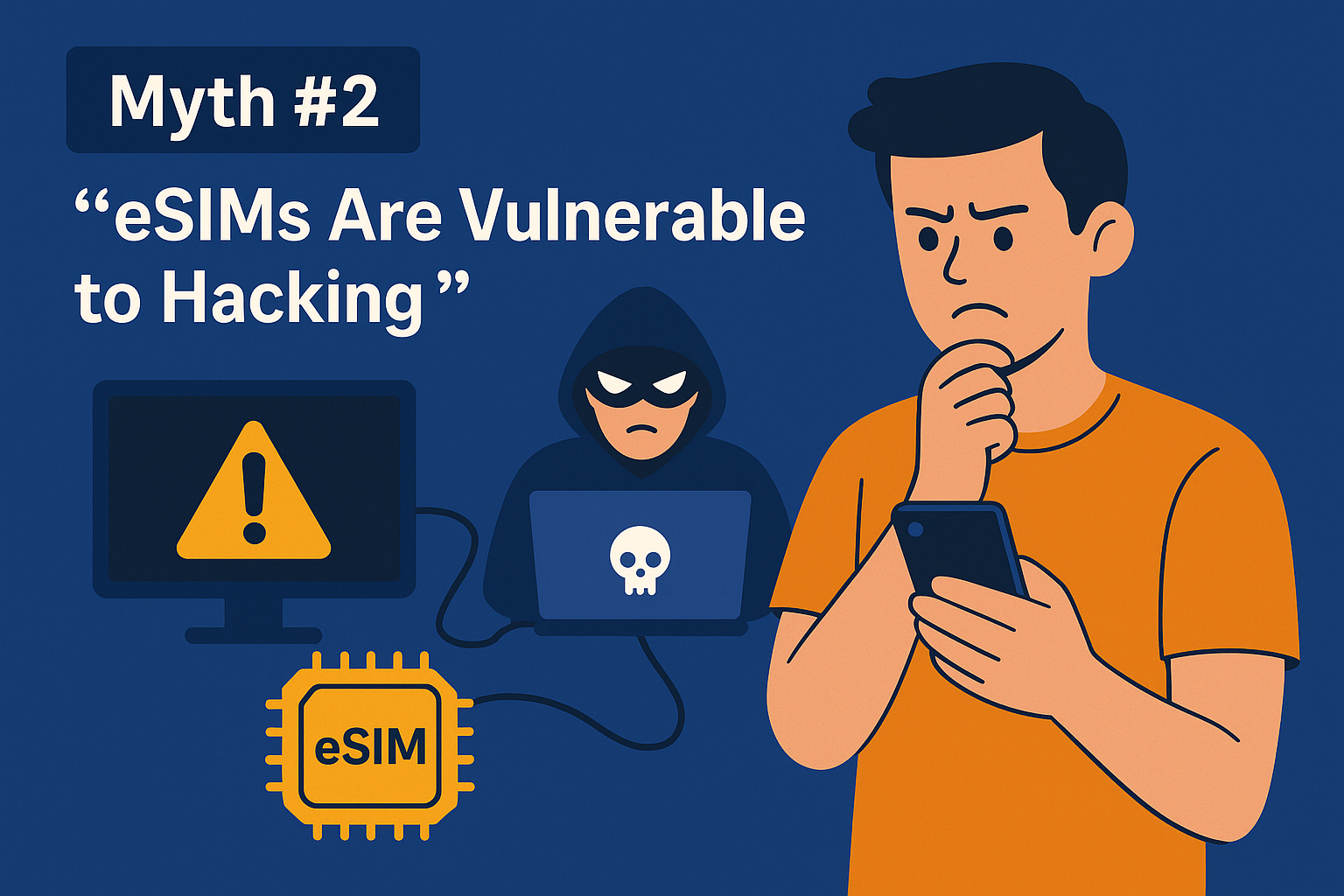
Myth #2: “eSIMs Are Vulnerable to Hacking”
In reality, eSIMs have more layers of security than removable SIMs.

Traditional SIMs can be cloned, stolen, or compromised via phishing. eSIMs, by contrast, require several things to go wrong simultaneously:

  • Physical access to your device

  • Device passcode bypass

  • Carrier authentication override (protected by certificates)

Each of these layers includes encryption and identity verification, making successful attacks extremely unlikely.

To date, there are no known large-scale eSIM hacks. By design, eSIMs comply with stringent GSMA security standards — the same framework used by global carriers and banks for digital authentication.


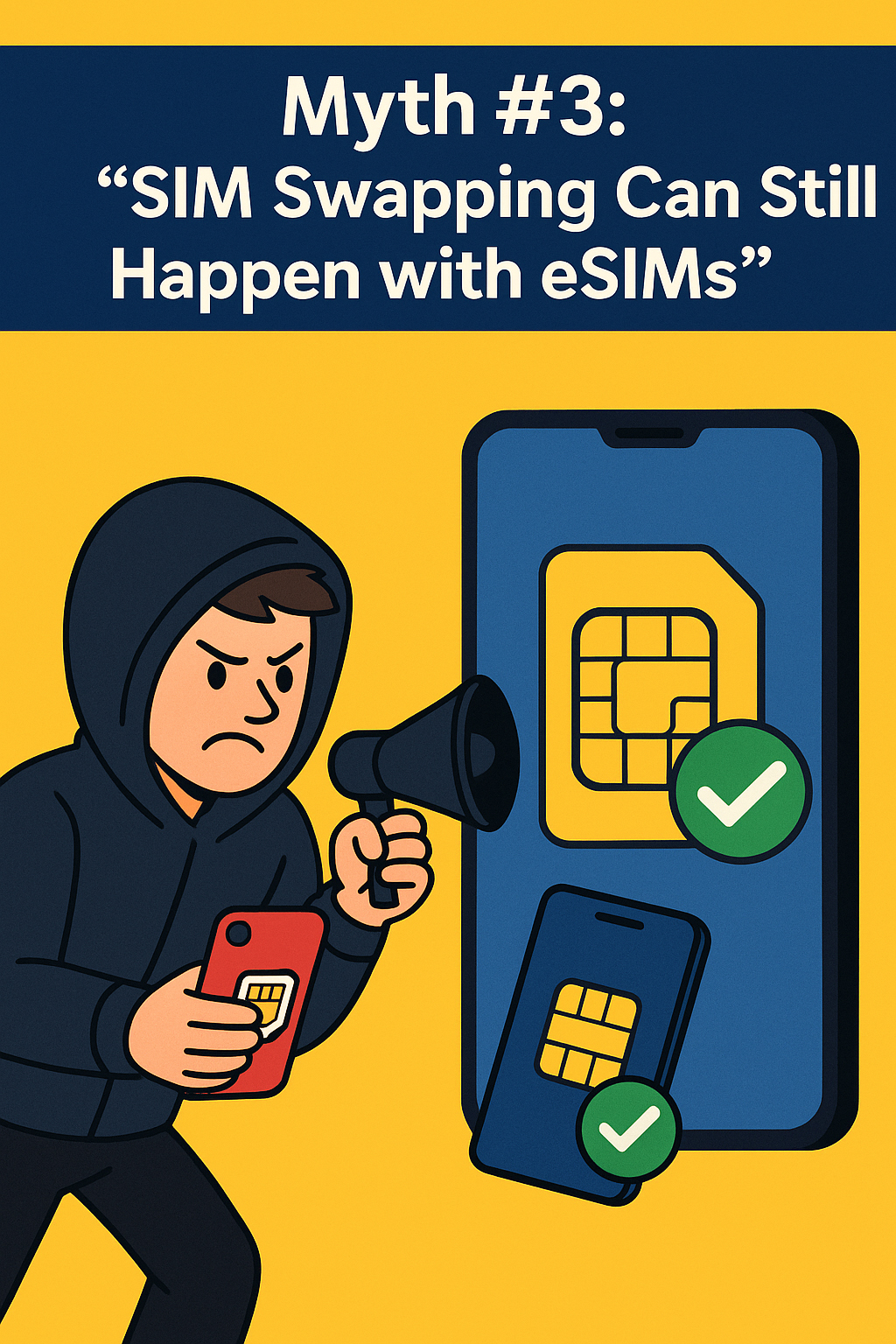
Myth #3: “SIM Swapping Can Still Happen with eSIMs”
SIM swapping — where hackers trick a carrier into transferring your number to their SIM — has become a serious problem in recent years.

However, eSIM technology dramatically reduces that risk.

Here’s why:

  • Carriers use multi-factor verification before transferring eSIM profiles.

  • Every eSIM installation must be authorized from your device, often requiring biometrics or a passcode.

  • Profiles can’t be downloaded or duplicated without your device’s unique identifier (EID).

In other words, even if a hacker convinces a carrier to create a new eSIM profile, they’d still need your phone’s secure hardware to activate it.

For travelers, this means your mobile identity is safer in digital form than plastic form.


Real-World Travel Scenarios: How eSIMs Protect You

✈️ Airport SIM Swaps — Eliminated

In the past, travelers had to buy local SIMs from kiosks, handing over passports and personal info. eSIMs remove that exposure — everything happens securely online through trusted providers like OneSimCard.

Public Wi-Fi Attacks — Minimized

When you connect via eSIM, your cellular data bypasses unencrypted Wi-Fi risks entirely. That’s critical when checking banking apps or booking flights from airports and hotels.

Lost or Stolen Phones

Even if someone steals your device, your eSIM can’t be removed and resold. You can remotely disable or wipe the profile using Apple’s “Find My” or Android’s “Find My Device.”

Cross-Border Roaming

With OneSimCard’s multi-network redundancy, your eSIM automatically connects to the most secure available partner — no need to switch SIMs or trust local vendors.


How eSIMs Handle Personal Data

All eSIM provisioning is governed by GSMA’s Remote SIM Provisioning (RSP) standard, which defines exactly how your profile is created, stored, and deleted.

Key security principles include:

  • End-to-end encryption: No one — not even the carrier — can view your actual authentication keys.

  • Secure profile storage: eSIM data lives inside a hardware-based “secure enclave,” isolated from apps or system files.

  • Controlled access: Only authorized carriers can send updates or delete profiles.

When you delete a OneSimCard eSIM profile, the system erases it from both your device and the carrier database — no lingering data remains.


Traveler Tips for Maximum eSIM Security

Even with built-in protections, good digital hygiene goes a long way:

  1. Use a reputable provider — Stick with established brands like OneSimCard that comply with GSMA and GDPR privacy regulations.

  2. Lock your device — Enable biometric login (Face ID, fingerprint, or PIN).

  3. Don’t share your QR code — Treat your eSIM activation code like a password.

  4. Update regularly — Keep your phone’s OS current to ensure the latest security patches.

  5. Avoid sketchy networks — Rely on your eSIM’s cellular data instead of public Wi-Fi when handling sensitive info.


The Bottom Line: eSIMs Are Safer Than Traditional SIMs

For travelers, eSIMs are a leap forward in both convenience and protection. The combination of hardware-level encryption, remote management, and tamper-proof provisioning makes them a powerful shield against modern threats like SIM swapping, phishing, and data theft.

When you travel with a OneSimCard eSIM, your connectivity is not just global — it’s secure by design. You control your data, your identity, and your network access from anywhere in the world.


✅ Final Takeaway

Are eSIMs secure? Absolutely.
Are they safer than traditional SIMs? Without a doubt.

For travelers who value privacy and peace of mind, an eSIM offers the most secure way to stay connected across borders.


Stay Secure — Stay Connected

Your journey shouldn’t come with security compromises.

Activate your OneSimCard eSIM today and enjoy global data, privacy, and confidence — wherever you roam.

Get Your Secure OneSimCard eSIM Now

How to Choose the Right eSIM Plan: Pay-As-You-Go vs. Data Packages

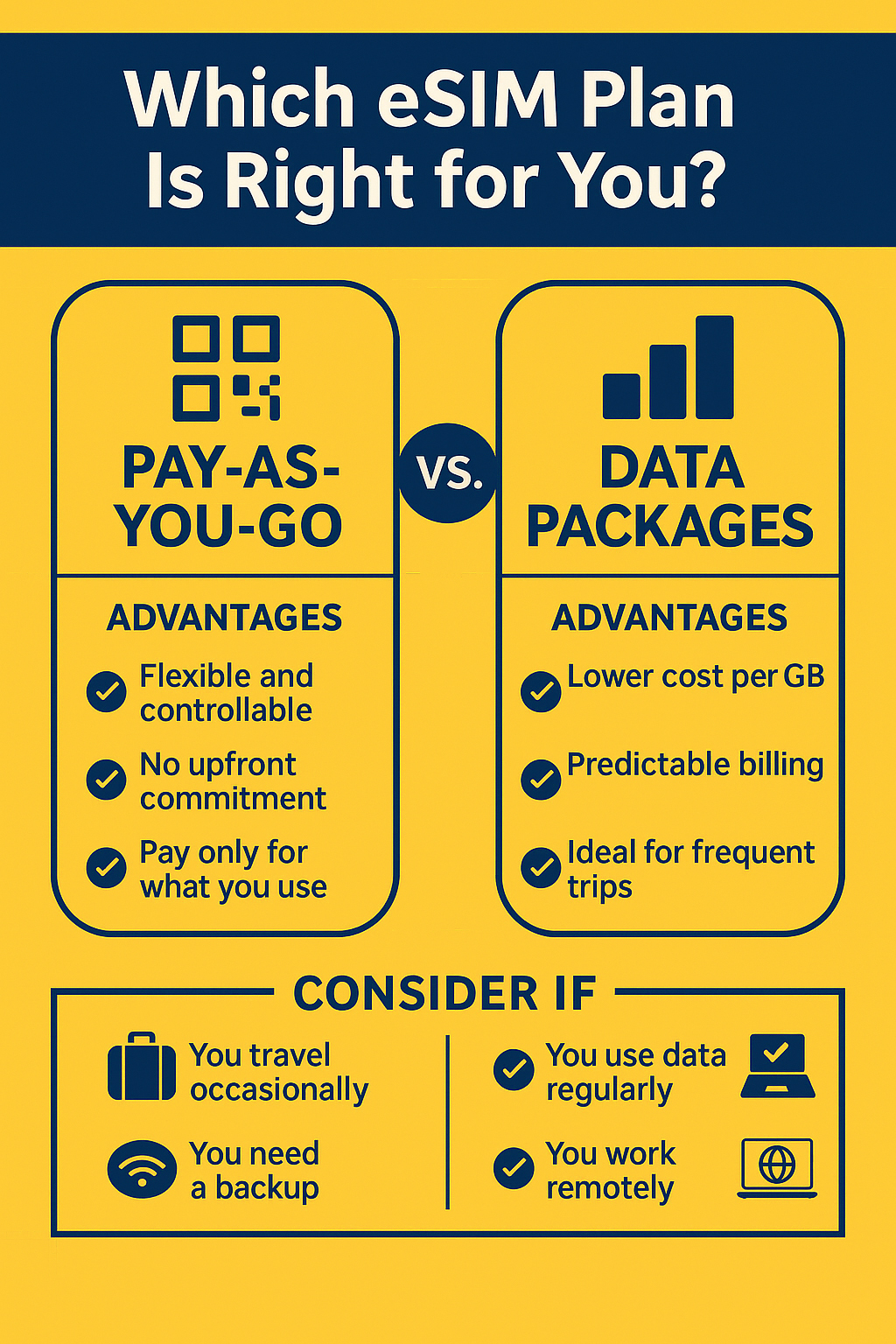
Pay-As-You-Go vs Data Package infographic for eSIM

Choosing the right travel eSIM plan can make or break your international trip. Whether you’re a weekend wanderer, a digital nomad, or a frequent flyer, your connectivity needs will differ — and so will your costs.

The two main models travelers encounter are pay-as-you-go eSIMs and prepaid data packages. Each has advantages depending on how often and how much you use data while abroad. Let’s break them down so you can make an informed decision and save money on your next journey.


Understanding eSIM Plan Pricing Models

Before you can compare eSIM data plans, it’s important to understand the three main pricing structures used by global eSIM providers.

Pay-As-You-Go Explained

With a pay-as-you-go (PAYG) eSIM, you only pay for the data you actually use. There’s no upfront commitment or monthly fee — perfect if your data needs vary from one trip to another. You can top up at any time, and your balance simply decreases as you consume data.

Advantages:

  • Great for short trips or uncertain usage

  • No wasted data or expiration pressure

  • Ideal backup for emergencies or secondary devices

Considerations:

  • Typically higher per-GB cost than bulk data plans

  • Requires active monitoring of your balance, or OneSimCard’s convenient auto-recharge option.

Prepaid Data Packages

These data packages are sold in specific sizes — for example, 1GB, 5GB, or 10GB bundles that expire after a set time (usually 7, 14, or 30 days). You pay upfront, and the eSIM provides consistent data speeds and coverage.

Advantages:

  • Much Lower cost per GB

  • Predictable spending

  • Simple to manage for longer stays

Considerations:

  • Unused data expires

  • You may need to top up before the plan ends

Subscription-Based Models

Some providers now offer monthly eSIM subscriptions, charging a flat fee for ongoing data access in one or more regions. These appeal to frequent travelers, but they often come with fixed limits or auto-renewal requirements.


✈️ When Pay-As-You-Go eSIM Plan Makes Sense

For certain travelers, PAYG eSIMs are the smartest and most flexible option.

Occasional Travelers

If you take just a few international trips a year, it doesn’t make sense to commit to recurring plans. PAYG lets you stay connected during short vacations or weekend getaways without pre-paying for unused data.

Light Data Users

Some travelers rely mostly on hotel Wi-Fi and only need mobile data for maps or ride-hailing apps. PAYG plans are perfect here — you pay a little, use a little, and avoid waste.

Backup Connectivity

Even if you primarily rely on local SIM cards or Wi-Fi, having a PAYG eSIM installed ensures you’re never stranded without data when crossing borders or losing signal from your primary SIM.

In short, PAYG equals control — perfect for those who value flexibility over volume.


When a Data Package eSIM Plan Is Better

If you’re abroad frequently or use your phone as a mobile office, data packages are the more cost-effective solution.

Long-Term Travelers and Expats

For anyone staying abroad for weeks or months, prepaid eSIM packages offer stable pricing and dependable connectivity. You can easily renew the same plan or switch to another country’s bundle through your eSIM portal.

Business Travelers

Professionals need reliability and predictability. Data packages eliminate surprise top-ups, offering a steady stream of data for email, video calls, and navigation without running out mid-meeting.

Digital Nomads and Remote Workers

If you’re working from Lisbon one week and Bali the next, having a regional eSIM plan ensures coverage across multiple countries at a flat rate. This helps simplify billing and guarantees network consistency for streaming, uploading, and video conferencing.


How to Compare Costs Between eSIM Providers

With so many global eSIM brands competing for travelers’ attention, it’s worth learning how to do an eSIM pricing comparison properly.

Example Pricing Overview (1GB in Europe)

Provider 1GB Validity Approx. Cost
OneSimCard eSIM $4.50 14 days Multi-network access
Airalo $7.50 7 days Single-network coverage
Holafly $19 Unlimited High upfront cost
Nomad $8 30 days Regional
Ubigi $9 30 days Auto top-up required

(Pricing as of 2025 – subject to change)

Effective Cost per GB

To evaluate the true value, divide your plan cost by its duration and total data. For example, a 5GB / 30-day plan for $25 costs $5 per GB, which may outperform a cheaper plan that expires after 7 days.

Look beyond the sticker price. Factors like coverage, speed, and network redundancy matter just as much as cost.


Why OneSimCard Offers the Best Balance

Choosing between pay-as-you-go and data packages doesn’t have to be all or nothing — with OneSimCard, you can mix and match both.

  • Transparent pricing: No hidden fees, surcharges, or forced subscriptions.

  • OneSimVoIP app: Add optional voice and SMS to any eSIM data plan.

  • Customizable bundles: Buy what you need — whether it’s 500MB for a weekend or 20GB for a month-long project.

  • Global reliability: Multi-network access in 200+ countries ensures your connection never drops mid-journey.

With OneSimCard, you’re not tied to a single plan type — your eSIM adapts to your travel lifestyle.


Find the Right Plan for Your Trip

Whether you’re a casual vacationer or a full-time remote worker, understanding travel eSIM plans helps you stay connected without overspending.

Pay-as-you-go gives flexibility and control; data packages offer predictable value and stability. With OneSimCard, you get the best of both worlds — coverage, clarity, and cost efficiency.

Find the Right Plan for Your Trip — Activate Your OneSimCard eSIM Now!

Troubleshooting eSIM Issues While Abroad

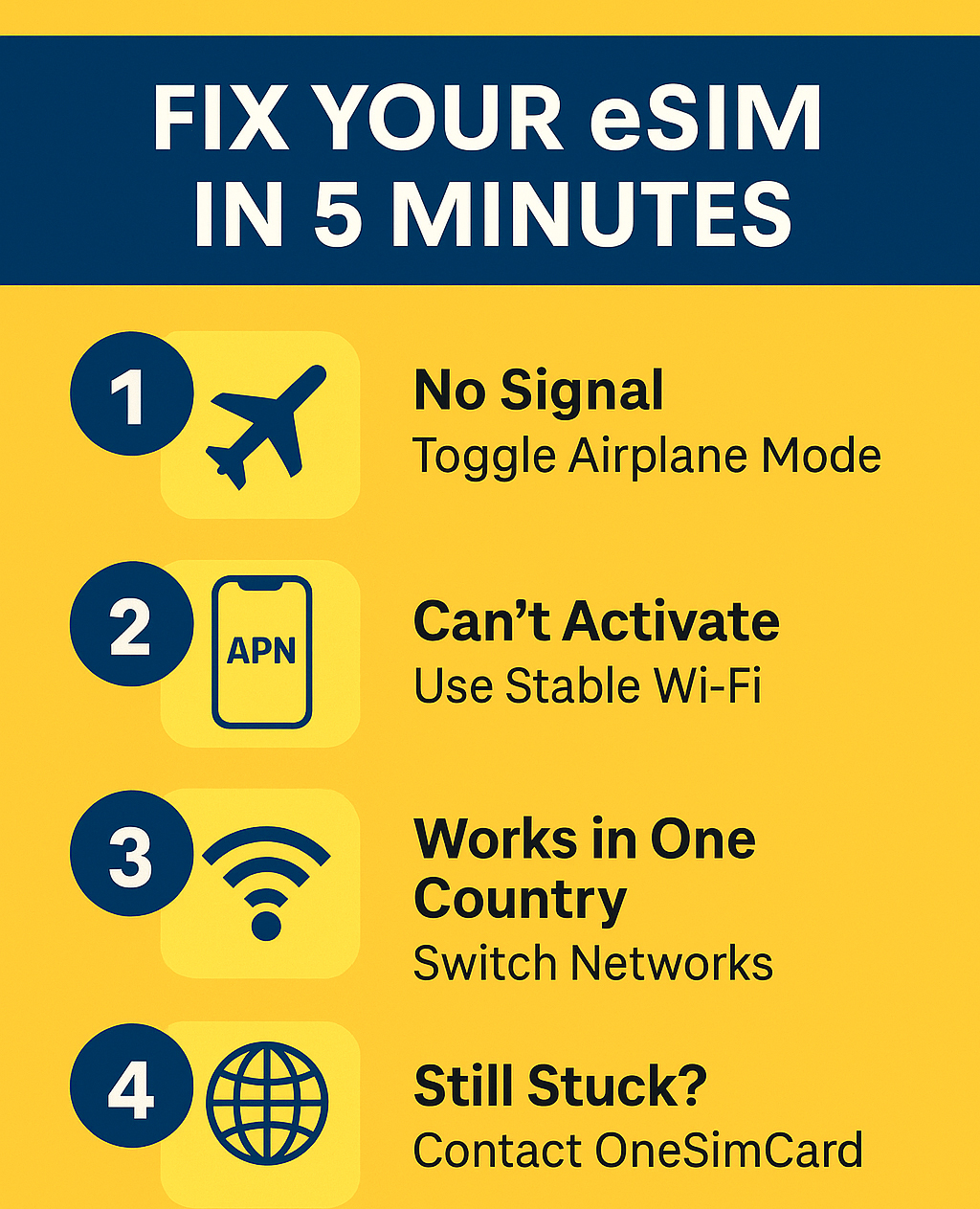
Troubleshooting eSIMsReal-World Help for Travelers: Signal Loss, APN Setup & More. Troubleshooting eSIMs is simple!
When looking for international SIM cards, eSIMs have transformed international travel. Instead of juggling physical SIM cards or paying outrageous roaming fees, travelers can now activate data plans instantly with a quick QR scan. But even though eSIMs make staying connected easier, problems can still arise — especially when hopping between countries or networks. Whether you’re in Paris, Phuket, or Patagonia, here’s a practical guide to troubleshooting eSIM issues while abroad.


1. No Signal or “No Service” After Activation

This is the most common issue travelers face after installing an eSIM. You’ve scanned the QR code, it shows as “active,” but your phone still says “No Service.”

✅ Step-by-Step Fix:

  1. Turn Airplane Mode On and Off
    Wait 30 seconds and disable it — this forces your phone to rescan for available networks.

  2. Manually Select a Network

    • Go to Settings → Cellular → Network Selection (iPhone) or Settings → Connections → Mobile Networks → Network Operators (Android).

    • Toggle Automatic off, then pick one of the listed networks manually.

    • If you’re using a OneSimCard eSIM, try selecting one of our preferred roaming partners in your country.

  3. Restart Your Device
    Simple but effective — restarting clears temporary network glitches.

  4. Check if Data Roaming is On

    • For eSIMs, roaming must be enabled to access local partner networks abroad.

    • Navigate to Settings → Cellular → eSIM Plan → Data Roaming → On.

Pro Tip: In some regions, 2G or 3G networks are no longer supported. If your phone is older or set to connect automatically, switch to 4G/LTE only for better results.


⚙️ 2. Can’t Access Mobile Data (Even with Signal)

You have bars of signal but no internet — pages won’t load, maps can’t refresh, and apps spin endlessly. This typically means your APN (Access Point Name) isn’t set up correctly.

✅ Step-by-Step Fix:

  1. Check APN Settings

    • iPhone:
      Settings → Cellular → Your eSIM Plan → Cellular Data Network

    • Android:
      Settings → Mobile Network → Access Point Names

  2. Enter the Correct APN Information

    • For OneSimCard eSIM, the APN is typically: OSC
      (unless otherwise noted in your installation email).

    • Leave Username, Password, and Proxy fields blank.

  3. Restart Data Connection

    • Turn off Mobile Data for 10 seconds, then turn it back on.

    • Reopen your browser or try a speed test to confirm connectivity.

⚠️ Common Mistake: Many travelers forget to switch the “default data line” to their eSIM.
Go to Settings → Cellular Data → Select Your eSIM to ensure data routes through the correct plan.


3. eSIM Not Downloading or Activating

If your eSIM profile fails to download or install, it could be due to poor Wi-Fi, expired QR codes, or device compatibility.

✅ Step-by-Step Fix:

  1. Ensure You Have a Stable Wi-Fi Connection
    Activation requires internet access. If hotel Wi-Fi is unreliable, use a hotspot or café connection.

  2. Scan the QR Code Again

    • Go to Settings → Cellular → Add eSIM (or Mobile Plan).

    • Re-scan your OneSimCard QR code from your email or app.

    • If it’s expired, request a fresh activation link from support. This may require getting a new eSIM.

  3. Check Device Compatibility
    Only devices with built-in eSIM support will work. See our Complete eSIM Compatibility Guide for iPhone and Android for reference.

  4. Update Your Operating System
    Outdated software can block installation. Update to the latest version of iOS or Android before retrying.


4. eSIM Plan Doesn’t Appear in Settings

Sometimes, travelers install their eSIM successfully, but it doesn’t show under “Cellular Plans” or disappears after an update.

✅ Step-by-Step Fix:

  1. Restart Your Device — this often restores the display.

  2. Check Your Primary SIM Settings
    If you’re using a physical SIM simultaneously, ensure it isn’t set to “data only” while your eSIM is disabled.

  3. Reinstall the eSIM Profile

    • Delete the current profile under Settings → Cellular Plans → Remove eSIM

    • Re-scan the QR code to reinstall it fresh.

Pro Tip: Always save a backup of your eSIM QR code before traveling — many users delete their activation email by mistake!


5. Data Works in One Country but Not Another

Multi-country eSIMs (like OneSimCard’s) are designed for roaming, but occasionally, coverage may vary due to regional network preferences or restrictions.

✅ Step-by-Step Fix:

  1. Manually Switch Carriers

    • Turn off Automatic Network Selection.

    • Try another partner network in your current country (list provided in your OneSimCard app or welcome email).

  2. Enable Data Roaming
    Even if it worked before, moving across borders sometimes resets roaming permissions.

  3. Restart Device After Crossing Borders
    This refreshes your connection with the new country’s local network.

Tip for Frequent Travelers: Enable the OneSimCard eSIM Portal to monitor live connections, toggle networks remotely, and check data balances in real-time. Also, BE PATIENT!! Sometimes when you cross boarders it takes up to 15 minutes to find the right carrier(s)!


6. Battery Draining Faster Than Usual

Using dual SIMs (physical + eSIM) can slightly increase power usage because your phone pings two networks simultaneously.

✅ Step-by-Step Fix:

  • Turn off the SIM you’re not using.

  • Disable Background App Refresh for high-data apps like Maps or Instagram.

  • Use Low Power Mode while on the go.

⚙️ eSIMs themselves don’t drain extra battery — it’s the additional background network activity that does.


7. Calls or Texts Aren’t Working

If you can access data but can’t make calls or send SMS, the issue usually lies in your phone’s “Default Voice Line” settings or VoIP configuration.

✅ Step-by-Step Fix:

  1. Set Your eSIM as the Default Line for Calls
    Settings → Cellular → Default Voice Line → Choose eSIM

  2. Check Preferred Network Type
    Switch to “4G/VoLTE Preferred.” Some regions no longer support 3G voice networks.

  3. Use OneSimVoIP App for Calls
    If your plan is data-only, you can still make and receive calls with the OneSimVoIP app — available on iOS and Android.


8. When to Contact Support

If you’ve tried all the above steps and your eSIM still isn’t working:

  • Check your plan’s data balance or expiration date in your OneSimCard account.

  • Make sure your device IMEI isn’t carrier-locked.

  • Contact OneSimCard Support with the following info:

    • Device model and OS version

    • Country you’re in

    • Signal status and network name

Our team can run a live diagnostic and often resolve issues within minutes.

The Complete International eSIM Compatibility Guide for iPhone and Android

What Is an eSIM — and Why It Matters

An eSIM (embedded SIM) is a digital version of the traditional plastic SIM card. Instead of inserting a physical chip, you simply download a mobile profile directly to your smartphone.

For travelers, this means you can:

  • Activate international data instantly without visiting a store

  • Switch between local and global plans in seconds

  • Keep multiple numbers or data profiles on one device

  • Avoid roaming fees and lost SIM cards

As eSIM adoption grows, most new phones from Apple, Samsung, Google, and other brands now include this feature. Let’s explore which models support it — and how to check if yours does.

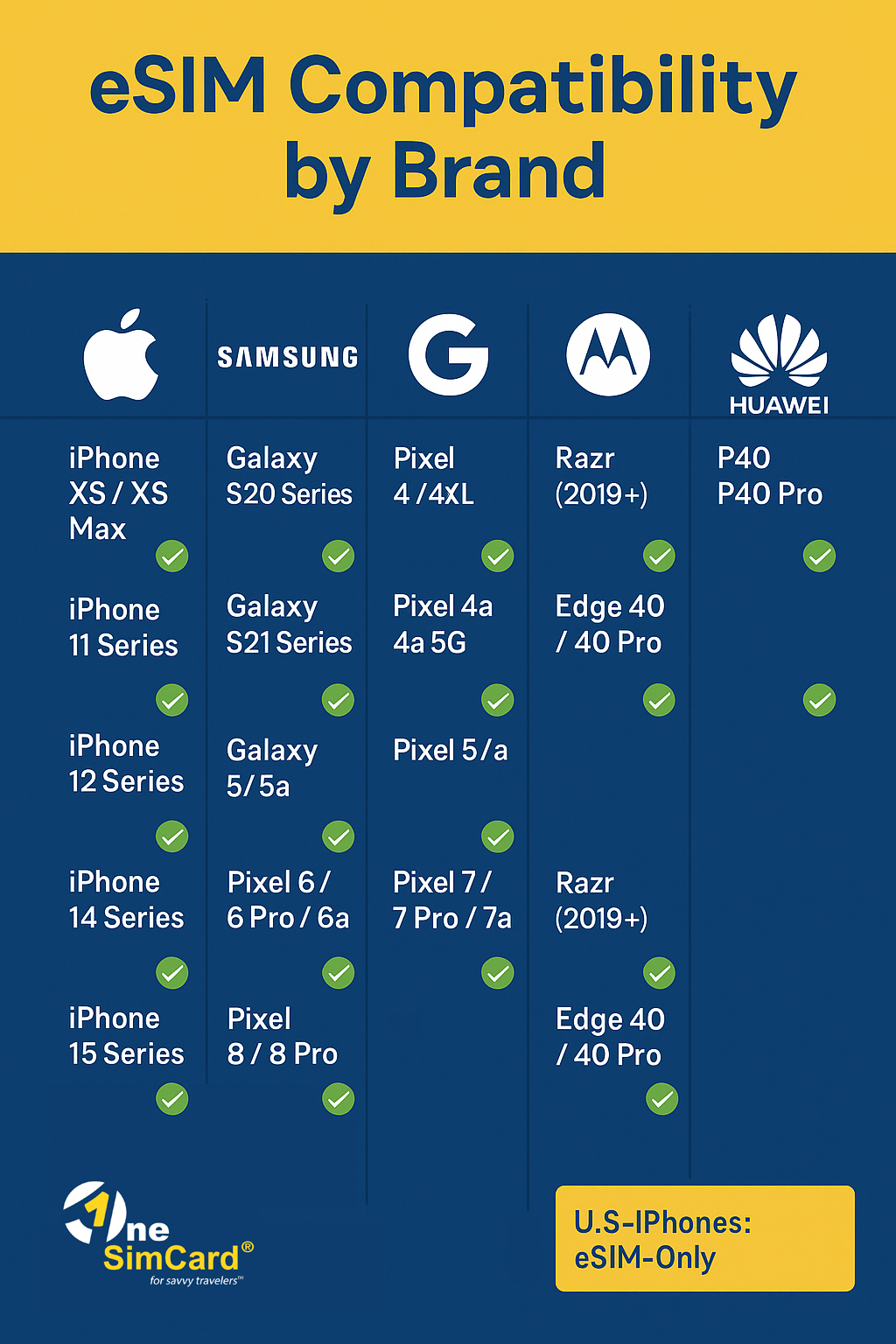
Infographic Chart Showing eSIM compatibility for iPhone, Samsung, Google, Motorola and Huawei devices
Compatible Phones – Quick Reference

Apple iPhone eSIM Compatibility

Apple was the first major brand to push eSIM adoption, starting in 2018.

iPhone Model eSIM Supported Dual eSIM Capability
iPhone XS / XS Max ✅ Yes ❌ One eSIM + one physical SIM
iPhone XR ✅ Yes
iPhone 11 / 11 Pro / 11 Pro Max ✅ Yes
iPhone 12 / 12 mini / 12 Pro / 12 Pro Max ✅ Yes ✅ Dual eSIM supported (iOS 15+)
iPhone 13 / 13 mini / 13 Pro / 13 Pro Max ✅ Yes
iPhone 14 Series ✅ Yes ✅ (U.S. models are eSIM-only)
iPhone 15 / 15 Plus / 15 Pro / 15 Pro Max ✅ Yes ✅ (U.S. models are eSIM-only)

Pro Tip: If you bought your iPhone in the U.S. (starting with the iPhone 14), it likely has no physical SIM slot — meaning you’re already using eSIM by default.

How to check your iPhone for eSIM support:

  1. Go to Settings → Cellular (or Mobile Data)

  2. Tap Add eSIM or Add Cellular Plan

  3. If you see the option to scan a QR code, your phone supports eSIM.


Android eSIM Compatibility

Unlike Apple, Android phones vary more widely across manufacturers and regions. But most premium and newer mid-range devices support eSIM.

Samsung eSIM Support

Model eSIM Supported Notes
Galaxy S20 / S20+ / S20 Ultra ✅ Yes Region-specific (not all carriers enable it)
Galaxy S21 / S21+ / S21 Ultra ✅ Yes Dual SIM with eSIM support
Galaxy S22 / S22+ / S22 Ultra ✅ Yes Global support
Galaxy S23 / S23+ / S23 Ultra ✅ Yes Full eSIM functionality
Galaxy Z Flip / Flip3 / Flip4 / Flip5 ✅ Yes Compact dual-SIM flexibility
Galaxy Z Fold / Fold2 / Fold3 / Fold4 / Fold5 ✅ Yes Ideal for frequent travelers

Note: Some carrier-locked versions may disable eSIM — always confirm with your provider or use OneSimCard eSIM for universal activation.


Google Pixel eSIM Support

Model eSIM Supported
Pixel 3 / 3 XL (some models) ✅ Partial
Pixel 4 / 4 XL ✅ Yes
Pixel 4a / 4a 5G ✅ Yes
Pixel 5 / 5a ✅ Yes
Pixel 6 / 6 Pro / 6a ✅ Yes
Pixel 7 / 7a / 7 Pro ✅ Yes
Pixel 8 / 8 Pro ✅ Yes

Pixels are among the most eSIM-friendly phones — they work across dozens of global networks, making them ideal for international travelers using OneSimCard eSIM.


Other Android Brands

Brand Compatible Models eSIM Notes
Motorola Razr 2019+, Edge 40, Edge 40 Pro ✅ Yes, on select models
Huawei P40, P40 Pro, Mate 40 Pro ✅ Yes, but limited Google support
OPPO Find X3 Pro, Find X5, Reno 8 Pro ✅ eSIM support growing rapidly
Xiaomi 13 Series, 13T Pro ✅ Supported in select regions
Honor Magic5 Pro ✅ Supported
Sony Xperia 10 III+, Xperia 5 IV, Xperia 1 V ✅ Yes

Regional Variations to Know

Not all models sold in every market have eSIM enabled.
For example:

  • Some Samsung phones in South America or Asia ship without eSIM activation.

  • iPhones purchased in China or Hong Kong may have dual physical SIM slots instead.

  • Pixel devices are generally universal, but activation depends on the local carrier.

✅ Always confirm your model’s eSIM capability by visiting your phone’s manufacturer support page or checking in the SIM settings menu.

Call to action to buy eSIM


Why Travelers Love eSIM

For anyone using an international eSIM like OneSimCard, compatibility means freedom:

  • Instant activation: Scan a QR code before your flight.

  • No waiting for delivery: Perfect for last-minute trips.

  • Switch plans anytime: Use one eSIM for Europe, another for Asia.

  • Stay connected: Keep your home number active while using local data.

With more than 200 countries covered, OneSimCard eSIMs work on major devices listed above — ensuring your phone stays connected whether you’re hiking in the Alps or working remotely from Bali.


Final Thoughts

eSIM technology is transforming how we travel, communicate, and stay connected. With nearly all major phones now supporting it, you can leave behind the hassle of swapping plastic SIMs — and enjoy instant, global data at your fingertips.

Whether you’re using the latest iPhone 15, Samsung Galaxy S23 Ultra, or Google Pixel 8, a OneSimCard eSIM ensures seamless connectivity across borders, at local rates, with no contracts or roaming surprises.

So before your next trip, check your phone’s eSIM settings, grab a OneSimCard eSIM with our App on Apple App Store or Google Play Store, and enjoy the freedom of truly borderless communication.

The Ultimate Guide to International Travel eSIMs

Man downloading an international travel eSIM

If you travel often — for work, study, or adventure — you know that staying connected across borders can be a challenge. Finding a reliable SIM card in every new country, juggling data plans, and avoiding roaming charges are all part of the old-school traveler’s struggle.

But there’s good news. Thanks to the travel eSIM technology, international travelers can now connect instantly in over 200 countries — no plastic SIM, no waiting in line, no surprises on the bill.

In this ultimate guide, we’ll break down what an eSIM is, how it works, and why OneSimCard’s global eSIM is the smartest solution for anyone exploring multiple destinations.


What Is an eSIM?

An eSIM — short for embedded SIM — is a digital version of the traditional SIM card. Instead of inserting a physical chip into your phone, you can download a mobile data plan directly onto your device.

Think of it like installing an app. You scan a QR code, your phone downloads the plan, and you’re connected.

eSIMs are built right into the latest smartphones, tablets, and even some laptops and smartwatches. Because they’re embedded at the hardware level, you can store multiple profiles, switch between carriers instantly, and manage your connectivity anywhere — all without removing or replacing a SIM card.


How an eSIM Works

While the idea sounds high-tech, using an eSIM is surprisingly simple. Here’s the step-by-step process:

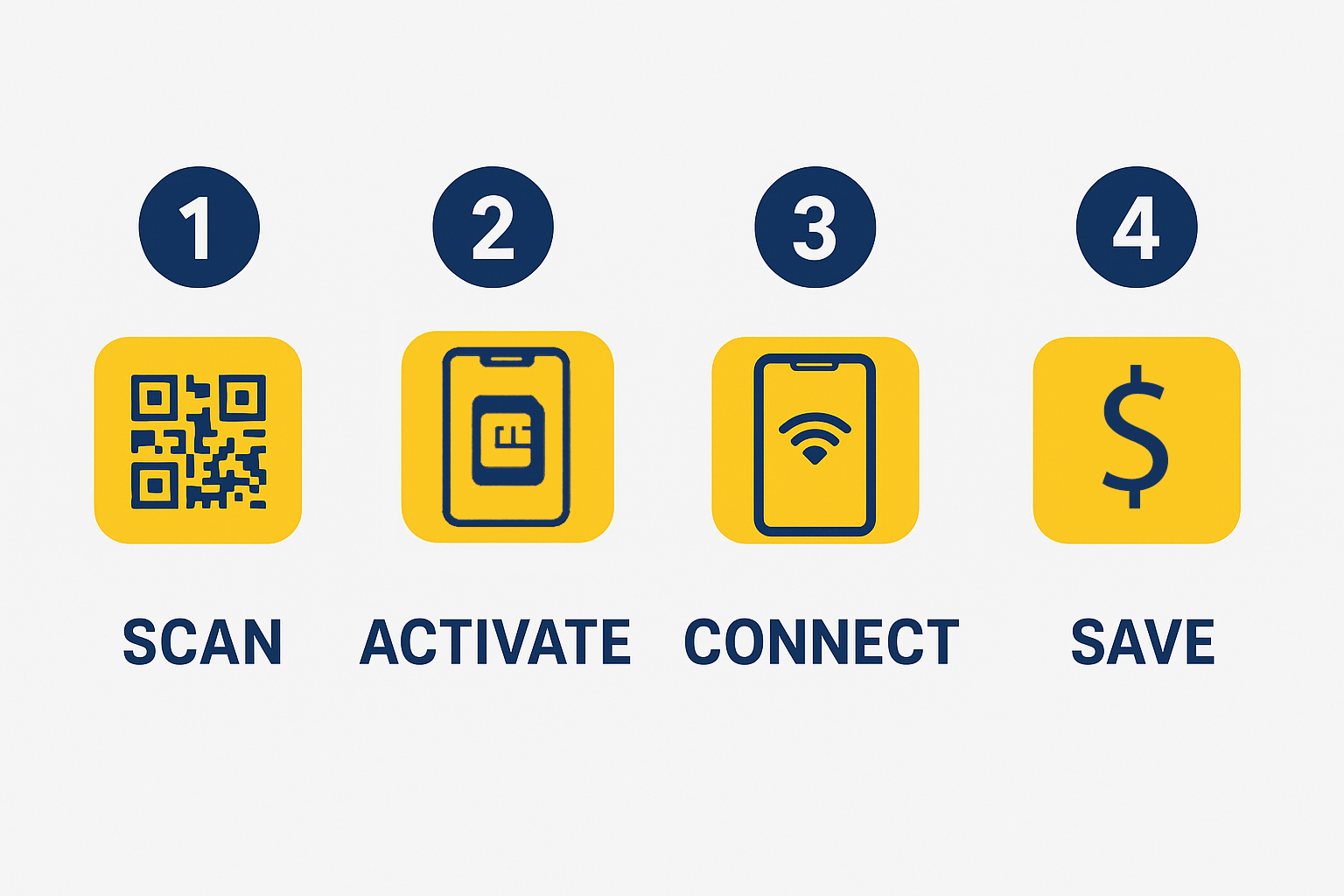
  1. Purchase an eSIM plan online from a provider like OneSimCard.

  2. Receive a QR code by email.

  3. Scan the QR code using your phone’s camera or eSIM setup menu.

  4. Activate the plan — your device connects instantly to local partner networks.

No waiting for shipping. No dealing with tiny SIM trays. No store visits or paperwork.

Under the hood, eSIMs use the same secure technology as physical SIMs. They authenticate your device with the mobile network, manage your plan settings, and handle secure connections — but they do it digitally, giving you much greater flexibility and control.


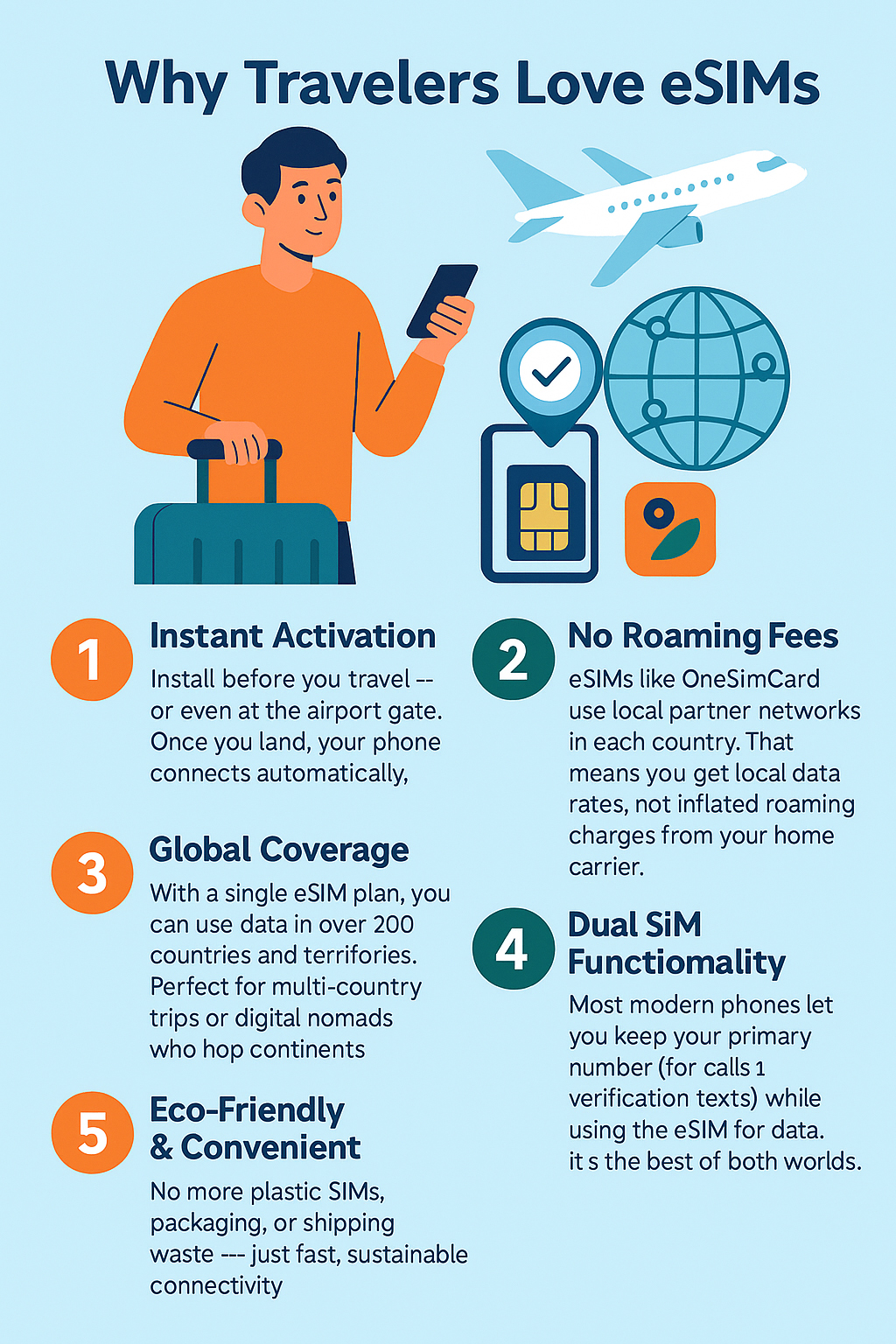
Why Travelers Love eSIMs

If you’ve ever landed in a foreign country and spent an hour trying to find Wi-Fi or buy a prepaid SIM, you already know why eSIMs are a game-changer.

Here are some of the biggest benefits for international travelers:

5 reasons infographic why travelers love international eSIM


OneSimCard: The Traveler’s Global eSIM

While many providers now offer eSIMs, OneSimCard stands apart with 30 years of expertise in international mobile connectivity.

The OneSimCard eSIM is designed specifically for travelers who want:

  • Instant global data access in over 200 countries

  • High-speed 4G/5G connectivity

  • No contracts or commitments

  • Pay-as-you-go flexibility

  • Multi-network redundancy — your device connects to the strongest available signal

Let’s look at what makes it the ideal choice for frequent travelers and global professionals.


1. True Global Coverage

OneSimCard’s eSIM works in over 200 countries and automatically connects to 350+ local networks worldwide.

That means whether you’re sipping espresso in Rome, attending meetings in Tokyo, or exploring the beaches of Bali, you’ll have strong, reliable data without ever swapping SIMs.

You can even move across borders — for example, from France to Germany to Switzerland — and your eSIM will seamlessly switch networks as you travel.


2. Multi-Network Redundancy

Unlike many budget eSIMs that “steer” your device toward a preferred carrier (even if the signal is weak), OneSimCard’s eSIM uses a no-steering policy.

Your device always connects to the best available local network, ensuring strong signal, faster speeds, and fewer dropped connections.

This makes a big difference for travelers in rural areas, mountains, or regions with uneven coverage.


3. Easy Setup in Minutes

OneSimCard’s activation process is designed to be fast and frustration-free:

  1. Purchase your eSIM on onesimcard.com.

  2. Receive your QR code instantly by email.

  3. Scan it using your phone’s camera.

  4. Turn on data roaming — and you’re connected.

There’s no app to download, no physical card to insert, and no waiting period. The whole process takes under five minutes.


4. Flexible Data Plans

Every traveler’s data needs are different. That’s why OneSimCard offers multiple eSIM plan options:

  • DataMax eSIM – Perfect for frequent travelers who want maximum global coverage and fast data speeds.

  • Universal eSIM – Ideal for vacations and multi-country trips across Europe, Asia, and beyond.

  • Expedition eSIM – Great for extended adventures or remote work in off-grid regions.

You can also easily add top-ups online, monitor usage, and manage multiple eSIMs in your OneSimCard account.


5. Reliable Customer Support

Travel doesn’t always happen on a 9-to-5 schedule — and neither does OneSimCard’s support. Their customer service team is available worldwide to help with setup, plan management, or troubleshooting.


6. Works Seamlessly with the OneSim VoIP App

If you need to make calls or send texts over data, OneSimCard also offers the OneSim VoIP App (available for iOS and Android).

The app lets you:

  • Make and receive calls using your OneSimCard number.

  • Send and receive SMS messages globally.

  • Access voicemail and call forwarding features.

That means even if your phone is in eSIM-only mode, you can still stay fully connected — without worrying about roaming charges or switching SIMs.


How to Install and Activate Your OneSimCard eSIM

The setup is simple and takes less time than ordering coffee:

  1. Buy Your eSIM at OneSimCard.com.

  2. Receive Your QR Code via email instantly.

  3. Scan and Install using your phone’s camera or cellular settings.

  4. Enable Data Roaming for your OneSimCard plan.

  5. Connect and Go — you’ll be online in seconds.

It’s that easy.


Why a OneSimCard eSIM Beats Local SIMs

While buying a local SIM might seem cheaper, it’s rarely practical for travelers visiting multiple countries.

Feature Local SIM OneSimCard eSIM
Setup Requires store visit Instant digital activation
Coverage One country only 200+ countries
Network Locked to one carrier Multi-network redundancy
Data Plans Fixed Flexible and top-up ready
Device Swap Physical SIM change Digital profile switching

With OneSimCard, you get the flexibility to cross borders without losing service — and without juggling multiple cards or contracts.


The Future of Travel Connectivity

The eSIM isn’t just the future — it’s the now of travel connectivity. As airlines, airports, and global travelers embrace digital technology, eSIMs are fast becoming the standard for staying connected on the go.

By combining instant activation, global coverage, and multi-network reliability, OneSimCard’s international eSIM gives you something priceless: freedom.

Freedom from roaming fees.
Freedom from local SIM hassles.
Freedom to connect — anywhere, anytime.


Final Thoughts

Traveling should be about experiences, not about fighting with connectivity. With OneSimCard’s international eSIM, you can focus on what matters — exploring new places, meeting new people, and sharing your journey in real time.

Whether you’re a digital nomad working remotely, a student studying abroad, or a family on a European adventure, OneSimCard’s eSIM is your passport to seamless global connectivity.

One QR code. 200+ countries. Zero stress.
That’s the OneSimCard difference.