Can I Keep My Regular Phone Number While Using an International eSIM?

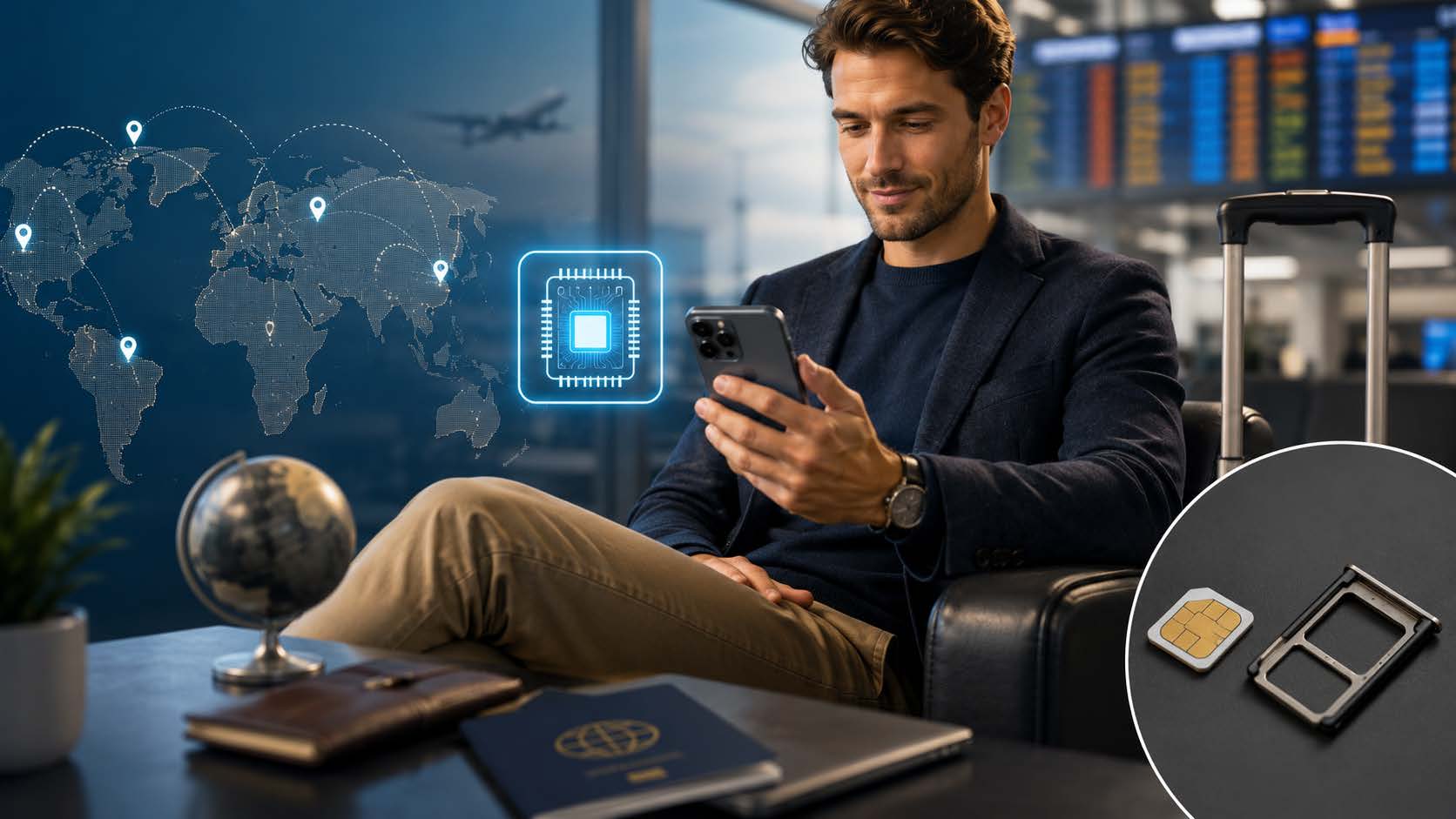
Keep your phone number with an international eSIM

Yes. In most cases, you can keep your regular phone number while using an international eSIM for mobile data.

Modern smartphones often support Dual SIM, which means your regular SIM and a travel eSIM can be active on the same phone at the same time. This lets you use the international eSIM for affordable data while keeping your normal number available for calls, texts, and messaging apps.

How Dual SIM Works When Traveling

Your phone can have two separate lines:

  • Your regular SIM: Keeps your normal phone number.
  • Your international eSIM: Provides mobile data while you travel.

In your phone’s settings, you can select the travel eSIM as the line used for cellular data while leaving your regular SIM active.

The important part is making sure your phone does not use your regular carrier for cellular data, which could trigger international roaming charges.

What About Calls and Text Messages?

You can usually continue receiving calls and SMS messages on your normal number while abroad. However, your home carrier may charge international roaming fees for certain calls, texts, or other activity.

If you want to minimize roaming charges, check your carrier’s international policies before traveling and avoid making or answering traditional cellular calls on your regular line unless you know the cost.

Will iMessage Still Work?

For iPhone users, iMessage can generally continue using your regular phone number while your travel eSIM supplies the internet connection.

Before traveling, check Settings > Apps > Messages > Send & Receive and make sure your regular number is selected.

Messages sent through iMessage use data rather than traditional SMS, so they can travel over your international eSIM connection.

What About WhatsApp?

WhatsApp is even simpler.

Your WhatsApp account remains associated with your existing phone number even if you use a different eSIM for data. You do not need to change your WhatsApp number just because you’re using an international eSIM.

Calls, messages, photos, and videos in WhatsApp simply use the internet connection provided by your travel eSIM.

The Best of Both Worlds

Using Dual SIM gives international travelers a convenient combination: keep your familiar phone number while using a separate international eSIM for data.

Before you leave, simply make sure your phone supports Dual SIM and eSIM, set the international eSIM as your cellular data line, and review your home carrier’s roaming policies.

That way, your regular number stays with you while your travel data follows you around the world.

Reusable eSIM vs. Single-Trip eSIM: Which Is Better for International Travel?

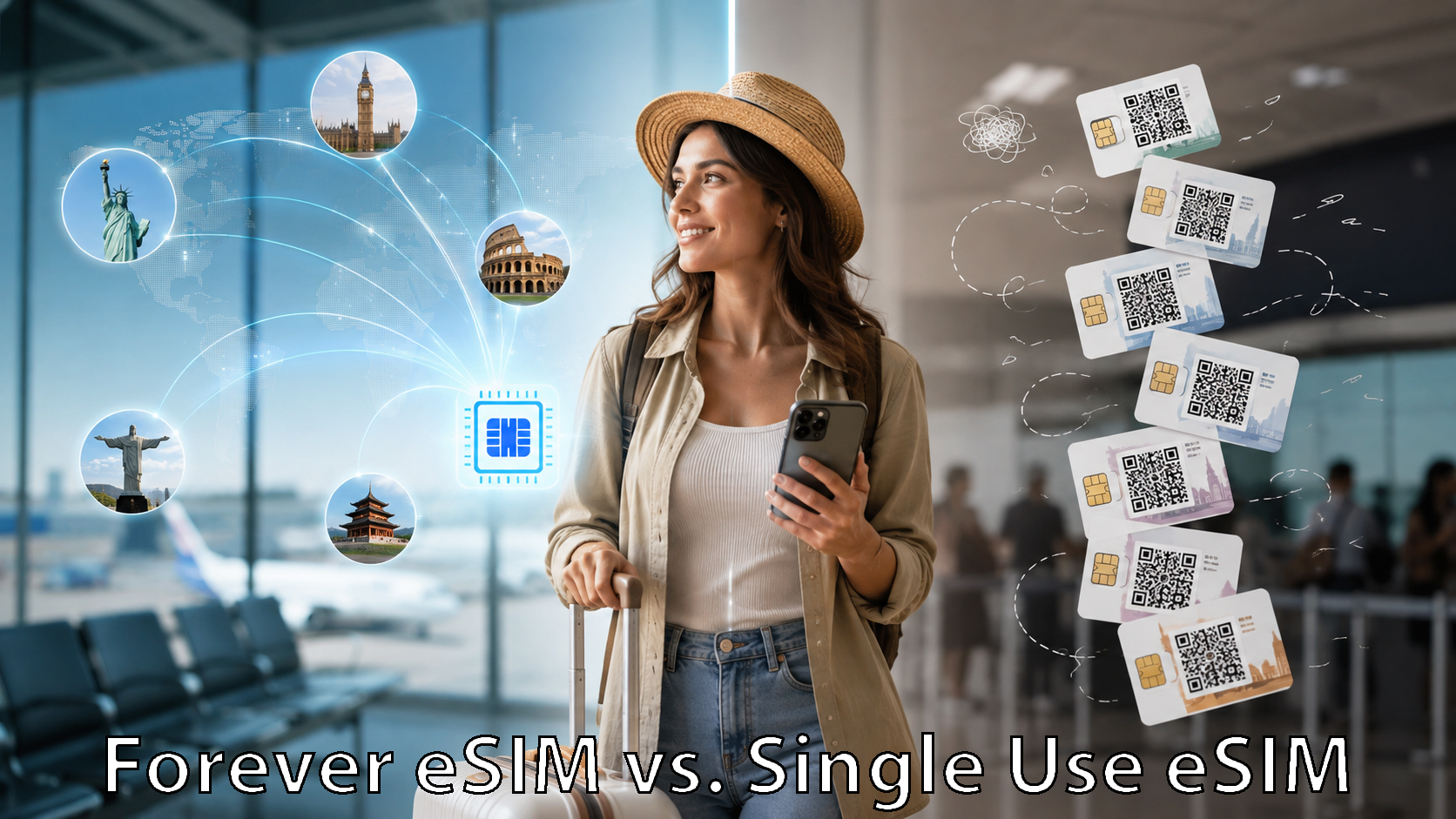
Forever, reusable eSIM versus Single use eSIM

Travel eSIMs have made staying connected abroad much easier. Instead of hunting for a local SIM card after landing or paying expensive international roaming charges, travelers can install an eSIM and get mobile data in another country within minutes.

But not all travel eSIMs work the same way.

Many eSIMs are designed for a single trip. You buy a plan for a particular country or region, use it while traveling, and then purchase another eSIM the next time you go somewhere.

A reusable eSIM works differently. You install the eSIM once and keep it on your phone. When another trip comes around, you simply add a new data plan instead of installing another eSIM.

So which approach is better? It depends largely on how often you travel and how much convenience you want.

What Is a Single-Trip eSIM?

A single-trip eSIM is typically purchased for a particular destination or travel period.

For example, if you’re traveling to France for two weeks, you might purchase a France eSIM with 5GB of data valid for 15 or 30 days.

You receive a QR code or installation link, install the eSIM on your phone, activate it when you arrive, and use the included data during your trip.

Once the plan expires or the data is used, the eSIM may no longer be useful. For your next trip, you may need to purchase and install another one.

For occasional travelers, this can work perfectly well.

The downside is that frequent travelers can eventually end up with a collection of old eSIM profiles on their phones and another installation process every time they travel.

What Is a Reusable Travel eSIM?

A reusable eSIM is designed to stay installed on your phone between trips.

Instead of treating the eSIM itself as a disposable travel product, the eSIM becomes your permanent travel connectivity profile.

When you’re preparing for another international trip, you can simply purchase or activate a new data plan for your destination.

For example, you might use the same eSIM for:

  • A trip to Italy in April
  • Canada in July
  • Japan in October
  • A multi-country European vacation the following year

The eSIM remains on your phone. The plan changes based on where you’re traveling.

This approach is particularly useful for frequent international travelers.

The Biggest Difference: Install Once vs. Install Every Trip

The biggest practical difference between reusable and single-trip eSIMs is what happens before your next vacation.

With a single-trip eSIM, the process might look like this:

Choose destination → Choose provider → Buy eSIM → Install eSIM → Travel → Delete or abandon eSIM

Then you repeat the process for your next trip.

With a reusable eSIM:

Install eSIM once → Choose plan → Travel → Choose another plan for the next trip

There is simply less setup to repeat.

That may not sound important when you’re taking one vacation a year. But for frequent travelers, business travelers, cruise passengers, digital nomads, or anyone regularly traveling internationally, eliminating repeated eSIM installations can make travel connectivity much simpler.

Can You Leave a Reusable eSIM Installed?

Yes.

A reusable travel eSIM can remain installed on a compatible phone even when you’re not actively using it.

Modern smartphones can store multiple SIM and eSIM profiles. You can usually turn an individual eSIM line on or off through your phone’s cellular settings.

When you’re back home, you can simply use your normal mobile service.

Before your next international trip, you can enable your travel eSIM and activate the appropriate data plan.

This also reduces the possibility of accidentally deleting an eSIM and needing to reinstall it later.

What Happens When You Travel to Another Country?

This is where reusable eSIMs can become particularly convenient.

Instead of purchasing an entirely new eSIM, you choose a plan that works in your next destination.

Suppose you’re taking three trips:

Trip 1: Spain
Trip 2: Mexico
Trip 3: Thailand

With a traditional single-trip approach, you might purchase three separate eSIMs.

With a reusable global eSIM, the same installed eSIM can be used for all three trips. You simply select the appropriate plan or coverage option before each trip.

For travelers who frequently visit multiple countries, this dramatically simplifies managing international mobile service.

Reusable eSIM vs. Single-Trip eSIM Cost

The cheapest option depends on the destination, amount of data needed, length of the trip, and available plans.

A single-trip eSIM can sometimes offer an extremely inexpensive promotional price for one country.

But the headline price isn’t the only cost worth considering.

Frequent travelers should also consider:

  • Whether they need to buy another eSIM for every trip
  • Whether unused data expires
  • How easily additional data can be added
  • Whether the eSIM works in multiple countries
  • Whether the provider offers multiple networks
  • Whether customer support is available
  • Whether the eSIM can remain installed indefinitely

A reusable eSIM may provide more long-term value even when another provider occasionally offers a slightly cheaper destination-specific plan.

The difference is similar to buying a new travel adapter for every trip versus keeping one universal adapter in your suitcase.

What About Multi-Country Trips?

Reusable global eSIMs can be particularly useful when visiting several countries during the same trip.

Imagine a European vacation covering:

France → Switzerland → Italy → Austria

With destination-specific eSIMs, you might need separate plans or profiles depending on the provider.

A regional or global reusable eSIM may allow you to stay connected as you cross borders without repeatedly changing your phone’s SIM configuration.

That can be especially valuable when traveling by train, driving between countries, taking a cruise, or making an itinerary that crosses several regions.

When Does a Single-Trip eSIM Make Sense?

Single-trip eSIMs still have advantages.

They can be a good choice if:

  • You rarely travel internationally
  • You’re visiting only one country
  • You need connectivity for only a few days
  • You find an unusually inexpensive destination-specific plan
  • You don’t mind installing a new eSIM for each trip

For someone taking one international vacation every few years, the convenience advantage of a reusable eSIM may not matter very much.

When Does a Reusable eSIM Make More Sense?

A reusable eSIM becomes more attractive when international travel is something you do regularly.

It may be a better fit if:

  • You travel internationally several times a year
  • You frequently visit different countries
  • You take multi-country trips
  • You travel for business
  • You want a travel eSIM ready on your phone at all times
  • You don’t want to install a new eSIM before every trip
  • You want access to different data plans without changing eSIMs

It can also provide some peace of mind.

Once you’ve installed and tested your travel eSIM, you already know where it is in your phone settings and how it works. The next trip requires fewer moving parts.

And international travel already has enough moving parts.

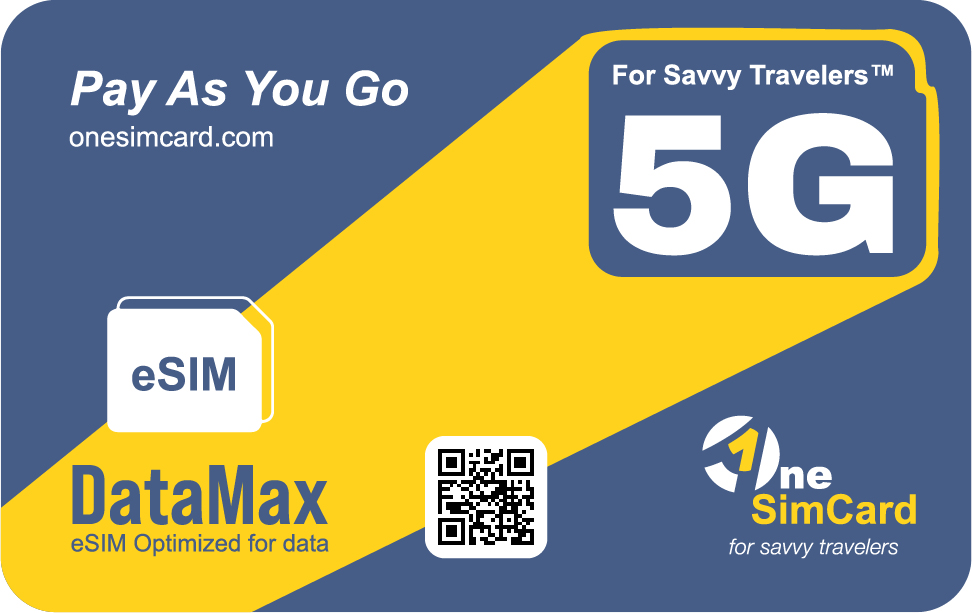
OneSimCard DataMax: A Reusable “Forever eSIM”

OneSimCard’s DataMax eSIM is designed around this reusable approach.

Instead of purchasing a disposable eSIM for every vacation, travelers can install the DataMax eSIM and keep it on their compatible phone for future international trips.

When you’re planning another trip, you can select the appropriate data option for your destination rather than installing another eSIM profile.

DataMax offers connectivity across 200+ countries and territories, with plans designed for international travelers who want the flexibility to use the same eSIM again and again.

That makes the eSIM particularly useful for frequent travelers who don’t want to start from scratch every time they cross a border.

Reusable eSIM vs. Single-Trip eSIM: Which Should You Choose?

Neither type of eSIM is automatically better for every traveler.

If you take an international trip once every few years, purchasing a destination-specific eSIM may be perfectly adequate.

But if international travel is a regular part of your life, a reusable eSIM can make considerably more sense.

Instead of thinking of your travel eSIM as something you buy for a vacation, think of it as part of your phone.

Your normal SIM connects you at home.

Your reusable travel eSIM is already there whenever your next trip begins.

Frequently Asked Questions

Does a reusable eSIM expire?

The eSIM profile itself may remain installed even when you don’t currently have an active data plan. Exact policies depend on the provider, so travelers should check whether there are inactivity or account requirements.

Can I keep a travel eSIM installed when I’m not traveling?

Yes. Most compatible smartphones allow you to keep an eSIM installed and simply disable that cellular line when you’re not using it.

Do I need to delete my regular SIM to use a reusable eSIM?

Usually not. Many modern phones support Dual SIM functionality, allowing your regular carrier SIM and travel eSIM to remain installed at the same time.

Can I change countries without installing another eSIM?

With a reusable global eSIM, you can generally purchase or activate another compatible plan for your next destination without installing a new eSIM profile. Providers like OneSimCard offer coverage zones for regional coverage plans, that cover a number of destinations.

Can I add more data during my trip?

Many reusable eSIM services allow additional data or another plan to be purchased if you need more data while traveling.

Is a reusable eSIM better for frequent travelers?

For many frequent travelers, yes. The biggest advantages are convenience, fewer eSIM installations, easier multi-country travel, and having international connectivity already available on the phone before the next trip.


Why More International Travelers Are Choosing eSIM

International travel has changed dramatically in recent years. Boarding passes live in mobile wallets, hotel rooms can be unlocked with an app, and travelers can translate menus or navigate unfamiliar cities from their phones.

Now, the traditional plastic SIM card is also being rethought.

More frequent international travelers are choosing eSIM because it offers a faster and more flexible way to stay connected abroad. Instead of searching for a mobile store after landing or opening a phone with a tiny SIM-ejector tool, travelers can install a mobile plan digitally and connect when they arrive.

However, physical SIM cards have not disappeared. They still offer important advantages for certain phones, destinations, and travel situations.

Understanding the differences can help travelers choose the best international connectivity option for each trip.

What Is an eSIM?

An eSIM, or embedded SIM, is a digital version of the removable SIM card traditionally inserted into a phone.

Rather than receiving a plastic card, the traveler installs an eSIM profile on a compatible device. This is commonly done by scanning a QR code, using a provider’s mobile app, or entering activation details manually.

Once installed, the eSIM functions much like a physical SIM. It connects the device to participating mobile networks and may provide data, voice, SMS, or a combination of services, depending on the plan.

Many modern smartphones can store multiple eSIM profiles, allowing travelers to keep different plans for different destinations or trips.

Why Frequent Travelers Are Switching to eSIM

1. eSIM Can Be Installed Before Departure

One of the biggest advantages of eSIM is that travelers can arrange mobile service before leaving home.

There is no need to wait for a SIM card to arrive in the mail or locate a mobile shop at the airport. The eSIM can often be installed while the traveler still has reliable Wi-Fi and time to review the activation instructions.

This can make arrival much smoother. Instead of standing in an airport kiosk line, the traveler can turn on the appropriate eSIM and connect to a supported network.

For someone who travels internationally several times a year, those saved minutes begin to add up.

2. There Is No Tiny Card to Lose

Physical SIM cards are small, delicate, and remarkably talented at disappearing into luggage.

Travelers who replace their home SIM with a local SIM must store the original card safely until the end of the trip. Losing it can create problems when returning home, particularly when the original number is used for banking, authentication, or business calls.

An eSIM remains digitally installed on the phone. There is no tray to open and no plastic card to keep in a folded receipt, wallet pocket, or mysterious corner of a carry-on bag.

3. Travelers Can Keep Their Primary SIM Active

Many eSIM-compatible phones support dual-SIM functionality. This may allow the traveler to use an international eSIM for mobile data while keeping the primary physical SIM or eSIM active for calls and messages.

For frequent travelers, this can be particularly valuable. They may continue receiving texts sent to their regular number while using a separate travel plan for affordable data.

The exact dual-SIM capabilities vary by device, carrier, and plan, so travelers should review their phone settings and roaming charges before departure.

4. Switching Between Plans Is Easier

Frequent travelers rarely visit the same destination every time. One trip may involve France and Spain, while the next includes Japan, Thailand, and Singapore.

A phone that supports multiple stored eSIM profiles can make it easier to manage different travel plans. Travelers can label profiles by region, destination, or provider and activate the one needed for the current trip.

Some international eSIM products are also reusable, allowing customers to add a new data package to an existing eSIM rather than installing a completely new profile for every journey.

That turns the phone into a small connectivity passport, with less plastic and fewer airport-store negotiations.

5. eSIM Offers Greater Flexibility During a Trip

Travel plans change. A two-country vacation may unexpectedly become a three-country adventure. A short conference may be extended, or a traveler may use more data than expected.

With eSIM, it may be possible to purchase additional data or activate another plan without finding a retail location. This is especially useful during late arrivals, long layovers, rail journeys, or visits to places where mobile stores are difficult to reach.

The ability to manage connectivity online gives travelers more control over how and when they purchase service.

6. eSIM Works Well With Travel Apps

Modern international trips rely heavily on mobile data.

Travelers use their phones for:

  • Maps and navigation
  • Airline and train apps
  • Hotel reservations
  • Ride-hailing services
  • Translation tools
  • Messaging and video calls
  • Mobile payments
  • Restaurant research
  • Digital tickets and confirmations

An eSIM can provide access to these services shortly after arrival, helping the traveler avoid unsecured public Wi-Fi or expensive roaming charges from a domestic carrier.

Why Some Travelers Still Choose a Physical SIM Card

Despite the convenience of eSIM, a physical international SIM card can still be the better choice in some situations.

The Phone May Not Support eSIM

Not every device is eSIM-compatible. Some older phones, entry-level models, and devices sold in certain markets may only accept physical SIM cards.

Even when a phone model generally supports eSIM, regional variations or carrier restrictions can affect compatibility.

Travelers should always verify that their exact device model is unlocked and supports the type of eSIM being purchased.

Physical SIM Cards Can Be Moved Between Devices

A physical SIM can usually be removed from one compatible unlocked device and inserted into another.

This can be useful when a traveler carries a backup phone, mobile router, hotspot, tablet, or other connected device. If the primary phone is damaged, the SIM may be transferred to another device without reinstalling a digital profile.

An eSIM is typically tied more closely to the device on which it was installed. Moving it may require a transfer process or assistance from the provider.

Setup May Feel More Familiar

Some travelers simply prefer the certainty of inserting a card into a SIM tray.

A physical SIM does not require scanning a QR code, navigating cellular settings, or understanding which SIM should handle mobile data. For travelers who are less comfortable adjusting phone settings, the traditional approach may feel more straightforward.

Physical SIMs Remain Useful for Longer Trips

Travelers staying abroad for several months may want a local number, local voice service, or access to a domestic carrier plan that is only available through a physical SIM.

In these cases, buying a local SIM after arrival may still make sense, particularly when the traveler will remain in one country for an extended period.

eSIM vs. Physical SIM: Which Is Better for International Travel?

Neither option is automatically best for every traveler.

An eSIM may be the stronger choice when the traveler:

  • Has an unlocked, eSIM-compatible phone
  • Wants to arrange service before departure
  • Visits several countries during one trip
  • Travels internationally frequently
  • Wants to keep a primary SIM active
  • Prefers not to handle or store plastic SIM cards
  • Needs fast access to mobile data upon arrival

A physical SIM may be preferable when the traveler:

  • Uses a phone without eSIM support
  • Wants to move the SIM between devices
  • Needs service in a hotspot or mobile router
  • Prefers a traditional installation process
  • Plans to purchase a long-term local mobile plan
  • Wants a physical backup connectivity option

Some frequent travelers use both. They keep a reusable international eSIM on their phone for convenient data access and carry a physical SIM as a backup or for use in another device.

What Travelers Should Check Before Buying

Before choosing either an eSIM or physical SIM, travelers should confirm:

  1. Device compatibility: The phone must support the selected SIM type. Use our compatibility checker HERE.
  2. Carrier unlocking: A locked phone may not accept another provider’s SIM or eSIM.
  3. Destination coverage: Check which countries and networks are included.
  4. Plan duration: Make sure the package remains valid for the entire trip.
  5. Data allowance: Consider navigation, streaming, hotspot use, and video calls.
  6. Voice and SMS availability: Some travel eSIMs provide data only.
  7. Dual-SIM settings: Understand which SIM will be used for data, calls, and texts.
  8. Roaming settings: Incorrect settings may prevent service or create unexpected charges.

Installing and testing the service before departure, when permitted by the provider, can prevent a small technical issue from becoming an arrival-day headache.

The Future of Travel Connectivity Is More Flexible

Travelers are choosing eSIM because it removes many of the small obstacles traditionally associated with international mobile service.

It can be purchased remotely, installed digitally, activated quickly, and managed directly from a compatible phone. For people who cross borders frequently, that convenience is difficult to ignore.

Physical SIM cards still have an important role, especially for older devices, transferable service, backup phones, and long-term local plans. The most practical solution is not necessarily choosing one format forever. It is having access to the right format for each destination and device.

As travel becomes increasingly digital, the best connectivity options will be the ones that give travelers flexibility. Whether that means an eSIM, a physical SIM, or a combination of both, the goal remains the same: reliable mobile service without allowing connectivity logistics to take over the journey.

How Much Data Do You Need for International Travel?

Woman with travel eSIM using phone for multiple apps
How much data do I need for a eSIM for travel?

One of the most common questions travelers ask before buying an international eSIM is simple: how much data do I actually need?

The answer depends on how you use your phone abroad. A traveler who mainly checks email, uses maps, and sends messages may need far less data than someone who streams videos, uploads travel reels, joins video calls, or uses their phone as a hotspot. Buying too little data can leave you scrambling for Wi-Fi in an airport, hotel lobby, or café. Buying too much can mean paying for gigabytes you never use.

The good news is that most travelers can estimate their data needs pretty accurately before they leave.

A Quick Rule of Thumb

For a typical international trip, here are some useful starting points:

Traveler Type Estimated Data Need
Light user 1GB to 3GB per week
Average traveler 3GB to 7GB per week
Heavy user 7GB to 15GB+ per week
Hotspot or video-heavy user 15GB+ per week

A light user might rely mostly on messaging, email, maps, and occasional browsing. An average traveler may use social media, maps, restaurant searches, ride apps, and some photo uploads. A heavy user may stream video, use TikTok or Instagram Reels, upload lots of photos, join video calls, or use the phone as a laptop hotspot.

How Much Data Common Travel Activities Use

Here are general estimates for common mobile activities:

Activity Approximate Data Usage
Web browsing and email About 60 MB per hour
Music streaming About 100 to 150 MB per hour
Social media, mostly text and images About 120 MB per hour
Social media with video or reels Up to 1GB to 2GB per hour
Video streaming in HD About 1.5GB to 2GB per hour
Maps and navigation Usually low to moderate, depending on use
Messaging apps Usually very low
Video calls Often high, depending on quality

These numbers are estimates, but they show why two travelers on the same trip can use very different amounts of data. One person may spend a week in Europe using only 2GB, while another can burn through 2GB in a single evening of video streaming.

How Long Is Your Trip?

Trip length is one of the easiest ways to estimate your data needs.

For a short trip of 3 to 5 days, many travelers can get by with 1GB to 3GB if they are mainly using maps, messaging, email, and occasional browsing.

For a one-week trip, 3GB to 5GB is a comfortable range for many travelers. This gives room for daily maps, ride apps, restaurant searches, messaging, social media, and light photo sharing.

For a two-week trip, 5GB to 10GB is often a better fit, especially if you are moving between cities, using travel apps frequently, or posting photos and videos.

For longer trips, frequent business travel, digital nomad work, or multi-country travel, a larger plan or an eSIM that can be recharged may be the better choice.

Destination Matters

Where you are going can also affect your data usage. In some destinations, free Wi-Fi is widely available in hotels, cafés, airports, and public spaces. In others, Wi-Fi may be slower, less secure, or harder to find.

You may also use more data in countries where you rely heavily on translation apps, maps, transit apps, ride-hailing apps, airline apps, and online ticketing. Travelers visiting several countries in one trip often use more data because they are constantly checking routes, bookings, maps, train schedules, and local information.

This is where an international eSIM can be especially useful. Instead of hunting for a local SIM card in every country, you can arrive with mobile data ready to go.

Don’t Forget Maps, Messaging, and Travel Apps

Maps are one of the most important travel data uses. Even though maps do not usually use as much data as video, they can become a daily essential. You may use them for walking directions, public transportation, restaurant searches, hotel locations, and ride-share pickups.

Messaging apps such as WhatsApp, iMessage, Messenger, Telegram, and similar services usually use very little data for text messages. Photos, voice notes, and videos use more, but still far less than streaming video.

Travel apps can also add up. Airline apps, hotel apps, train apps, translation tools, mobile tickets, banking apps, and ride apps all need a reliable connection. You may not use huge amounts of data, but you will notice quickly if you do not have data when you need it.

The Biggest Data Drainers

The biggest travel data users are usually:

Video streaming
Social media videos and reels
Video calls
Cloud photo and video backups
App updates
Using your phone as a hotspot
Automatic downloads
High-resolution photo and video uploads

Before traveling, it is smart to turn off automatic app updates, automatic cloud backups, and background data for apps you do not need. These silent data goblins can eat through a plan while your phone sits in your pocket looking innocent.

Should You Use Hotel Wi-Fi?

Hotel Wi-Fi can help reduce your mobile data usage, especially for large downloads, video calls, streaming, and photo backups. However, travelers should be careful when using public Wi-Fi networks, especially for banking, business accounts, or sensitive logins.

An eSIM gives you a private mobile data connection when you do not want to rely on public Wi-Fi. For many travelers, the best approach is to use mobile data for everyday travel needs and use trusted Wi-Fi for high-data activities when available.

How to Save Data While Traveling

You can stretch your travel eSIM data by making a few simple changes before and during your trip:

Download offline maps before you leave.
Turn off automatic app updates.
Disable cloud photo and video backup on mobile data.
Use Wi-Fi for large downloads.
Lower video streaming quality.
Close apps running in the background.
Turn off autoplay video in social media apps.
Use messaging instead of video calling when possible.

These small changes can make a noticeable difference, especially on longer trips.

How Much Data Should You Buy?

For most vacation travelers, 3GB to 5GB per week is a practical starting point. Light users may need less, while travelers who stream, post videos, use hotspot, or work remotely should choose more.

A good travel eSIM should give you flexibility. Ideally, you want coverage in the countries you are visiting, clear pricing, easy activation, and the ability to recharge or add more data if your trip changes.

Final Recommendation

Here is a simple way to choose:

Choose 1GB to 3GB if you mostly use maps, messaging, email, and light browsing.

Choose 3GB to 7GB if you use social media, travel apps, photo sharing, maps, and occasional streaming.

Choose 7GB to 15GB or more if you use video, hotspot, cloud uploads, video calls, or travel for more than one week.

Choose a rechargeable international eSIM if you want more flexibility during your trip.

International travel is unpredictable. Flights change, train platforms move, hotel addresses hide in tiny alleyways, and your “quick dinner nearby” search somehow becomes a 45-minute navigation quest. Having enough mobile data keeps your trip smoother, safer, and less dependent on public Wi-Fi.

With the right international eSIM plan, you can land, connect, and start using your phone right away, without guessing where to buy a local SIM card or worrying about surprise roaming charges.

What is the Best VoIP App for eSIM?

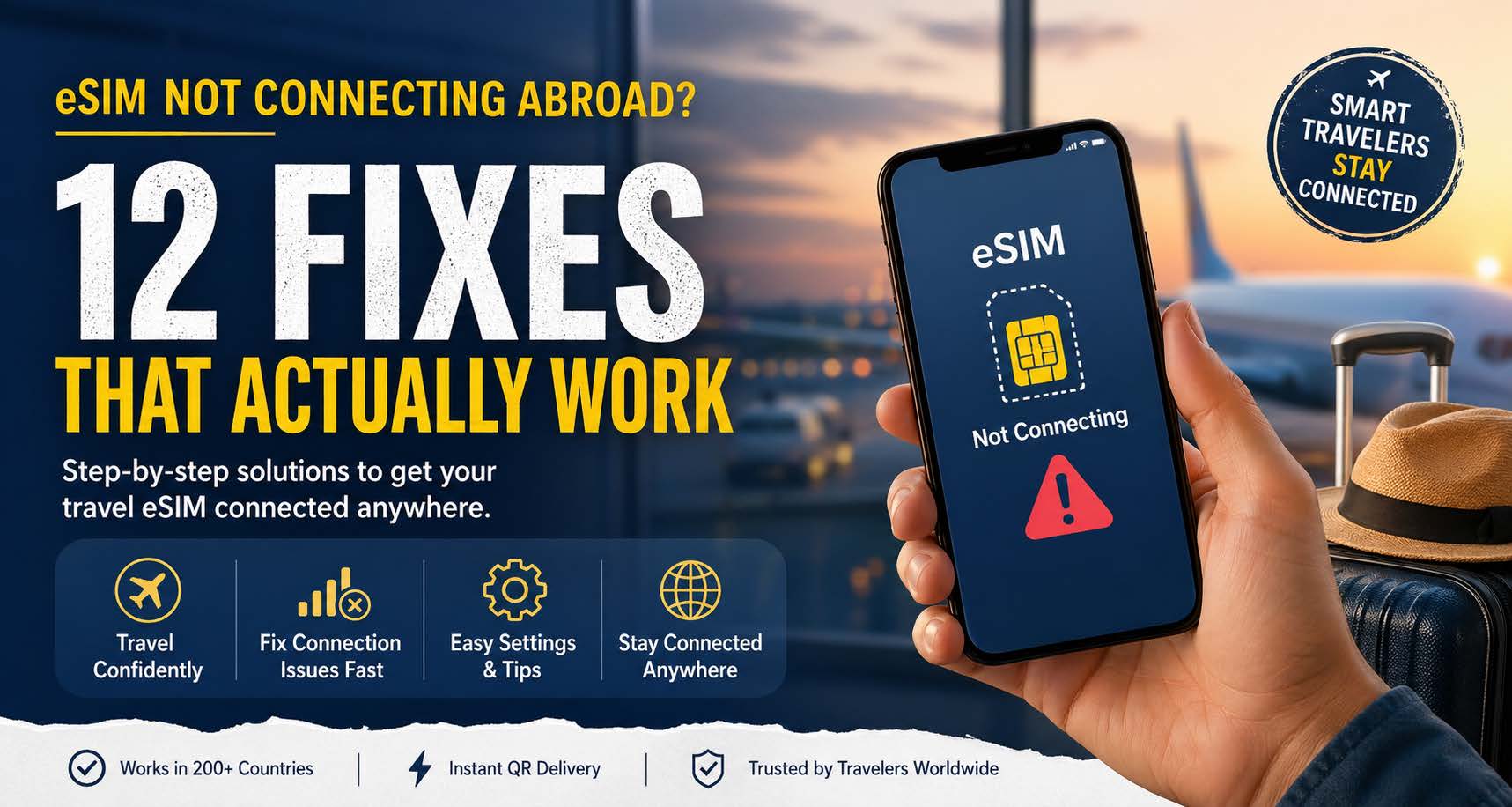
International traveler using OneSim VoIP app to stay in touch

International traveler using OneSim VoIP app to stay in touch

Why Travelers and Global Professionals Use VoIP Apps

International travel has changed dramatically over the last decade. Travelers now expect reliable data, affordable connectivity, and the ability to stay reachable anywhere in the world without dealing with expensive roaming charges or juggling multiple local phone numbers. While eSIMs and international SIM cards solve much of the connectivity problem, voice communication still creates challenges for many travelers.

That is where the OneSim VoIP App becomes an important part of the travel toolkit.

The OneSim VoIP App allows users to make and receive calls and messages using internet connectivity instead of relying entirely on traditional cellular voice networks. Whether connected through WiFi, hotel internet, airport hotspots, or mobile data from a OneSimCard eSIM or SIM card, the app helps travelers maintain affordable global communication almost anywhere.

Avoid Expensive International Roaming

Traditional carrier roaming rates can become surprisingly expensive, especially for voice calls. Even short international conversations may generate significant charges when using a home carrier abroad.

The OneSim VoIP App helps reduce those costs by routing calls over an internet connection. Instead of paying international roaming voice rates, users can often place calls at much lower costs while keeping communication simple and familiar.

For frequent travelers, digital nomads, remote workers, and international business teams, this creates a far more predictable and affordable communication experience.

Stay Reachable Worldwide

One major advantage of the OneSim VoIP App is flexibility. Travelers are no longer dependent on finding a local SIM card in every country they visit.

A traveler using a OneSimCard DataMax eSIM can land in a new country, activate data instantly, and continue using the VoIP App for communication without interruption. This is especially valuable for multi-country trips where changing SIM cards repeatedly becomes frustrating and time consuming.

The app works well for:

  • International travelers
  • Business travelers
  • Students studying abroad
  • Cruise passengers
  • Remote workers
  • Global sales teams
  • Expats and long-term travelers

Instead of constantly notifying friends, family, or clients about temporary foreign numbers, users can maintain consistent communication channels while traveling internationally.

How OneSim VoIP Compares to Other VoIP Apps

Many travelers already use apps such as WhatsApp, Skype, Telegram, or Viber for communication. While those apps are useful, they often work best only when both parties have the same application installed.

The OneSim VoIP App offers an important advantage for travelers because users can call standard landline and mobile phone numbers worldwide. This means you can contact:

  • Hotels
  • Airlines
  • Restaurants
  • Taxi drivers
  • Clients
  • Family members
  • Banks and customer support centers

…without requiring the other person to download or install a specific app.

That difference becomes extremely important while traveling internationally. If your hotel in Tokyo, your driver in Rome, or your tour operator in Bangkok only has a regular phone number, app-to-app messaging services may not help much. The OneSim VoIP App behaves more like a traditional phone service layered on top of internet connectivity.

Compared to Voice + SMS eSIM Providers

Some modern travel eSIM providers now advertise “voice and SMS included” plans. While convenient in some situations, these offerings often come with limitations:

  • Temporary local phone numbers
  • Country-specific restrictions
  • Limited roaming regions
  • Higher package costs
  • Voice minutes that expire quickly
  • Separate plans required for different regions

Using a global data eSIM together with the OneSim VoIP App creates a more flexible setup. Instead of depending on region-specific voice plans, travelers can use reliable data connectivity almost anywhere and place calls through the app when needed.

This approach is especially useful for travelers visiting multiple countries during one trip because they do not need to repeatedly change voice plans or manage multiple temporary numbers.

Perfect Companion for eSIM Travel

Modern travelers increasingly rely on eSIM technology because it eliminates the need for physical SIM swaps. Pairing a global eSIM with the OneSim VoIP App creates a powerful travel communication setup.

Using mobile data through an international eSIM while routing voice communication through VoIP gives travelers:

  • Lower communication costs
  • Fast activation
  • Multi-country coverage
  • Greater flexibility
  • Reduced roaming dependency
  • The ability to call real phone numbers worldwide

For many travelers, this combination replaces the need for expensive international roaming plans entirely.

A Smarter Way to Communicate Abroad

Global connectivity is no longer just about having internet access. Travelers also need reliable and affordable voice communication that works across borders.

The OneSim VoIP App helps bridge that gap by giving users a flexible communication solution that works alongside international eSIMs and SIM cards.

Whether traveling for business, adventure, or long-term international living, combining global data connectivity with internet-based voice communication creates a simpler and more cost-effective way to stay connected worldwide.

eSIM Not Connecting Abroad? 12 Fixes That Actually Work

Landing in a new country should feel like an adventure… not a tech support nightmare.

If your eSIM isn’t connecting abroad, you’re not alone. This is one of the most common issues travelers face, especially right after landing when you need maps, rides, or messages immediately.

The good news: most eSIM issues can be fixed in under 5 minutes.

Let’s get you connected


Quick Fix First (Try This Before Anything Else)

Before diving into deeper troubleshooting, do these 3 things:

  1. Turn Airplane Mode ON → wait 30 seconds → turn it OFF
  2. Restart your phone
  3. Make sure your eSIM line is turned ON

If that didn’t work, keep going.


1. Make Sure Your eSIM Is Activated

Some eSIMs don’t fully activate until you connect to a supported network abroad.

  • Go to Settings → Cellular / Mobile Data
  • Check that your eSIM shows as active
  • If not, toggle it OFF → ON

If you installed it before your trip, this is often the issue.


2. Enable Data Roaming (Yes, Really)

This feels counterintuitive, but it’s required.

  • Go to your eSIM line settings
  • Turn Data Roaming = ON

eSIM providers use local partner networks, so “roaming” is how you connect.


3. Select the Correct eSIM for Data

Your phone might still be using your home SIM.

  • Go to Cellular / Mobile Data
  • Set Mobile Data = your eSIM
  • Disable data switching if needed

4. Manually Select a Network

Automatic network selection doesn’t always pick the best option.

  • Turn Automatic Network Selection = OFF
  • Wait for available networks
  • Try one manually (this may take a minute)

In many countries, switching networks instantly fixes the issue.


5. Check APN Settings (If Required)

Most modern eSIMs auto-configure, but not all.

  • Go to Cellular → eSIM → APN settings
  • Enter the APN provided by your eSIM provider (if missing)

For many setups, this is something like:

  • APN: internet or provider-specific (e.g., OSC for certain configs)

6. Make Sure You’re in Coverage

Not all plans work everywhere within a country.

  • Check your provider’s coverage list
  • Rural areas, underground transit, and remote regions can be spotty

If you just landed, step outside the airport or building.


7. Disable Your Primary SIM Temporarily

Your home SIM can interfere.

  • Turn OFF your primary SIM
  • Leave only the eSIM active
  • Test connectivity again

8. Check If You Have an Active Data Plan

It sounds obvious… but it happens a lot.

  • Make sure your plan:
    • Is not expired
    • Has data remaining
    • Covers the country you’re in

9. Reset Network Settings

This clears out bad configurations.

  • iPhone: Settings → General → Transfer or Reset → Reset Network Settings
  • Android: System → Reset → Network Settings

⚠️ This will remove saved WiFi passwords.


10. Update Your Phone Software

Outdated OS versions can cause eSIM bugs.

  • Check for updates in Settings → Software Update

11. Reinstall the eSIM

If nothing else works:

  • Delete the eSIM
  • Re-scan the QR code
  • Reinstall clean

This fixes corrupted profiles or incomplete installs.


12. Check If Your Phone Is Actually eSIM Compatible

Not all phones support eSIM globally (or fully).

  • Some devices:
    • Are region-locked
    • Support eSIM but not all bands
    • Have carrier restrictions

If your device is borderline compatible, connection issues are more likely.


Why This Happens (Quick Explanation)

eSIM connectivity issues usually come down to:

  • Network selection conflicts
  • Roaming settings not enabled
  • Device configuration mismatches
  • Coverage limitations

It’s rarely a “broken eSIM” — just a small setting blocking the connection.


✈️ Pro Tip: Avoid This Problem Before You Travel

Set up your eSIM before you leave, then:

  • Turn it ON while still at home (if supported)
  • Double-check settings
  • Save troubleshooting steps (or bookmark this page )

Still Not Working?

If you’ve tried everything and still aren’t connected:

  • Contact support (include screenshots of your settings)
  • Try a different network manually again
  • Confirm your plan includes your current country

Get a More Reliable eSIM

Not all eSIMs are created equal.

Many connectivity issues come from:

  • Limited network partnerships
  • “Steered” SIMs that force weaker carriers
  • Poor provisioning

A better solution uses:

  • Multiple network access
  • Automatic selection of the strongest signal
  • Coverage in 200+ countries

Explore reliable global eSIM options here:
https://www.onesimcard.com/esim/


Final Thoughts

When your eSIM isn’t connecting abroad, it feels like everything stops.

But in reality, it’s usually one small setting standing in your way.

Run through these fixes, and you’ll almost always be back online within minutes.

Now go enjoy your trip

Travel Influencers’ Secret Weapon: Why eSIMs Beat Pocket Wi-Fi

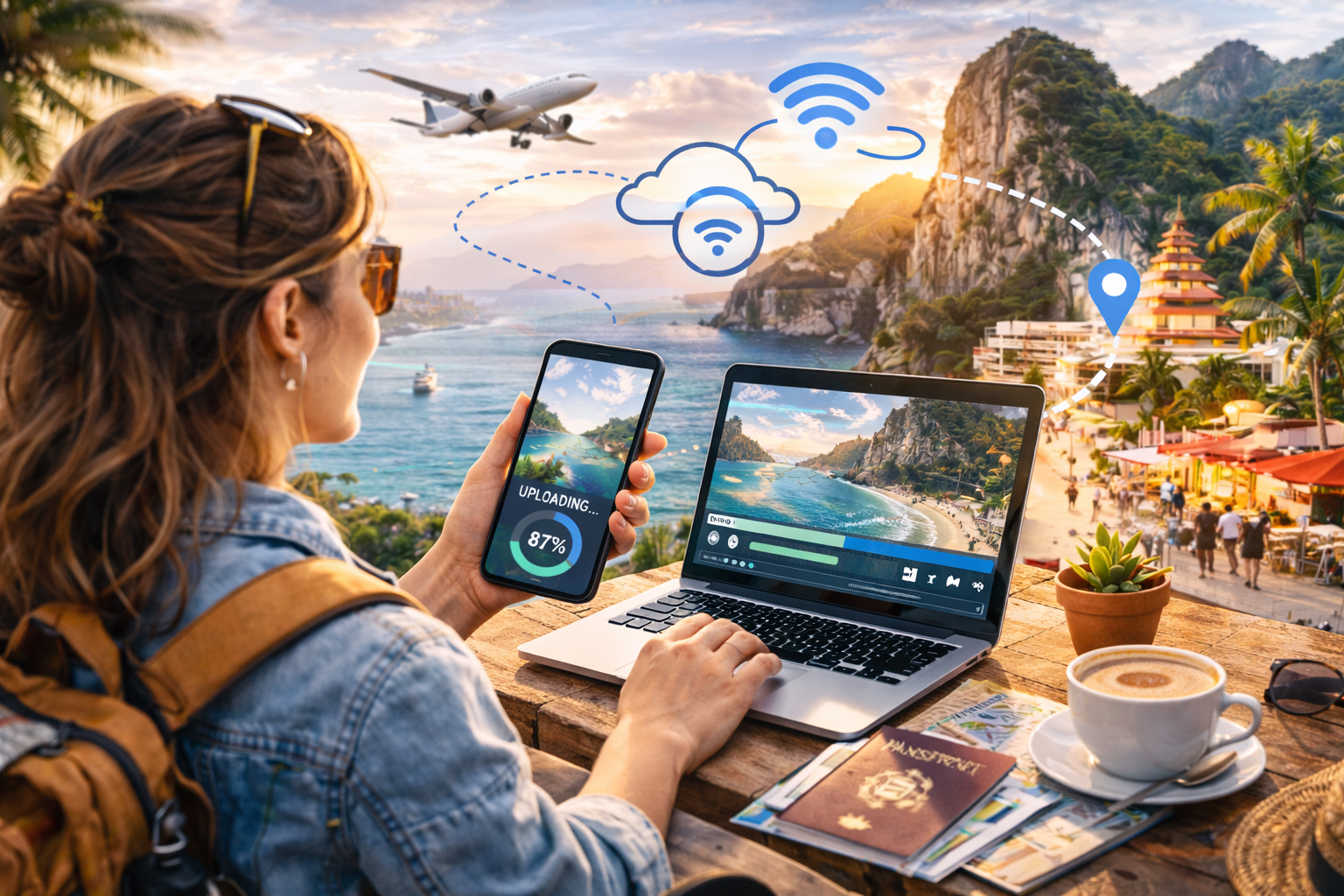
Travel influencer working in a tropical location with her eSIM enabled smartphone connecting her other devices.

How creators stay connected, upload faster, and travel lighter with modern mobile connectivity

Scroll through any travel influencer’s feed and it looks effortless. Sunset reels posted in real time. Drone shots uploaded from mountain viewpoints. Stories shared from trains, taxis, beaches, and bustling city streets.

What you don’t see is the invisible infrastructure behind it all.

Content creation on the road depends on one critical resource: reliable internet. Without it, uploads stall, collaborations lag, and opportunities disappear faster than a golden-hour sunset.

For years, pocket Wi-Fi devices were the go-to solution for international creators. But quietly, a shift has happened. Increasingly, travel influencers are leaving pocket routers behind and switching to travel eSIMs.

Here’s why the smartest creators now consider eSIMs their real travel essential.


The Old Standard: Pocket Wi-Fi Explained

Pocket Wi-Fi devices rose to popularity because they solved a major problem. Instead of paying expensive roaming fees, travelers could rent a small mobile hotspot that connected multiple devices to local cellular networks.

The concept was simple:

  • Carry a small router

  • Turn it on

  • Connect phones and laptops via Wi-Fi

For early digital nomads and creators, it felt revolutionary.

But over time, the downsides started to show, especially for influencers constantly on the move.


Problem #1: One More Thing to Carry

Travel influencers already travel with a surprising amount of gear:

  • Cameras

  • Lenses

  • Drones

  • Microphones

  • Tripods

  • Power banks

  • Laptops

Adding a pocket Wi-Fi device means adding another object that must be charged, packed, tracked, and protected.

An eSIM removes the device entirely.

Your phone becomes the connection.

No extra hardware. No rental pickup. No return shipping. No bulky charger tangled in your bag.

For creators who value mobility, removing friction matters more than adding gadgets.


Problem #2: Battery Anxiety

Pocket Wi-Fi devices run on their own batteries. And they rarely last a full creator day.

Imagine this scenario:
You’re filming all afternoon, navigating a new city, uploading clips, and messaging collaborators. Suddenly, the hotspot battery dies.

Now every connected device loses internet at once.

With an eSIM, connectivity lives inside your smartphone, which already has optimized battery management and portable charging solutions. One device to power instead of two.

Less juggling. Less stress.


Problem #3: Airport Logistics

Pocket Wi-Fi rentals often require pickup counters or shipping arrangements.

That means:

  • Waiting in airport lines

  • Finding return drop boxes

  • Paying late fees if travel plans change

Influencers thrive on flexibility. Plans shift constantly.

An eSIM activates digitally. Many creators install their data plan before departure and connect instantly when landing.

The difference feels small until you arrive after a long flight and walk straight past the rental counters while everyone else waits.


Problem #4: Upload Speed and Stability

Creators don’t just browse. They upload.

High-resolution photos, reels, and videos require consistent speeds. Pocket Wi-Fi devices typically rely on a single local network, which may slow down during congestion.

Many travel eSIMs support multiple partner networks. Your device connects to the strongest available signal automatically.

For influencers, this translates into:

  • Faster uploads

  • Fewer dropped livestreams

  • Reliable posting schedules

Consistency matters when algorithms reward timing.


The Creator Workflow Advantage

Modern travel influencers operate like mobile production studios.

A typical day might include:

  • Shooting footage in the morning

  • Editing during transit

  • Uploading content before peak engagement hours

  • Responding to brand messages in real time

An eSIM fits naturally into this workflow because connectivity follows the creator, not the device.

No reconnecting networks, or sharing passwords, or resetting routers.

Just open the phone and work.


Multi-Country Travel Without Resetting Everything

Influencers rarely stay in one place.

A Europe trip might include five countries in ten days. A Southeast Asia tour might involve weekly flights.

Pocket Wi-Fi devices often require new rentals or regional limitations.

Travel eSIMs, on the other hand, can provide multi-country coverage under a single plan. As creators cross borders, their connection continues seamlessly.

No setup interruption means no content interruption.

And in the creator economy, consistency equals visibility.


The Livestream Test

Nothing exposes weak connectivity faster than livestreaming.

Viewers expect smooth video and instant interaction. Buffering or dropped streams can hurt engagement and credibility.

Because eSIM connections use native cellular data directly on the phone, latency is often lower than routing traffic through an external hotspot.

The result:

  • Cleaner livestreams

  • Better audio sync

  • More reliable audience interaction

For influencers building communities, this is a major advantage.


Security Matters More Than You Think

Public Wi-Fi networks remain risky for creators managing accounts, payments, and brand partnerships.

Pocket Wi-Fi reduces reliance on public networks, but eSIM connections go a step further by keeping data directly on encrypted cellular networks tied to your device.

That means safer access to:

  • Social media accounts

  • Cloud storage

  • Banking apps

  • Business communications

Behind the scenes, this protection matters as much as speed.


Cost Predictability for Long Trips

Pocket Wi-Fi rentals often charge daily rates. Over a long trip, costs add up quickly, especially if travel dates change.

eSIM plans are typically prepaid data packages. Creators know exactly how much data they have and how long it lasts.

No surprise invoices arriving after the trip.

Predictability helps influencers manage travel budgets and campaign expenses more accurately.


The Invisible Upgrade

The biggest reason influencers are switching isn’t just performance or cost.

It’s simplicity.

Technology works best when it disappears into the background. The less time creators spend managing connectivity, the more time they spend creating.

An eSIM doesn’t feel like gear. It feels like freedom.

Freedom to:

  • Post instantly

  • Navigate confidently

  • Collaborate globally

  • Travel spontaneously

All without carrying extra equipment.


Why Influencers Are Moving On from Pocket Wi-Fi

Pocket Wi-Fi solved yesterday’s travel problem. eSIMs solve today’s.

Feature Pocket Wi-Fi Travel eSIM
Extra device required Yes No
Battery management Separate Phone only
Airport pickup needed Often No
Multi-country travel Limited Seamless
Instant activation No Yes
Creator mobility Medium High

For modern travelers and digital creators, fewer steps mean better experiences.


The Real Secret Weapon

Travel influencers succeed by capturing moments as they happen. The window between experience and sharing keeps shrinking.

The creators who win are the ones who stay connected everywhere, without interruption.

That’s why eSIMs have quietly become the new standard among experienced travelers.

Not flashy. Not obvious. Just reliable.

And sometimes, the most powerful travel tool isn’t the camera in your bag or the drone in your backpack.

It’s the signal that never disappears when you need it most

OneSimCard NEVER throttles data, even for other connected devices via mobile hotspot. This makes us different from many of our competitors that limit hotspot usage and throttle data speeds after a few GB.

No Bars, No Panic: Travel Survival Stories Powered by eSIMs

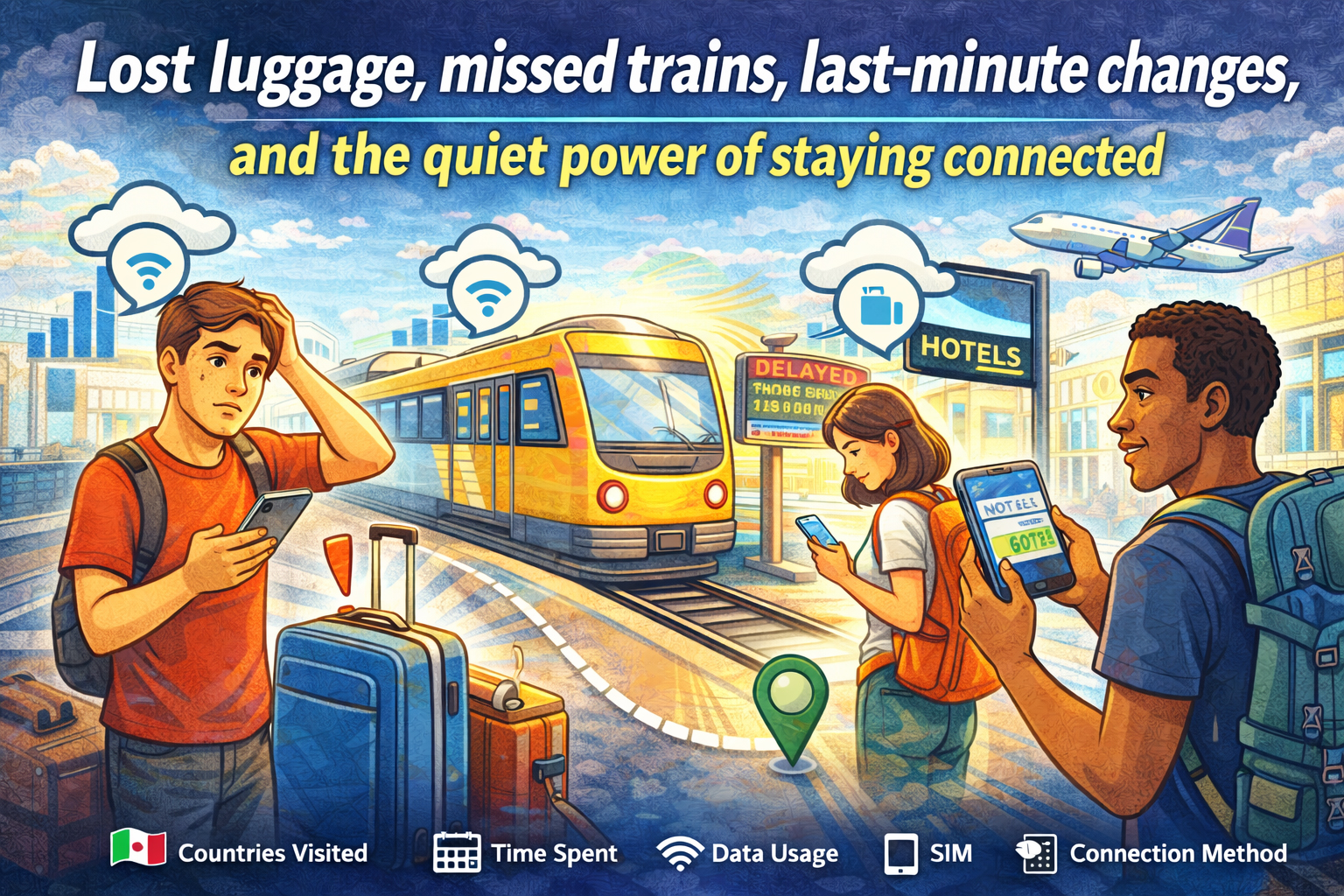
Lost luggage, missed trains, last-minute changes, and the quiet power of staying connected - travelers solving travel issues with eSIM

Lost luggage, missed trains, last-minute changes, and the quiet power of staying connected

Every traveler collects stories. Some are about beautiful views, incredible meals, and unexpected friendships. Others begin with a sinking feeling. A missed train. A lost bag. A canceled flight. A street sign you can’t read.

In those moments, the difference between stress and control often comes down to one simple thing: cellular signal.

There was a time when being overseas meant being temporarily unreachable. No maps, no ride apps, no instant help. Today, connectivity travels with you. And for many modern travelers, an eSIM has quietly become the difference between chaos and calm.

These are the kinds of real-world survival stories that play out every day. Not dramatic enough for headlines. But important enough to shape how a trip unfolds.

And in each one, a simple data connection turns panic into a plan.


The Missed Train That Didn’t Ruin the Trip

It happens fast. A late taxi. A long line for coffee. One wrong platform. Suddenly, the train you planned your day around is pulling away without you.

You’re in a country where you don’t speak the language, and the station boards flicker with destinations you don’t recognize.

In the past, this moment meant finding an information desk and hoping someone could help. Now, it’s a different kind of response.

Phone out. Data on.

Within minutes:

  • A new route is found on a maps app

  • A later train is booked online

  • A message goes out to the hotel about the delayed arrival

Instead of standing still, you’re moving again. A missed train becomes a detour instead of a disaster.

This is where an eSIM shines. Because your connection doesn’t depend on finding Wi-Fi in a crowded station. It’s already there, ready the moment plans change.


The Lost Luggage That Still Found Its Way Home

Standing at the baggage carousel while it spins and empties is a special kind of suspense. Everyone else leaves. The belt stops. Your bag is nowhere in sight.

Now what?

Without a connection, the process can feel slow and uncertain. But with reliable data, the next steps happen quickly.

Airline apps track the missing bag. Claim forms get filled out online. The hotel address gets sent directly to the airline. Notifications arrive when the bag is located and on its way.

You can even check nearby stores, order a few essentials, and get through the first night without your things.

Luggage gets lost. It’s part of travel. But staying connected means you’re never left guessing what happens next.


The Night Arrival in an Unfamiliar City

Landing in a new country after dark is always a little disorienting. The streets look different. The language sounds different. Even the signs feel unfamiliar.

Now imagine your hotel is across town, public transit is limited at night, and the taxi stand is crowded.

This is when a smartphone becomes your lifeline.

With data ready to go, you can:

  • Open a rideshare app and request a pickup

  • Double-check the hotel address

  • Share your location with someone back home

  • Translate directions if needed

Instead of wandering, you move with purpose. Instead of uncertainty, there’s a clear path from airport to door.

The difference is quiet but powerful. You don’t have to think about whether your phone will connect. It just does.


The Wrong Turn That Turned Into a Better Day

Some of the best travel memories begin with a wrong turn.

But in the moment, it doesn’t feel romantic. You’re in a neighborhood you don’t recognize. The street names don’t match your map. And you’re not sure which way leads back.

This is where instant access to navigation makes all the difference.

With mobile data:

  • You reorient in seconds

  • You find the nearest transit stop

  • You discover a café or landmark you never planned to see

Getting lost stops being stressful and starts becoming part of the experience.

A strong connection doesn’t just help you get un-lost. It helps you explore with confidence.


The Last-Minute Hotel Change

Flights get delayed. Connections get missed. Sometimes the hotel you planned to reach just isn’t reachable anymore.

Instead of arriving exhausted and searching for help, travelers with a steady connection can solve the problem on the spot.

Book a nearby room.
Check reviews.
Confirm availability.
Get directions instantly.

In the space of a few minutes, the night is back on track.

Without signal, this becomes a much longer, more complicated process. With signal, it’s just another quick adjustment.


The Emergency Call Home

Not every travel story is about inconvenience. Sometimes, things get serious.

A sudden illness. A stolen wallet. A situation where you need to reach someone quickly.

In those moments, being connected matters in a deeper way.

You can:

  • Call home through an app like OneSim VoIP

  • Contact your bank immediately

  • Find the nearest clinic or pharmacy

  • Access translation tools to explain what’s happening

It’s not just about data. It’s about reassurance. The ability to reach help, to explain, to solve problems as they happen.

And often, that connection starts the moment your plane lands, thanks to a travel eSIM already installed and ready to work. And with OneSim VoIP you can access SMS and voice. The best thing about OneSim VoIP is that, unlike other VoIP Apps, both sides don’t need to have the app, you can even call landlines!


The Work Emergency Abroad

For digital nomads and business travelers, the stakes can be even higher.

An urgent email arrives. A client needs a file. A meeting time changes.

When work travels with you, connectivity isn’t optional.

With reliable mobile data, you can:

  • Join a video call from a taxi

  • Send files from a train platform

  • Respond to urgent messages without searching for Wi-Fi

The trip continues, but your responsibilities stay in motion too.

And because an eSIM keeps you connected across countries, you don’t have to think about whether your data will work at the next stop.


The Confidence Factor

All of these moments have one thing in common.

They start with uncertainty. And they end with a solution powered by connection.

That’s the real value of staying connected while traveling. Not just the convenience, but the confidence.

Confidence to try new places.
Confidence to change plans.
Confidence to handle the unexpected.

Because you know that if something goes wrong, your phone is more than a camera. It’s your map, your translator, your booking desk, your safety net.


From “No Bars” to No Panic

The phrase “no bars” used to mean isolation. Silence. Waiting.

Today, the goal is simple: avoid that moment altogether.

A travel eSIM helps make that possible by giving you:

  • Instant connectivity when you land

  • Coverage across multiple countries

  • No need to swap physical SIM cards

  • Reliable access to data when you need it most

It doesn’t make problems disappear. But it makes them manageable.

And that’s the difference between panic and problem-solving.


Travel Will Always Be Unpredictable

That’s part of the magic.

Trains run late. Bags get lost. Plans change. Streets twist. Weather shifts.

But modern travel comes with tools that help you adapt as quickly as the world changes around you.

The ability to pull out your phone and find a solution in seconds can turn the worst moments into stories you laugh about later.

Stories that begin with a problem.
And end with a signal.

Because sometimes, survival on the road doesn’t come from planning every detail.

It comes from knowing that wherever you are, you’re still connected.

The Ultimate Packing List for International Travel

artboard 3 copy@4x-100.jpg

Get Ready for Your Summer Vacation!!

Summer is just around the corner (believe it or not!) and no doubt you are thinking about where your summer vacation will take you. If you are thinking of an international trip we prepared a “packing list” of things you may want to keep in mind to bring along.

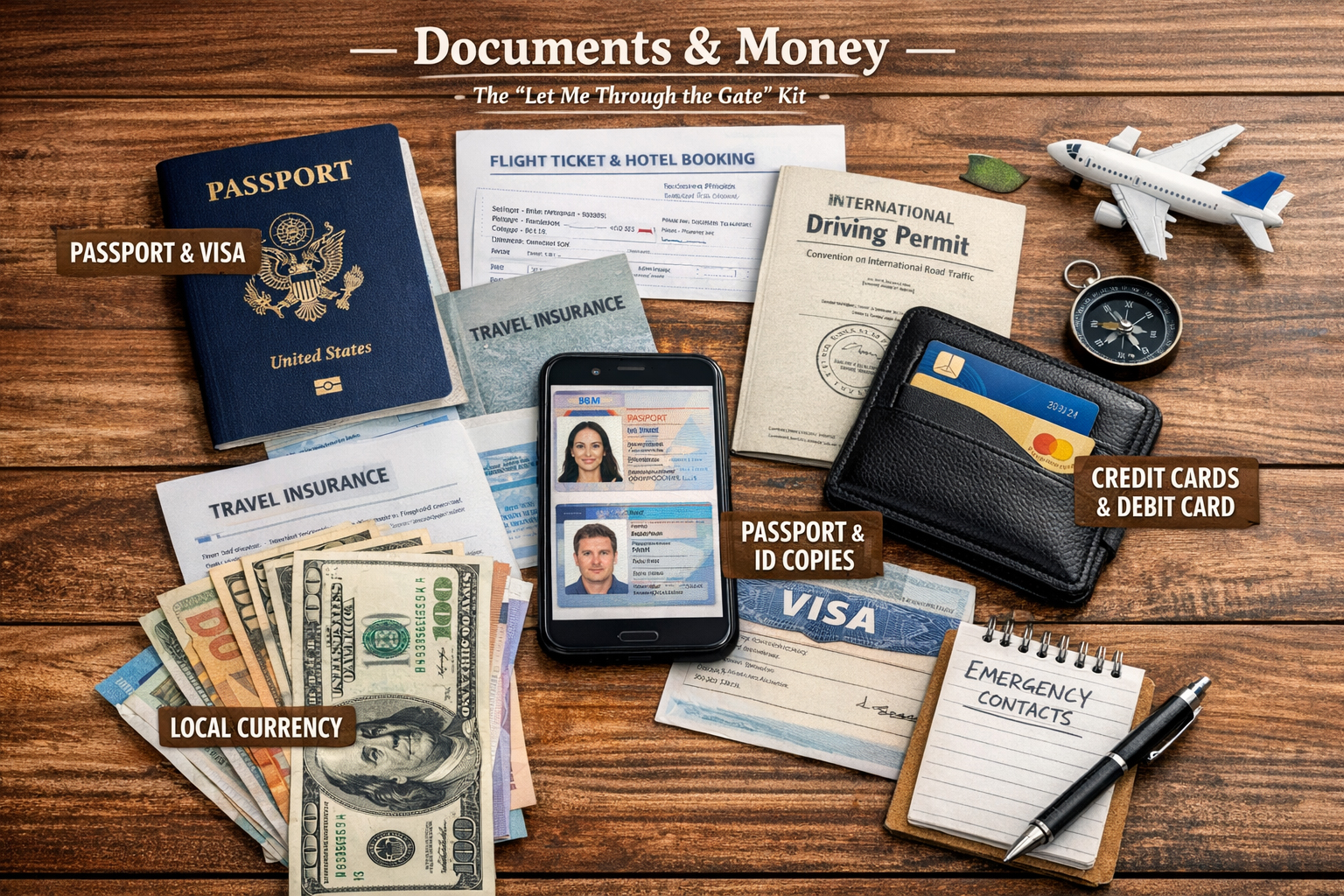
Documents & Money (The “Let Me Through the Gate” Kit)

chatgpt image feb 3, 2026, 01_16_37 pm copy.jpg

  • Passport (valid 6+ months, blank pages)

  • Visa (if required)

  • Photocopies / digital scans (passport, ID, insurance)

  • Travel insurance details

  • Flight, hotel, and tour confirmations

  • Driver’s license / International Driving Permit

  • Credit cards + debit card

  • Local currency (small bills)

  • Emergency contacts


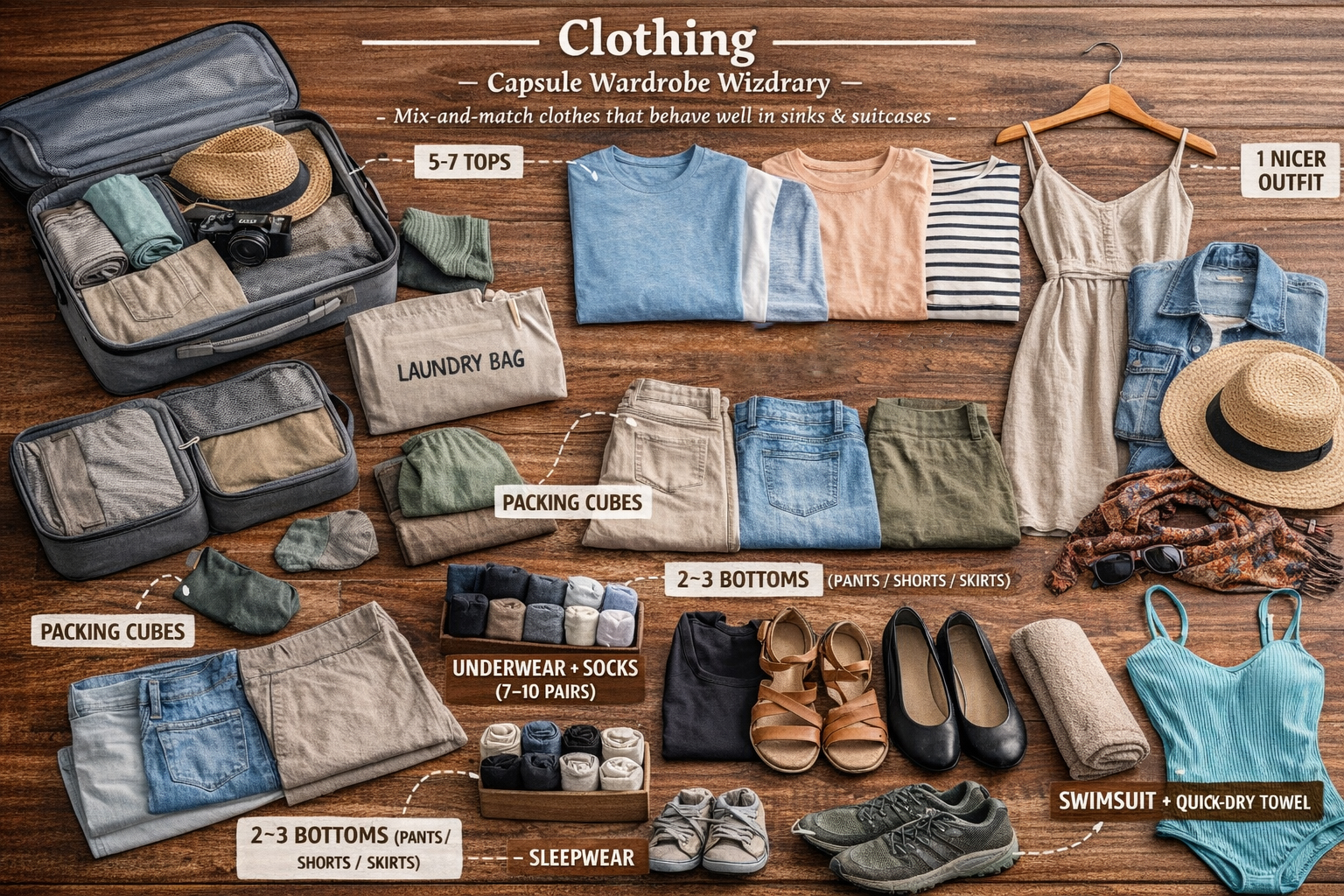
Clothing (Capsule Wardrobe Wizardry)

chatgpt image feb 3, 2026, 01_22_47 pm copy.jpg

Aim for mix-and-match pieces that behave well in sinks and suitcases.

  • 5–7 tops

  • 2–3 bottoms (pants/shorts/skirts)

  • 1 nicer outfit

  • Light jacket / sweater

  • Sleepwear

  • Underwear + socks (7–10 pairs)

  • Comfortable walking shoes

  • Dress shoes / sandals

  • Swimsuit + quick-dry towel

  • Hat / scarf (sun + style + warmth = triple agent)


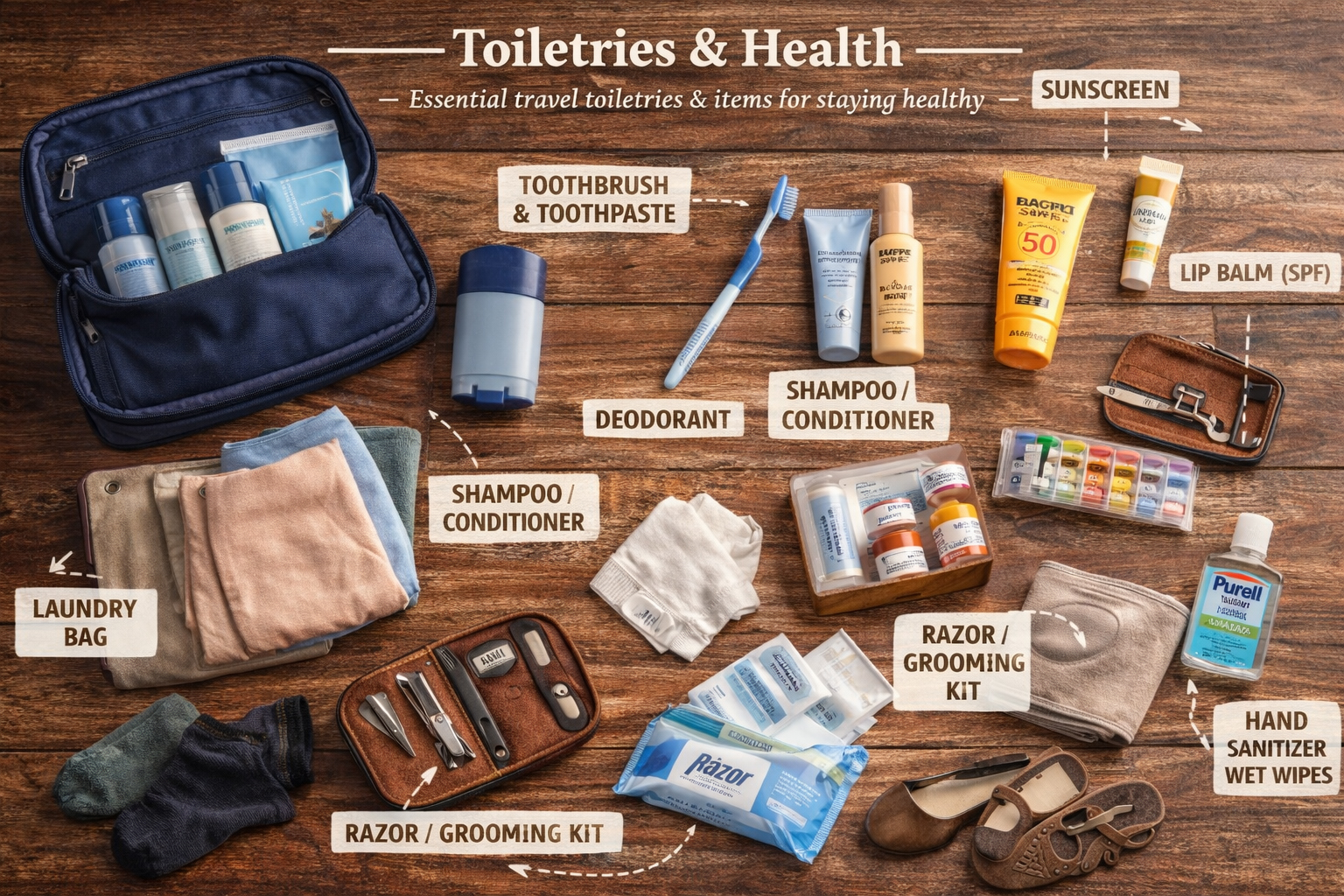
Toiletries & Health

chatgpt image feb 3, 2026, 01_43_56 pm copy.jpg

  • Toothbrush + toothpaste

  • Deodorant

  • Shampoo / conditioner (travel size)

  • Face wash / moisturizer

  • Sunscreen

  • Lip balm (SPF)

  • Razor / grooming kit

  • Medications + prescriptions

  • Small first-aid kit (band-aids, pain reliever, motion sickness tabs)

  • Hand sanitizer / wet wipes


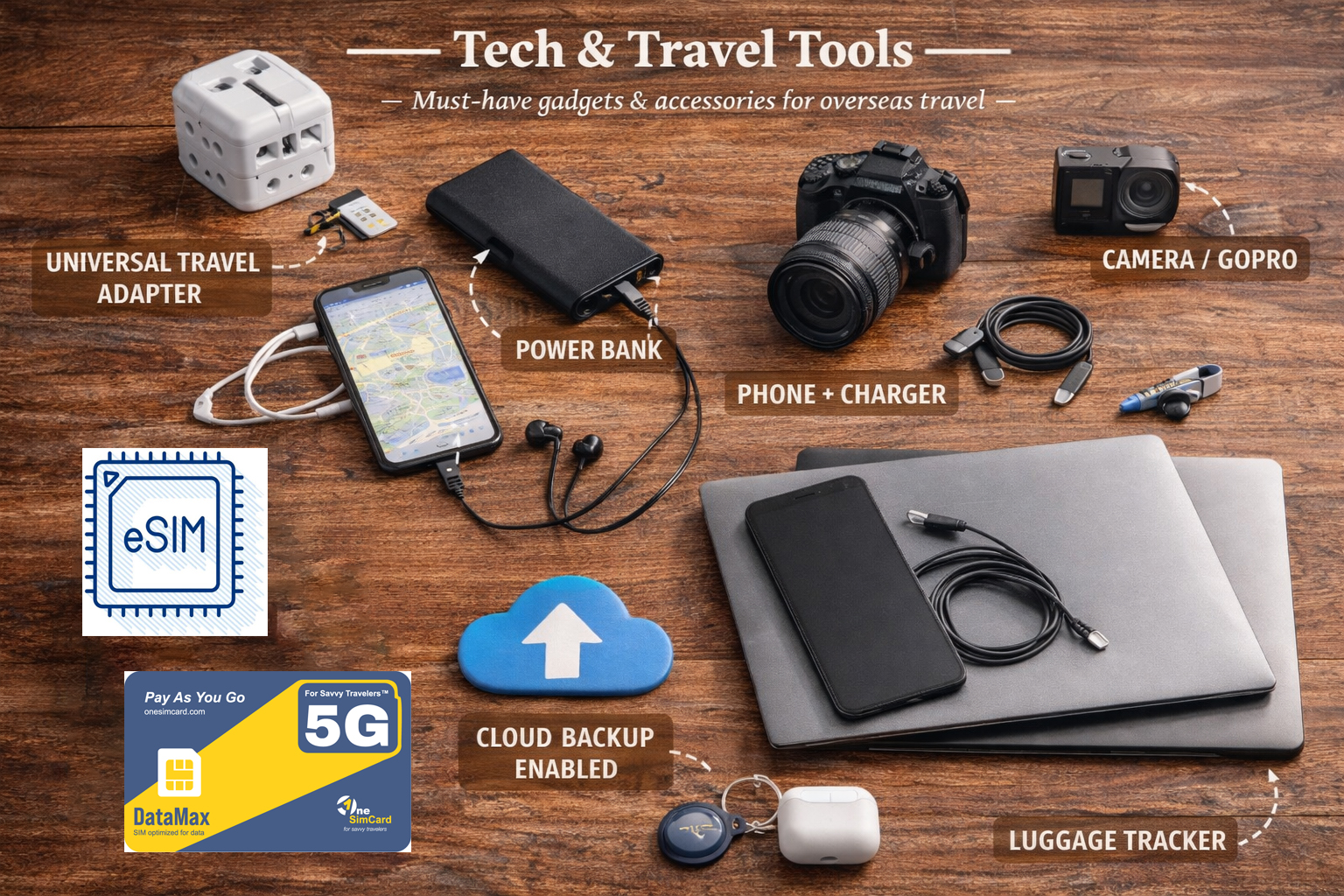
Tech & Travel Tools

chatgpt image feb 3, 2026, 01_48_41 pm copy.jpg

  • Phone + charger

  • Power bank

  • Universal travel adapter

  • Headphones / earbuds

  • Camera / GoPro (if you’re the documenting type)

  • SIM card or international eSIM (so your phone doesn’t become a $300 paperweight)

  • Laptop / tablet + charger (optional)

  • Cloud backup enabled (photos = memories with wings)


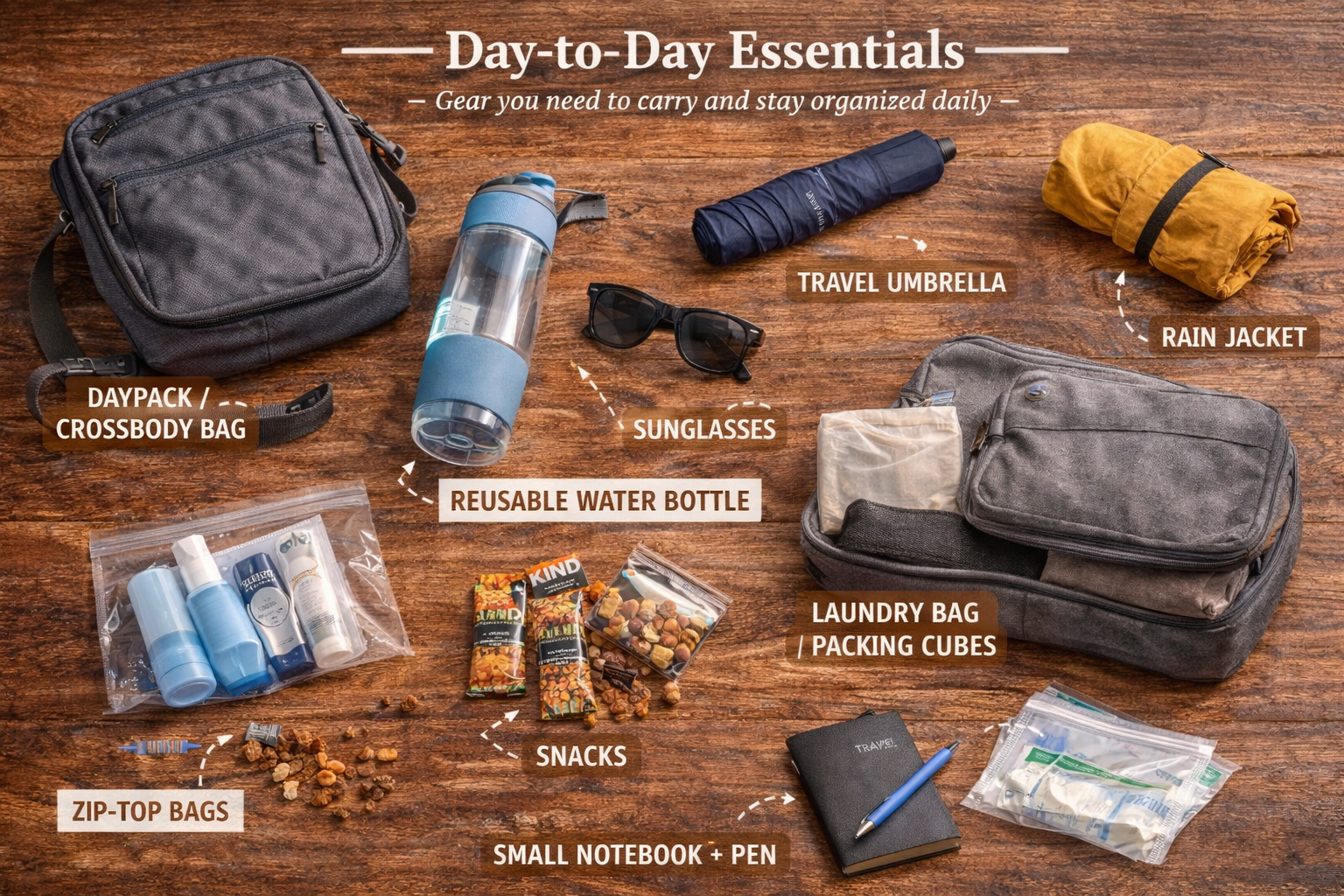
Day-to-Day Essentials

chatgpt image feb 3, 2026, 02_01_52 pm copy.jpg

  • Daypack / crossbody bag

  • Reusable water bottle

  • Sunglasses

  • Travel umbrella / rain jacket

  • Snacks (protein bars save friendships)

  • Laundry bag / packing cubes

  • Small notebook + pen

  • Zip-top bags (liquids, laundry, mystery items)


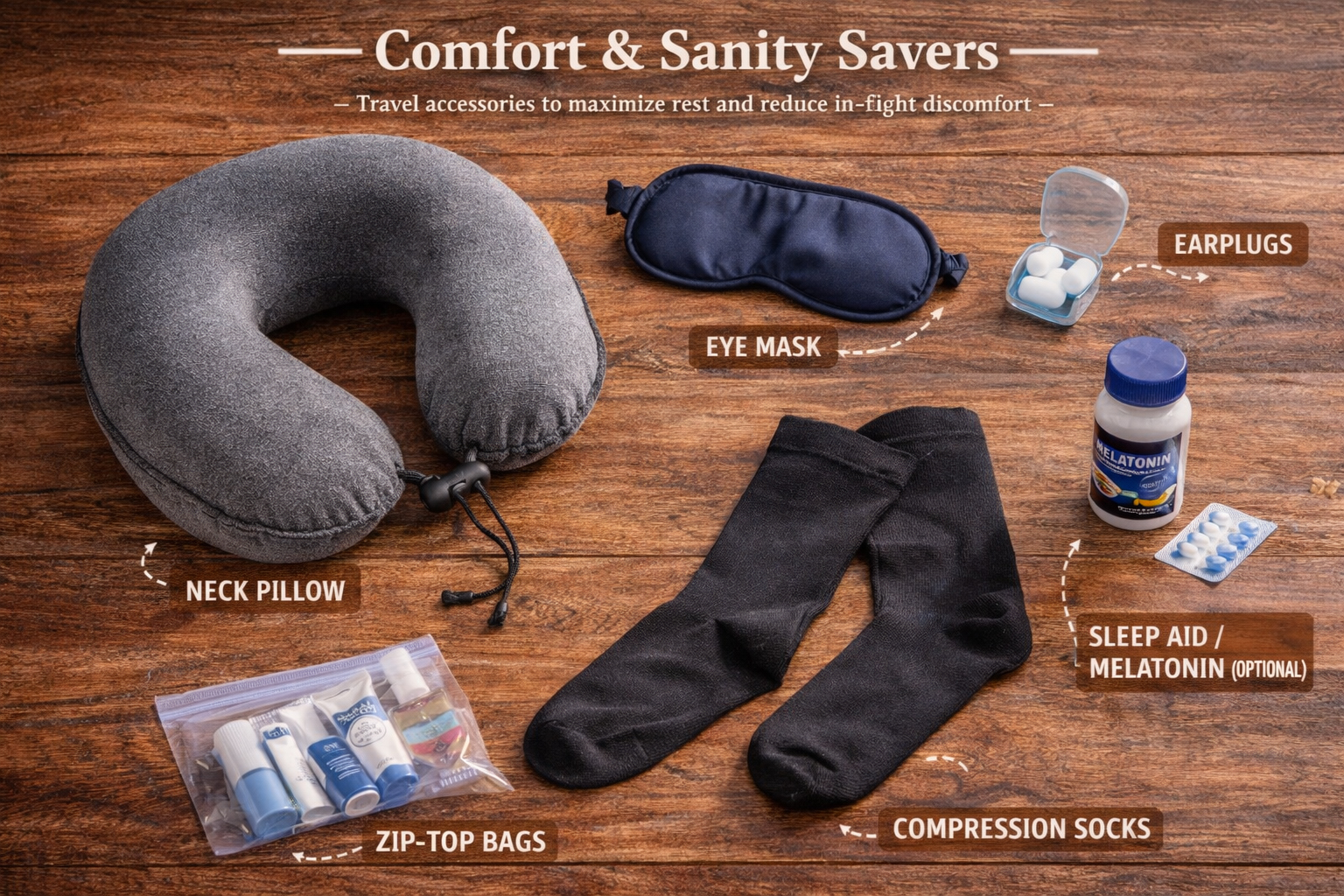
Comfort & Sanity Savers

chatgpt image feb 3, 2026, 02_06_10 pm copy.jpg

  • Neck pillow

  • Eye mask

  • Earplugs

  • Compression socks (long flights = happy legs)

  • Sleep aid / melatonin (optional)


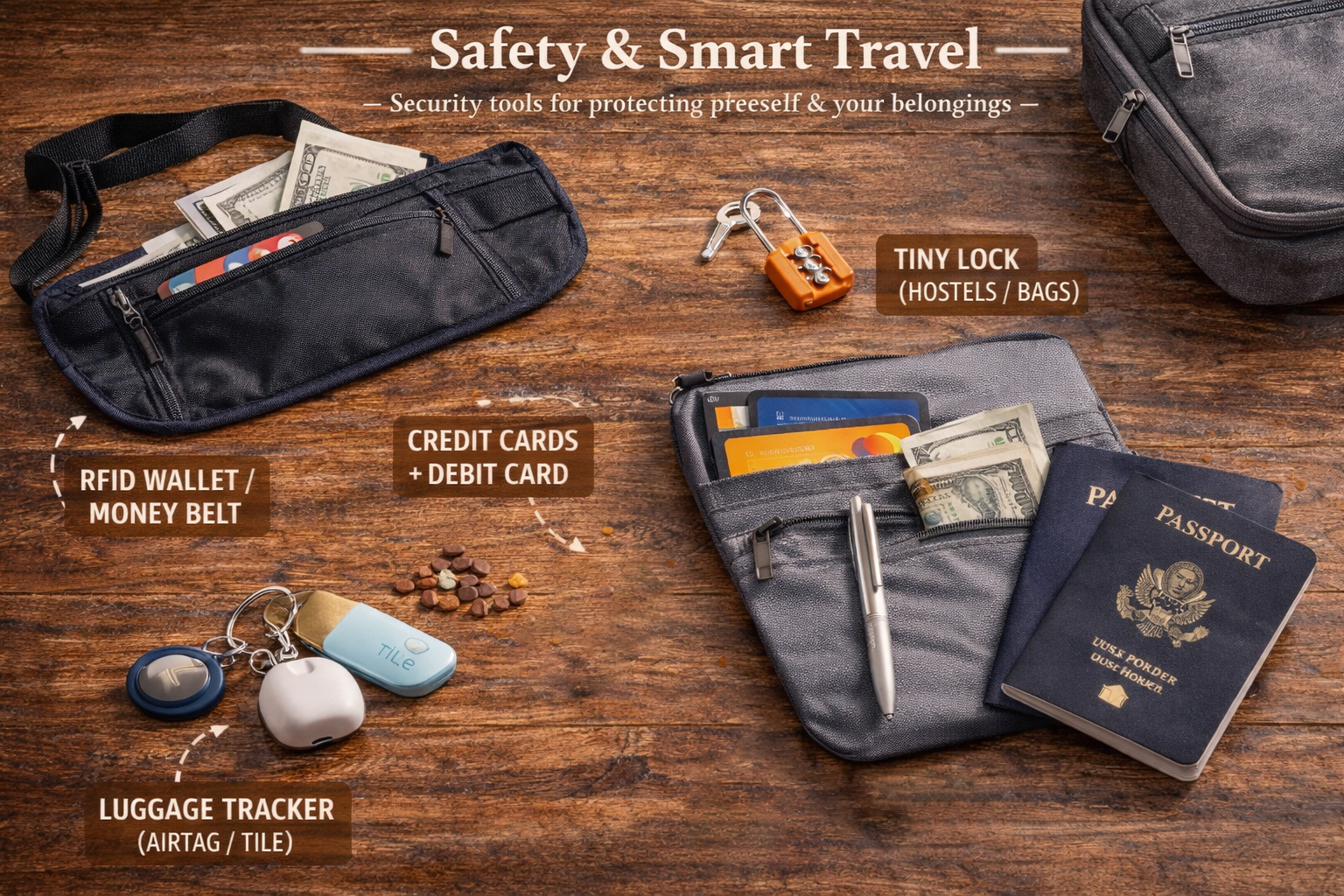
Safety & Smart Travel

chatgpt image feb 3, 2026, 02_10_43 pm copy.jpg

  • RFID wallet or money belt

  • Tiny lock (hostels / bags)

  • Luggage tracker (AirTag / Tile)

  • Hotel door stop (extra peace of mind)


“Don’t Forget These” Checks

  • Notify bank of travel

  • Download offline maps (Google Maps / Maps.me)

  • Download key apps (airline, rideshare, translation, currency converter)

  • Set international roaming or eSIM

  • Check weather forecast for destination

  • Leave itinerary with someone at home


Bonus: The Memory-Making Kit

  • A small gift from home (for hosts/new friends)

  • A flexible mindset

  • One empty space in your bag (for souvenirs and stories)

Whether you are planning a trip to Paris or Paraguay, Berlin or Beijing, OneSimCard has you covered. If it is our traditional plastic SIM or our newer DataMax eSIM, we have been helping travelers like you stay connected for over 30 years, and we would love the opportunity to keep you connected on your next journey!

Don’t have an eSIM yet?

We make it simple to get our latest eSIM optimized for data connectivity. Our DataMax eSIM is available for download (first time download is free with the purchase of a data plan) with our eSIM app available for iOS and Android devices:

android_app_on_play_large 2.png
available_on_appstore-2.png

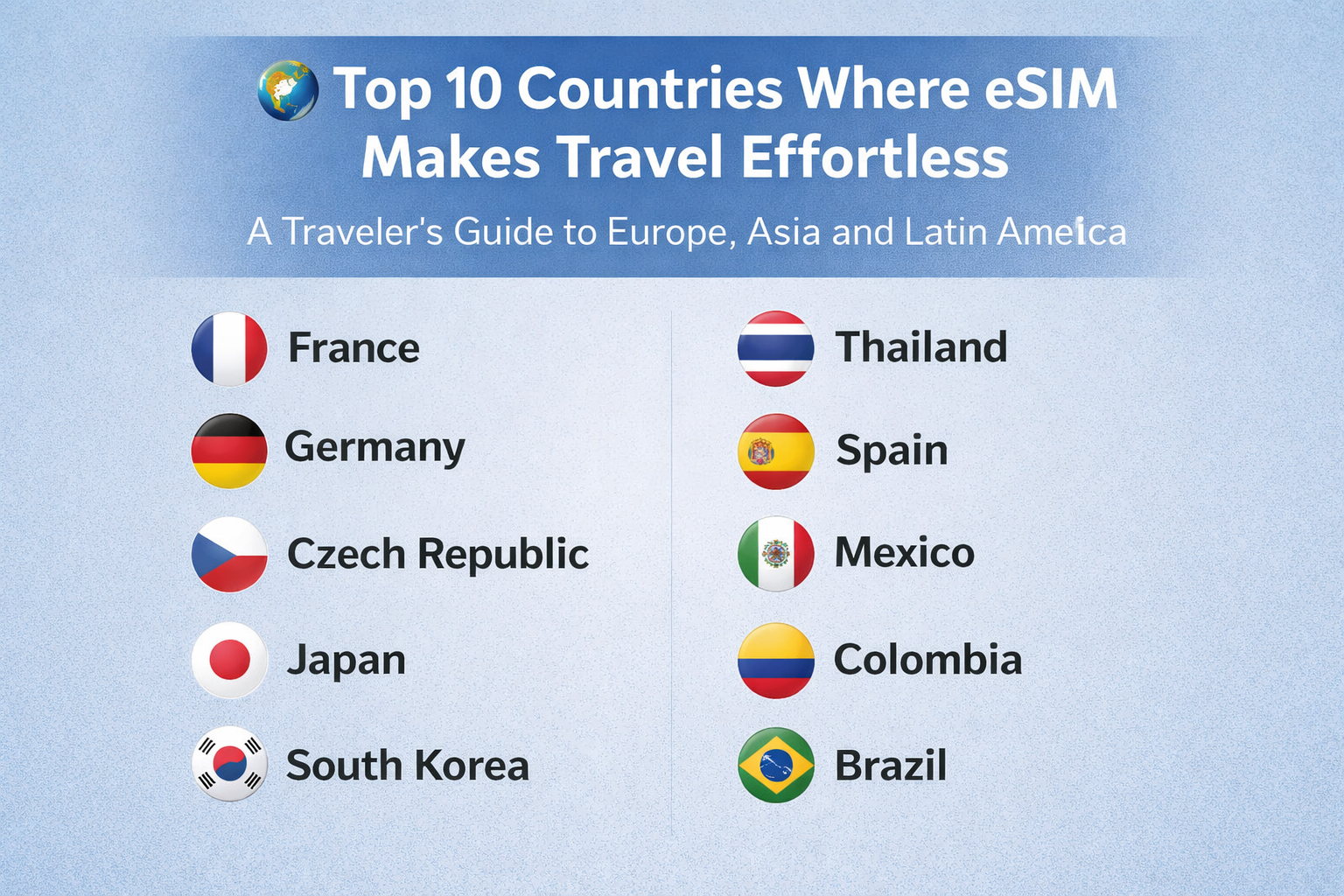
Top 10 Countries Where eSIM Makes Travel Effortless

eSIM Countries

A traveler’s guide to Europe, Asia, and Latin America

International travel used to come with a familiar ritual: land, scramble for Wi-Fi, hunt for a SIM kiosk, and hope the tiny plastic card doesn’t vanish into the airport carpet.
Today, a travel eSIM turns that whole routine into a quiet little magic trick: you activate digitally, connect instantly, and keep moving.

Not every destination feels equally “effortless,” though. The smoothest eSIM experiences tend to happen in countries with strong mobile infrastructure, multiple carrier partners, reliable 4G/5G coverage, and travel-friendly connectivity.
Below are 10 countries where eSIM travel feels particularly friction-free, with a focus on Europe, Asia, and Latin America.

Tip: For the smoothest start, install your eSIM before you fly (on Wi-Fi), then enable Data Roaming on the eSIM line when you arrive.

France flag1. France

Why it’s eSIM-friendly: Excellent nationwide coverage, fast LTE and 5G in major areas, and a travel-ready network environment.

France is the kind of destination where eSIM travel feels almost invisible. You can step off the plane in Paris, disable airplane mode, and immediately pull up transit routes,
reserve museum tickets, message your hotel, and navigate the city without bargaining with a SIM vendor. Connectivity stays reliable beyond the capital too, which is a big win
for travelers heading to the Loire Valley, Normandy, or the lavender-scented lanes of Provence.

Best for: City breaks, food-and-culture itineraries, rail travel.

Germany flag2. Germany

Why it’s eSIM-friendly: Strong infrastructure, multiple carrier options, and excellent connectivity along major transit routes.

Germany is built for movement: ICE trains, efficient city transit, and road trips that turn into spontaneous detours. A travel eSIM shines here because you can stay connected
through big hubs like Berlin, Munich, and Frankfurt while also keeping dependable data for navigation in smaller towns. If you’re crossing borders into Austria, the Czech Republic,
or beyond, eSIM convenience compounds fast: fewer plan changes, fewer “why isn’t this working” moments.

Best for: Multi-country trips, business travel, train-heavy itineraries.

Czech Republic flag3. Czech Republic

Why it’s eSIM-friendly: Excellent coverage in tourist areas, strong urban speeds, and easy connectivity for short stays.

The Czech Republic is compact, traveler-friendly, and wonderfully walkable, which makes it a perfect match for eSIM convenience. In Prague, you’ll likely use data constantly:
tram schedules, restaurant reservations, translation, tickets, and maps for wandering Old Town and beyond. With an eSIM, your phone stays reliably connected without requiring any
SIM swapping, even if your trip includes day trips or onward train travel into neighboring countries.

Best for: Weekend escapes, cultural tourism, rail routes from Western Europe into Central Europe.

Japan flag4. Japan

Why it’s eSIM-friendly: Advanced mobile networks, dense coverage, and eSIM convenience that avoids the “SIM counter puzzle” for visitors.

Japan is a dream for connected travel: precise transit, cashless options, and helpful apps for everything. It’s also a place where visitors often want data immediately to navigate
stations, translate menus, and coordinate reservations. A travel eSIM is ideal because you can install before departure and land with a working connection, no airport line required.
Whether you’re riding the Shinkansen, exploring Tokyo neighborhoods, or mapping out Kyoto temples, eSIM connectivity keeps the trip flowing.

Best for: First-time Asia travelers, solo travel, city exploration.

South Korea flag5. South Korea

Why it’s eSIM-friendly: Fast data speeds, strong coverage, and a tech-forward travel experience that depends on mobile connectivity.

South Korea makes “always connected” feel normal. Travelers use mobile data for navigation, translation, food delivery, ride-hailing, and on-the-fly planning. With a travel eSIM,
you can keep your trip moving smoothly from Seoul’s neighborhoods to coastal escapes like Busan. If you create content, you’ll appreciate the stability for uploads and messaging.
If you’re traveling for business, you’ll appreciate the reliability for calls and meetings.

Best for: Tech-forward travel, remote work, content creators.

Thailand flag6. Thailand

Why it’s eSIM-friendly: Strong networks in tourist corridors, reliable data in major cities, and a travel style that benefits from instant activation.

Thailand is a favorite for a reason: it’s welcoming, vibrant, and surprisingly connected. Whether you’re navigating Bangkok, booking ferries to islands, or working from Chiang Mai,
data is the backbone of a smooth trip. A travel eSIM helps you skip the airport SIM shuffle and keeps you connected as you hop between regions. It’s also perfect for travelers who
rely heavily on maps and messaging while moving day-to-day.

Best for: Backpackers, island hoppers, digital nomads.

Spain flag7. Spain

Why it’s eSIM-friendly: Strong 4G/5G coverage in major destinations, excellent transit connectivity, and effortless multi-city travel.

Spain is built for roaming the fun way: Barcelona to Madrid, Seville to Valencia, then maybe a last-minute coastal detour. With an eSIM, you don’t have to think about connectivity
every time you move cities. You can keep your maps and bookings live, share travel updates, and coordinate plans without hunting for local SIM solutions. If your trip extends across
borders (Portugal, France), an eSIM keeps the “same phone, same flow” experience going.

Best for: Multi-city vacations, festival travel, train routes.

Mexico flag8. Mexico

Why it’s eSIM-friendly: Strong coverage in cities and popular destinations, great value for travelers, and easy setup without in-person SIM purchases.

Mexico is one of the best Latin American countries for eSIM travel because it combines huge traveler demand with practical connectivity. In Mexico City, mobile data is essential for
navigation, ride-hailing, and restaurant planning. In beach regions like Cancún or Playa del Carmen, travelers often bounce between Wi-Fi and mobile data, making flexible eSIM access
especially handy. An eSIM is also useful for road trips where you want dependable navigation without depending on spotty public Wi-Fi.

Best for: Beach vacations, city breaks, road trips.

Colombia flag9. Colombia

Why it’s eSIM-friendly: Improving networks, excellent connectivity in major cities, and a growing digital-nomad scene.

Colombia has become a hotspot for travelers who want culture, scenery, and great long-stay value. In cities like Medellín and Bogotá, reliable data makes daily travel easier:
maps, messaging, translations, and work calls. A travel eSIM removes the need to navigate local SIM rules and keeps connectivity consistent as you explore different neighborhoods
or move between destinations.

Best for: Remote workers, city explorers, longer stays.

Brazil flag10. Brazil

Why it’s eSIM-friendly: Strong carrier competition in major cities and a travel style that benefits from consistent connectivity across large distances.

Brazil is big, bold, and sprawling, which makes SIM swapping especially annoying if your itinerary includes multiple cities. With an eSIM, you can move between major hubs like
São Paulo and Rio while keeping your navigation, plans, and communication stable. For travelers coordinating tours, transportation, or group plans, reliable data is the difference
between smooth logistics and frantic WhatsApp scrambling.

Best for: Multi-city trips, long-distance travel, business + leisure itineraries.

Why eSIMs Make Travel Effortless in These Countries

Across Europe, Asia, and Latin America, these destinations share a few important traits that make eSIM travel feel frictionless:

  • Strong mobile infrastructure with reliable 4G/5G service in key travel zones
  • Multiple carrier partners, giving your eSIM more options to connect
  • Travel-ready coverage across transit routes, city centers, and popular tourist regions
  • Easy cross-border movement (especially in Europe) where eSIMs avoid SIM swapping hassles

Why OneSimCard Is a Great Fit for Multi-Country Trips

If your itinerary includes more than one country, the convenience of an eSIM multiplies quickly. OneSimCard is designed for travelers who want dependable connectivity without the
usual logistics headache:

  • Coverage in 200+ destinations
  • One eSIM for multi-country travel (no swapping tiny plastic cards)
  • No contracts or subscriptions
  • Free incoming SMS
  • Optional voice calling with the OneSimVoIP app
  • Multi-network access to help maintain a strong connection on the move

✈️ Final Thoughts

The best trips are the ones where your phone quietly does its job in the background: maps load, tickets appear, translations work, messages go through, and you never have to
think about SIM trays or roaming surprises. In the 10 countries above, a travel eSIM is one of the simplest upgrades you can make for smoother travel.

Ready to stay connected effortlessly?

Activate your OneSimCard eSIM
and enjoy reliable data across borders with less hassle.