

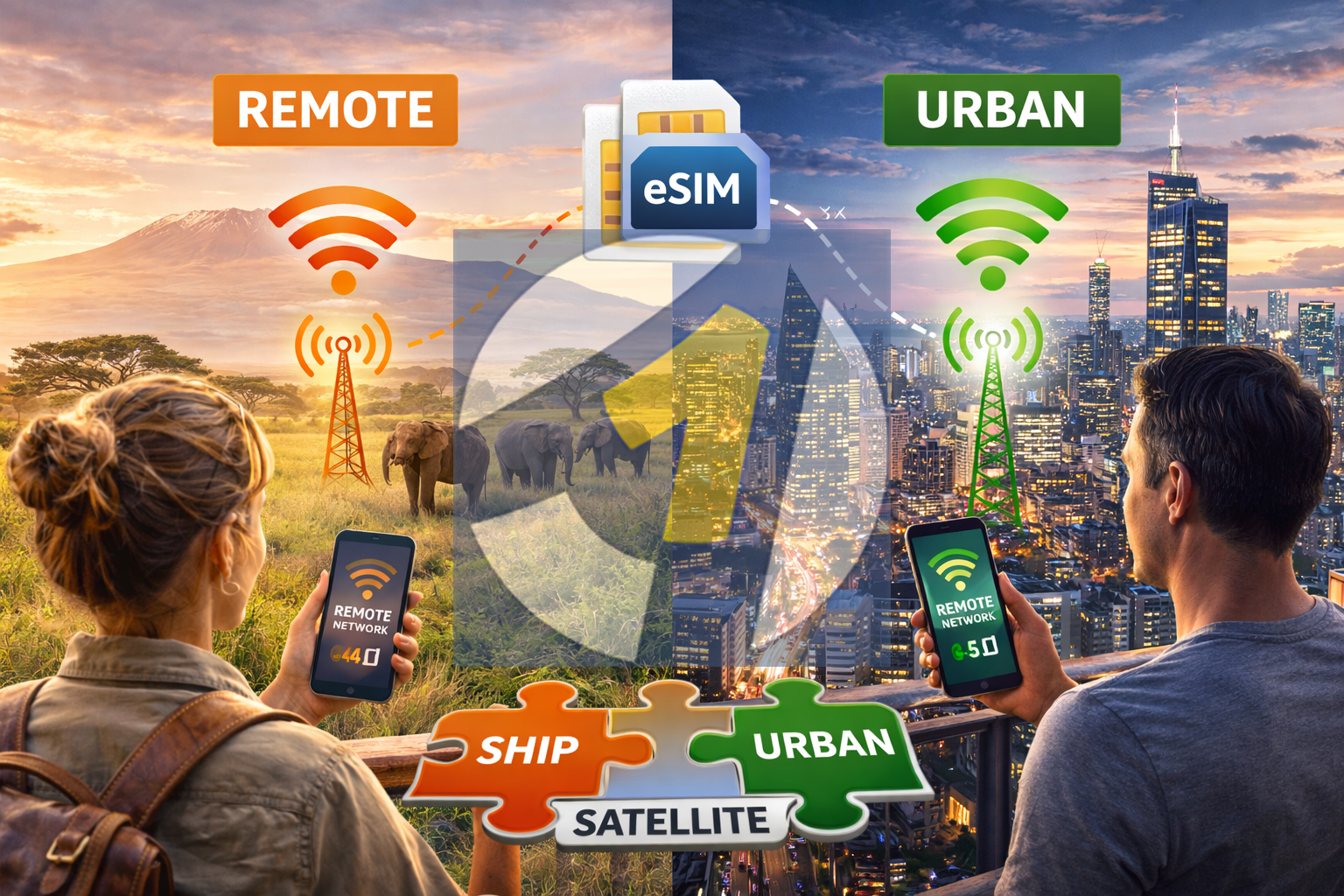
A wild vs. wired comparison journey
Travel has always been about contrast. One day you’re watching elephants cross a dusty African plain, the next you’re navigating a subway beneath glass towers and neon lights. Modern travelers move between worlds that couldn’t look more different, yet one tool now follows them everywhere: their smartphone.
Whether you’re posting photos from a safari lodge or navigating the streets of Tokyo, connectivity plays a critical role in the travel experience. And with the rise of eSIM technology, staying connected across wildly different environments has become easier than ever.
But how do eSIMs actually perform in these extremes? Does the same digital SIM that works in a dense city also work in remote wilderness?
Let’s explore the difference between wild landscapes and wired cities, and how eSIM connectivity adapts across both.
The Urban Jungle: Connectivity in Skyscraper Cities
Cities are the natural habitat of mobile networks.
Urban areas have dense infrastructure: cellular towers on rooftops, small cells on streetlights, fiber lines running beneath sidewalks. Carriers compete heavily in metropolitan markets, meaning faster speeds and wider coverage.
In places like New York, London, Seoul, or Singapore, smartphones rarely struggle to find a signal.
When using an eSIM in a major city, travelers often experience:
-
Strong multi-network coverage
-
Fast 4G and 5G speeds
-
Reliable indoor connectivity
-
High data capacity for streaming and uploads
Because many travel eSIMs partner with multiple local carriers, your phone can often connect to the strongest available network automatically. Instead of being locked to one provider, your device essentially “network hops” to maintain the best signal.
For digital nomads, influencers, and business travelers, this means the urban environment is where eSIMs truly shine.
Uploading photos from a rooftop bar? Instant.
Joining a video call from a café? No problem.
Streaming a live city tour for followers? Smooth and stable.
In cities, connectivity becomes so seamless that most travelers forget about it entirely. And that’s exactly the point.
The Wilderness Test: Connectivity on Safari
Now imagine a very different scene.
You’re in the Serengeti. The sun is rising over open savannah. A lion yawns in the distance. There are no skyscrapers, no subway stations, and certainly no fiber-optic cables running through the grasslands.
This is where connectivity shifts from infrastructure-driven to coverage-driven.
Remote destinations rely on fewer cellular towers spread across larger geographic areas. These towers often serve highways, villages, and tourism hubs rather than every square mile of terrain.
So how does an eSIM perform here?
Surprisingly well in many cases.
Because travel eSIM providers partner with major national carriers, your device can still connect to the same networks that serve local communities and lodges.
While speeds may be lower than in cities, travelers often still have enough connectivity for essential tasks:
-
Sending messages
-
Checking maps
-
Uploading photos
-
Accessing translation apps
-
Confirming bookings
In other words, even deep in the wild, a connection often exists. It’s simply a quieter, slower version of the urban experience.
Signal Strength: Dense Towers vs. Distant Towers
One of the biggest differences between urban and remote connectivity is tower density.
Cities may have hundreds of cellular sites packed into a few square miles. Rural areas may rely on towers that cover dozens of miles.
This affects two key factors:
Speed
Urban networks handle massive traffic with high-speed fiber backhaul. Remote networks may rely on microwave links or slower infrastructure.
Capacity
Cities support thousands of simultaneous connections. In remote areas, fewer users share the network, which sometimes offsets the infrastructure limitations.
Ironically, a safari lodge with only a handful of guests may experience stable speeds simply because there aren’t many devices competing for bandwidth.
Network Switching: A Hidden Advantage of eSIMs
One of the biggest benefits of travel eSIM technology is multi-network access.
Traditional SIM cards often lock you into one carrier. If that network has weak coverage in a certain area, your signal may drop entirely.
Many global eSIM platforms allow your phone to switch between partner networks automatically.
Imagine driving across a national park:
-
One carrier covers the highway well
-
Another carrier covers nearby villages
-
Your eSIM device switches seamlessly between them
This flexibility dramatically improves reliability when traveling through regions with uneven coverage.
For adventurers moving between cities and wilderness, this feature becomes invaluable.
Real Travel Scenario: Safari to City
Consider a traveler moving between two dramatically different environments.
Day 1–3: Safari Camp in Kenya
Connectivity is available but limited.
You wake before dawn and photograph elephants crossing a river. Back at the lodge, you upload a few photos and send messages home. The connection isn’t lightning fast, but it works reliably enough to stay in touch.
Maps still load. Messages still send.
The wilderness feels remote, but you’re never truly disconnected.
Day 4–7: Nairobi
Suddenly the digital world accelerates.
4G and 5G signals appear. Upload speeds jump dramatically. Video calls become effortless. You share safari footage, post reels, and download travel guides for the next destination.
The same eSIM profile that connected in the wild now taps into the city’s powerful network infrastructure.
No SIM swap required.
Just a stronger signal.
Power Consumption: Another Remote Factor
In remote areas, phones sometimes use more battery power because they work harder to maintain a connection with distant towers.
Your device may boost transmission power when signals are weak, which drains the battery faster.
Travelers visiting remote destinations often benefit from:
-
Portable power banks
-
Offline maps downloaded in advance
-
Data-saving settings for large uploads
But even with these adjustments, eSIM connectivity remains a valuable safety and navigation tool in remote areas.
The Role of Satellite in Extreme Locations
Some wilderness destinations go beyond cellular coverage entirely.
Deep deserts, open oceans, and polar regions may rely on satellite communication rather than traditional mobile networks.
In these rare cases, eSIMs cannot replace satellite connectivity. However, they still provide seamless coverage for the majority of travel routes leading to and from those remote areas.
Once you return within range of terrestrial networks, your eSIM reconnects automatically.
Why eSIMs Fit Modern Travel
The real strength of eSIM technology isn’t just speed or coverage.
It’s continuity.
Travelers today move constantly between environments:
-
Airports
-
Cities
-
National parks
-
Remote islands
-
Coastal villages
Each environment has its own connectivity profile. Traditional SIM cards struggle to adapt to that variety without manual switching.
eSIMs solve the problem digitally.
One installation. Multiple networks. Continuous connectivity across landscapes.
Wild vs. Wired: The Final Verdict
So how do eSIMs perform across extreme travel environments?
The answer is surprisingly consistent.
In cities, they deliver fast, high-capacity connectivity that rivals local plans. In remote regions, they connect to the same national networks that support local communities and tourism infrastructure.
The experience changes, but the connection remains.
That’s the real magic.
From safari plains to skyline views, your phone adapts to the environment just as travelers do.
Because modern exploration no longer requires choosing between adventure and connectivity.
With the right technology in your pocket, you can experience both worlds at once.
One moment you’re tracking wildlife across open savannah.
The next you’re uploading that moment from a café beneath the tallest buildings in the city.
From safari to skyscrapers, the signal travels with you.