
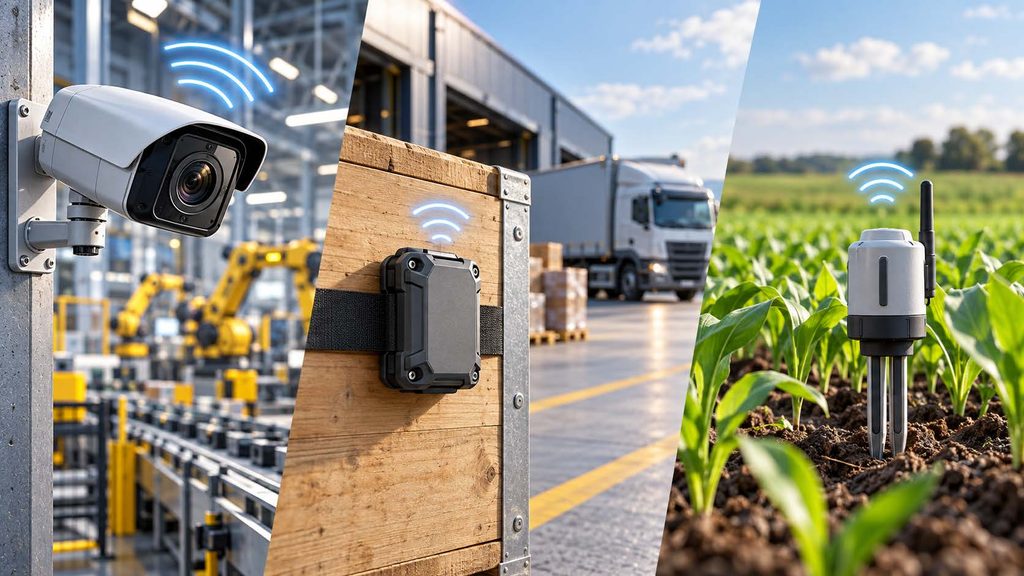
Not every IoT device/solution needs fast connectivity. In fact, most don’t. A soil-moisture sensor that sends a few bytes twice a day and a 4K security camera streaming around the clock live at opposite ends of the connectivity spectrum—and pairing either one with the wrong cellular technology means wasted battery, wasted money, or a device that simply can’t do its job.
Cellular IoT gives you three main options, each engineered for a different kind of device: 5G, LTE-M, and NB-IoT. Choosing well comes down to matching four things—data throughput, power consumption, latency, and mobility—to what your device actually does. Here’s how the three compare, and how to pick.
The Three Technologies at a Glance
5G is the high-performance tier: massive bandwidth, lower latency, and support for huge numbers of connected devices in dense areas. It’s built for data-hungry, real-time applications.
LTE-M (LTE Cat-M1) is a low-power wide-area (LPWA) technology tuned for IoT. It offers modest data speeds, solid coverage, good battery life, and—importantly—the ability to handle mobility. It’s the versatile middle ground.
NB-IoT (Narrowband IoT) is the ultra-low-power, ultra-low-bandwidth specialist. It sends small amounts of data infrequently, reaches deep indoors and underground, and can run for years on a single battery. It trades speed and mobility for reach and endurance.
Think of them as a spectrum: NB-IoT for tiny, patient, stationary sensors; LTE-M for mobile, responsive, moderate-data devices; and 5G for everything that needs real speed.
Factor 1: Data Throughput
Start with how much data your device moves.
If your device streams video, transfers large files, or pushes rich real-time telemetry, you need 5G (or at minimum LTE). Nothing in the LPWA tier can carry that load.
If your device sends moderate data—periodic images, firmware updates, or sensor batches —LTE-M is a strong fit. Its speeds (typically up to a few hundred kbps to low single-digit Mbps depending on category and network) cover a wide range of practical IoT jobs.
If your device sends tiny, infrequent messages—a meter reading, a status ping, a fill level—NB-IoT is purpose-built for it. Throughput is measured in tens of kbps, which is plenty for a payload the size of a text message, and inadequate for almost anything larger.
Rule of thumb: don’t overbuy bandwidth. A sensor that sends 50 bytes a day gains nothing from 5G and pays for it in cost and power.
Factor 2: Power Consumption and Battery Life
For battery-powered devices, power draw often decides everything.
NB-IoT is the endurance champion. Its power-saving features (PSM and eDRX) let a device sleep deeply between transmissions, stretching a single battery to 10 years or more in the right application. For devices installed somewhere you’ll rarely, if ever, revisit—buried water meters, remote environmental sensors—this is transformative.
LTE-M also supports the same power-saving modes and delivers excellent battery life, though its higher capability generally means somewhat more consumption than NB-IoT. For a mobile or moderate-data device that still needs to last years, it’s the sweet spot.
5G is the most power-hungry of the three by a wide margin. It’s designed for devices with reliable power or frequent charging—vehicles, gateways, cameras, industrial equipment—not for something meant to sip a coin cell for a decade.
Factor 3: Latency and Real-Time Response
How fast does your device need to react?
5G delivers ultra-low latency, which is essential for anything where split-second response matters: autonomous systems, remote control of machinery, real-time video analytics, or safety-critical automation.
LTE-M offers low-to-moderate latency—good enough for most interactive and near-real-time applications, like fleet telematics, alarms, or asset tracking that needs timely updates.
NB-IoT has higher latency and isn’t designed for real-time interaction at all. It’s built for “send data when there’s data to send,” where a delay of seconds—or intentionally much longer—is perfectly acceptable.
Factor 4: Mobility and Coverage
Where your device lives, and whether it moves, is the last major consideration.
Mobility: LTE-M handles movement well, maintaining connections as a device travels between cell towers—ideal for vehicles, wearables, and tracked assets. NB-IoT, by contrast, is optimized for stationary devices and handles handover between towers poorly, so it’s a weak choice for anything that moves. 5G supports mobility fully.
Deep coverage: NB-IoT’s narrowband signal penetrates exceptionally well into basements, tunnels, and dense buildings—places where other technologies struggle. If your device sits deep inside a structure or underground, NB-IoT’s reach is a genuine advantage.
Availability: 5G coverage continues to expand but isn’t universal, especially outside urban areas. LTE-M and NB-IoT availability varies by region and carrier. This is where a multi-network provider matters: coverage for any of these technologies depends heavily on which networks your SIM can actually reach.
A Simple Way to Decide
Match your device to the profile that fits:
- Choose NB-IoT for stationary, battery-powered devices sending small amounts of data infrequently, especially in hard-to-reach indoor or underground locations. Think utility meters, environmental sensors, and smart-city infrastructure.
- Choose LTE-M for mobile or moderate-data devices that need good battery life, timely response, or voice—like asset trackers, fleet telematics, wearables, and alarm panels. It’s the most versatile all-rounder.
- Choose 5G for high-bandwidth, low-latency, powered applications: video, gateways, connected vehicles, robotics, and real-time industrial automation.
One more consideration for long-lived deployments: the older 2G and 3G networks that many legacy IoT devices relied on are being switched off worldwide. If you’re designing hardware today, building on LTE-M, NB-IoT, or 5G future-proofs it against those sunsets. Although, it should be noted that the future of NB-IoT may be dubious. Recently, we have seen major networks like AT&T end support for NB-IoT. This may be a step towards a new standard called 5G RedCap (Reduced Capacity).
Getting the Connectivity Right
The best connectivity choice isn’t the fastest or the newest—it’s the one that matches your device’s real workload. Overbuild and you waste battery and budget; underbuild and your device can’t perform. Weigh throughput, power, latency, and mobility against what your device genuinely needs, and the right technology stands out.
At OneSimCard IoT, IoT SIMs run across multiple networks and support LTE-M, NB-IoT, and broader 2G/3G, 4G LTE/5G connectivity, so you can deploy the right technology for each device and reach the widest possible coverage from a single platform. Start with what your device does—then let that decide the network.