
Travel Influencers’ Secret Weapon: Why eSIMs Beat Pocket Wi-Fi

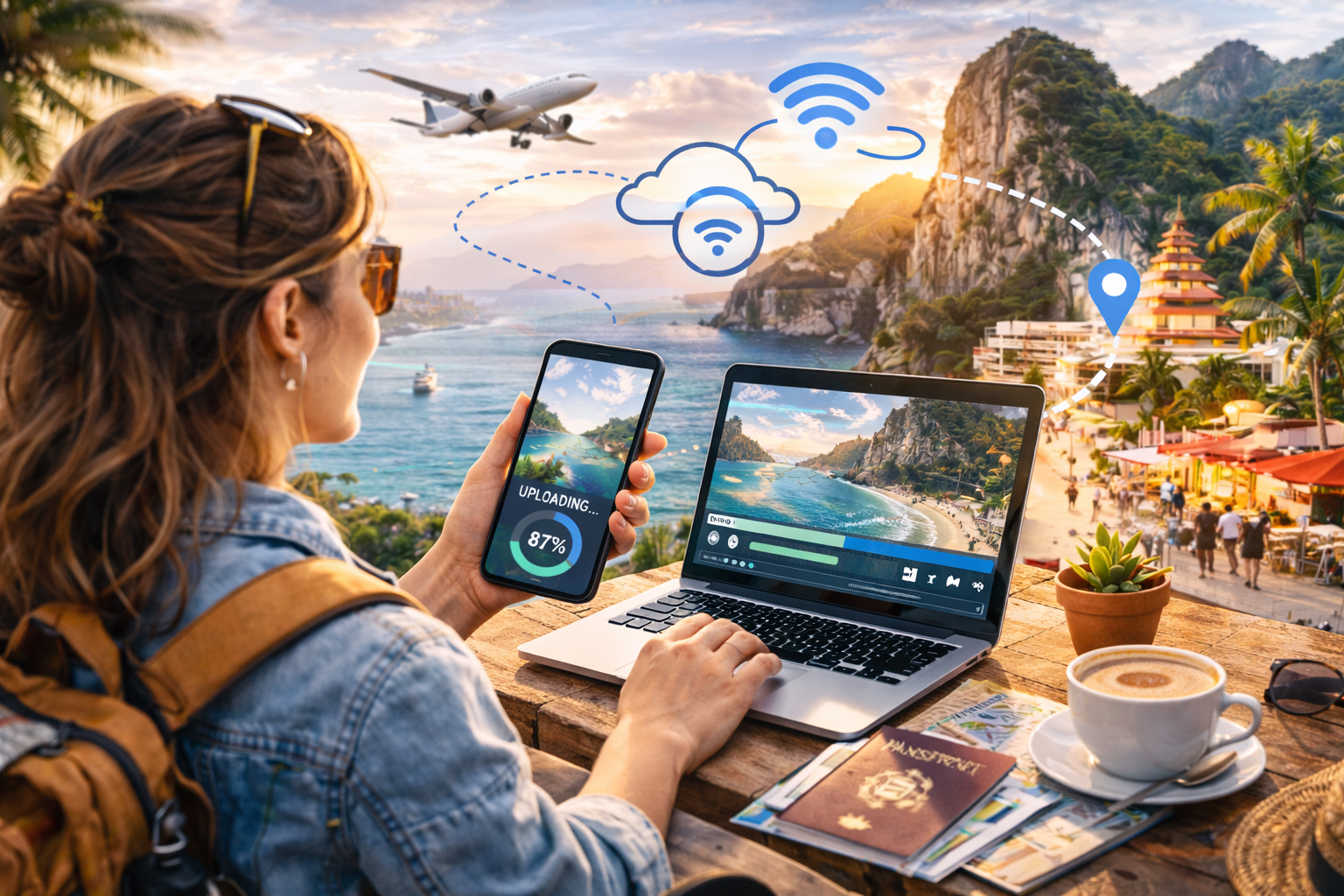
Travel influencer working in a tropical location with her eSIM enabled smartphone connecting her other devices.

How creators stay connected, upload faster, and travel lighter with modern mobile connectivity

Scroll through any travel influencer’s feed and it looks effortless. Sunset reels posted in real time. Drone shots uploaded from mountain viewpoints. Stories shared from trains, taxis, beaches, and bustling city streets.

What you don’t see is the invisible infrastructure behind it all.

Content creation on the road depends on one critical resource: reliable internet. Without it, uploads stall, collaborations lag, and opportunities disappear faster than a golden-hour sunset.

For years, pocket Wi-Fi devices were the go-to solution for international creators. But quietly, a shift has happened. Increasingly, travel influencers are leaving pocket routers behind and switching to travel eSIMs.

Here’s why the smartest creators now consider eSIMs their real travel essential.


The Old Standard: Pocket Wi-Fi Explained

Pocket Wi-Fi devices rose to popularity because they solved a major problem. Instead of paying expensive roaming fees, travelers could rent a small mobile hotspot that connected multiple devices to local cellular networks.

The concept was simple:

  • Carry a small router

  • Turn it on

  • Connect phones and laptops via Wi-Fi

For early digital nomads and creators, it felt revolutionary.

But over time, the downsides started to show, especially for influencers constantly on the move.


Problem #1: One More Thing to Carry

Travel influencers already travel with a surprising amount of gear:

  • Cameras

  • Lenses

  • Drones

  • Microphones

  • Tripods

  • Power banks

  • Laptops

Adding a pocket Wi-Fi device means adding another object that must be charged, packed, tracked, and protected.

An eSIM removes the device entirely.

Your phone becomes the connection.

No extra hardware. No rental pickup. No return shipping. No bulky charger tangled in your bag.

For creators who value mobility, removing friction matters more than adding gadgets.


Problem #2: Battery Anxiety

Pocket Wi-Fi devices run on their own batteries. And they rarely last a full creator day.

Imagine this scenario:
You’re filming all afternoon, navigating a new city, uploading clips, and messaging collaborators. Suddenly, the hotspot battery dies.

Now every connected device loses internet at once.

With an eSIM, connectivity lives inside your smartphone, which already has optimized battery management and portable charging solutions. One device to power instead of two.

Less juggling. Less stress.


Problem #3: Airport Logistics

Pocket Wi-Fi rentals often require pickup counters or shipping arrangements.

That means:

  • Waiting in airport lines

  • Finding return drop boxes

  • Paying late fees if travel plans change

Influencers thrive on flexibility. Plans shift constantly.

An eSIM activates digitally. Many creators install their data plan before departure and connect instantly when landing.

The difference feels small until you arrive after a long flight and walk straight past the rental counters while everyone else waits.


Problem #4: Upload Speed and Stability

Creators don’t just browse. They upload.

High-resolution photos, reels, and videos require consistent speeds. Pocket Wi-Fi devices typically rely on a single local network, which may slow down during congestion.

Many travel eSIMs support multiple partner networks. Your device connects to the strongest available signal automatically.

For influencers, this translates into:

  • Faster uploads

  • Fewer dropped livestreams

  • Reliable posting schedules

Consistency matters when algorithms reward timing.


The Creator Workflow Advantage

Modern travel influencers operate like mobile production studios.

A typical day might include:

  • Shooting footage in the morning

  • Editing during transit

  • Uploading content before peak engagement hours

  • Responding to brand messages in real time

An eSIM fits naturally into this workflow because connectivity follows the creator, not the device.

No reconnecting networks, or sharing passwords, or resetting routers.

Just open the phone and work.


Multi-Country Travel Without Resetting Everything

Influencers rarely stay in one place.

A Europe trip might include five countries in ten days. A Southeast Asia tour might involve weekly flights.

Pocket Wi-Fi devices often require new rentals or regional limitations.

Travel eSIMs, on the other hand, can provide multi-country coverage under a single plan. As creators cross borders, their connection continues seamlessly.

No setup interruption means no content interruption.

And in the creator economy, consistency equals visibility.


The Livestream Test

Nothing exposes weak connectivity faster than livestreaming.

Viewers expect smooth video and instant interaction. Buffering or dropped streams can hurt engagement and credibility.

Because eSIM connections use native cellular data directly on the phone, latency is often lower than routing traffic through an external hotspot.

The result:

  • Cleaner livestreams

  • Better audio sync

  • More reliable audience interaction

For influencers building communities, this is a major advantage.


Security Matters More Than You Think

Public Wi-Fi networks remain risky for creators managing accounts, payments, and brand partnerships.

Pocket Wi-Fi reduces reliance on public networks, but eSIM connections go a step further by keeping data directly on encrypted cellular networks tied to your device.

That means safer access to:

  • Social media accounts

  • Cloud storage

  • Banking apps

  • Business communications

Behind the scenes, this protection matters as much as speed.


Cost Predictability for Long Trips

Pocket Wi-Fi rentals often charge daily rates. Over a long trip, costs add up quickly, especially if travel dates change.

eSIM plans are typically prepaid data packages. Creators know exactly how much data they have and how long it lasts.

No surprise invoices arriving after the trip.

Predictability helps influencers manage travel budgets and campaign expenses more accurately.


The Invisible Upgrade

The biggest reason influencers are switching isn’t just performance or cost.

It’s simplicity.

Technology works best when it disappears into the background. The less time creators spend managing connectivity, the more time they spend creating.

An eSIM doesn’t feel like gear. It feels like freedom.

Freedom to:

  • Post instantly

  • Navigate confidently

  • Collaborate globally

  • Travel spontaneously

All without carrying extra equipment.


Why Influencers Are Moving On from Pocket Wi-Fi

Pocket Wi-Fi solved yesterday’s travel problem. eSIMs solve today’s.

Feature Pocket Wi-Fi Travel eSIM
Extra device required Yes No
Battery management Separate Phone only
Airport pickup needed Often No
Multi-country travel Limited Seamless
Instant activation No Yes
Creator mobility Medium High

For modern travelers and digital creators, fewer steps mean better experiences.


The Real Secret Weapon

Travel influencers succeed by capturing moments as they happen. The window between experience and sharing keeps shrinking.

The creators who win are the ones who stay connected everywhere, without interruption.

That’s why eSIMs have quietly become the new standard among experienced travelers.

Not flashy. Not obvious. Just reliable.

And sometimes, the most powerful travel tool isn’t the camera in your bag or the drone in your backpack.

It’s the signal that never disappears when you need it most

OneSimCard NEVER throttles data, even for other connected devices via mobile hotspot. This makes us different from many of our competitors that limit hotspot usage and throttle data speeds after a few GB.

No Bars, No Panic: Travel Survival Stories Powered by eSIMs

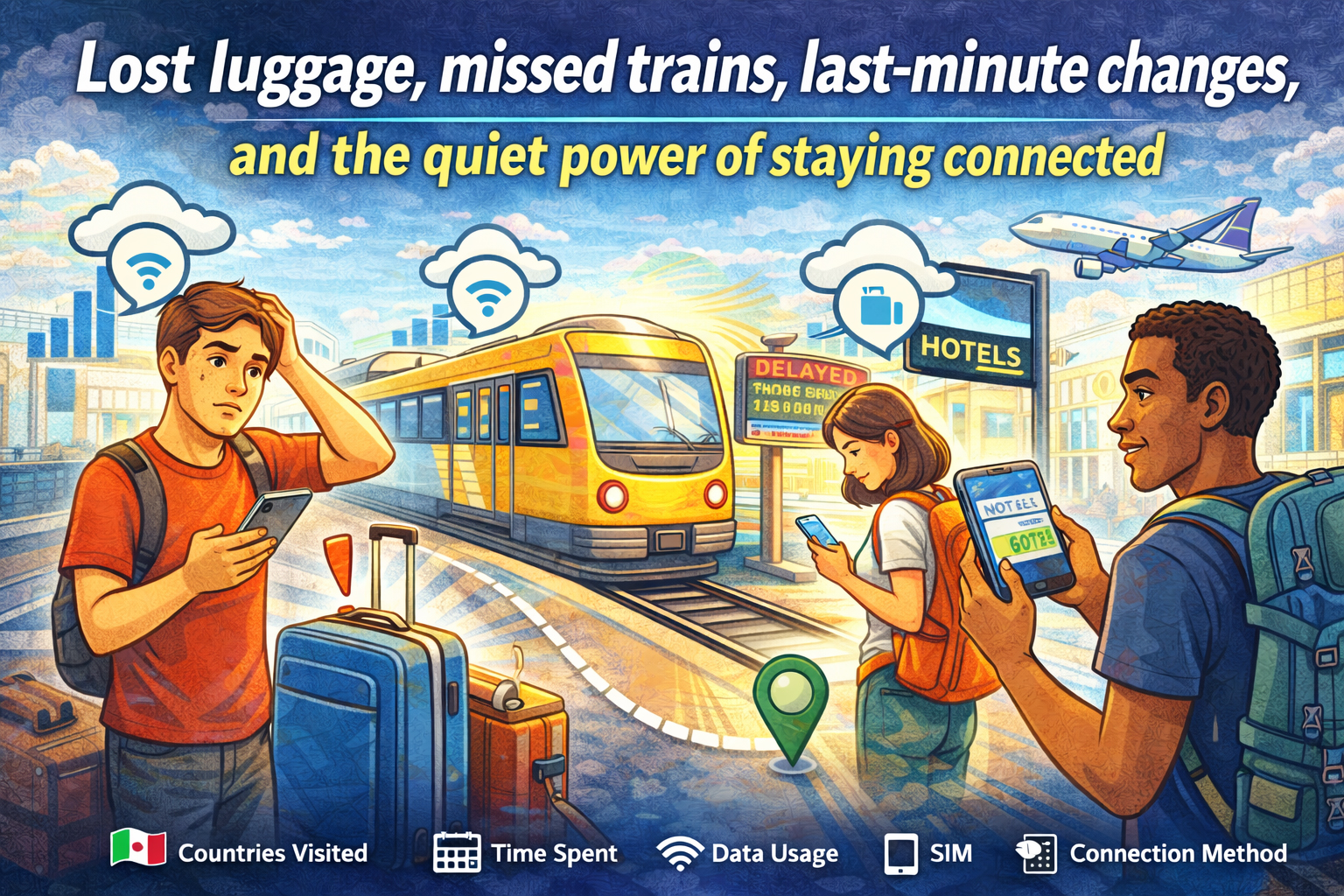
Lost luggage, missed trains, last-minute changes, and the quiet power of staying connected - travelers solving travel issues with eSIM

Lost luggage, missed trains, last-minute changes, and the quiet power of staying connected

Every traveler collects stories. Some are about beautiful views, incredible meals, and unexpected friendships. Others begin with a sinking feeling. A missed train. A lost bag. A canceled flight. A street sign you can’t read.

In those moments, the difference between stress and control often comes down to one simple thing: cellular signal.

There was a time when being overseas meant being temporarily unreachable. No maps, no ride apps, no instant help. Today, connectivity travels with you. And for many modern travelers, an eSIM has quietly become the difference between chaos and calm.

These are the kinds of real-world survival stories that play out every day. Not dramatic enough for headlines. But important enough to shape how a trip unfolds.

And in each one, a simple data connection turns panic into a plan.


The Missed Train That Didn’t Ruin the Trip

It happens fast. A late taxi. A long line for coffee. One wrong platform. Suddenly, the train you planned your day around is pulling away without you.

You’re in a country where you don’t speak the language, and the station boards flicker with destinations you don’t recognize.

In the past, this moment meant finding an information desk and hoping someone could help. Now, it’s a different kind of response.

Phone out. Data on.

Within minutes:

  • A new route is found on a maps app

  • A later train is booked online

  • A message goes out to the hotel about the delayed arrival

Instead of standing still, you’re moving again. A missed train becomes a detour instead of a disaster.

This is where an eSIM shines. Because your connection doesn’t depend on finding Wi-Fi in a crowded station. It’s already there, ready the moment plans change.


The Lost Luggage That Still Found Its Way Home

Standing at the baggage carousel while it spins and empties is a special kind of suspense. Everyone else leaves. The belt stops. Your bag is nowhere in sight.

Now what?

Without a connection, the process can feel slow and uncertain. But with reliable data, the next steps happen quickly.

Airline apps track the missing bag. Claim forms get filled out online. The hotel address gets sent directly to the airline. Notifications arrive when the bag is located and on its way.

You can even check nearby stores, order a few essentials, and get through the first night without your things.

Luggage gets lost. It’s part of travel. But staying connected means you’re never left guessing what happens next.


The Night Arrival in an Unfamiliar City

Landing in a new country after dark is always a little disorienting. The streets look different. The language sounds different. Even the signs feel unfamiliar.

Now imagine your hotel is across town, public transit is limited at night, and the taxi stand is crowded.

This is when a smartphone becomes your lifeline.

With data ready to go, you can:

  • Open a rideshare app and request a pickup

  • Double-check the hotel address

  • Share your location with someone back home

  • Translate directions if needed

Instead of wandering, you move with purpose. Instead of uncertainty, there’s a clear path from airport to door.

The difference is quiet but powerful. You don’t have to think about whether your phone will connect. It just does.


The Wrong Turn That Turned Into a Better Day

Some of the best travel memories begin with a wrong turn.

But in the moment, it doesn’t feel romantic. You’re in a neighborhood you don’t recognize. The street names don’t match your map. And you’re not sure which way leads back.

This is where instant access to navigation makes all the difference.

With mobile data:

  • You reorient in seconds

  • You find the nearest transit stop

  • You discover a café or landmark you never planned to see

Getting lost stops being stressful and starts becoming part of the experience.

A strong connection doesn’t just help you get un-lost. It helps you explore with confidence.


The Last-Minute Hotel Change

Flights get delayed. Connections get missed. Sometimes the hotel you planned to reach just isn’t reachable anymore.

Instead of arriving exhausted and searching for help, travelers with a steady connection can solve the problem on the spot.

Book a nearby room.
Check reviews.
Confirm availability.
Get directions instantly.

In the space of a few minutes, the night is back on track.

Without signal, this becomes a much longer, more complicated process. With signal, it’s just another quick adjustment.


The Emergency Call Home

Not every travel story is about inconvenience. Sometimes, things get serious.

A sudden illness. A stolen wallet. A situation where you need to reach someone quickly.

In those moments, being connected matters in a deeper way.

You can:

  • Call home through an app like OneSim VoIP

  • Contact your bank immediately

  • Find the nearest clinic or pharmacy

  • Access translation tools to explain what’s happening

It’s not just about data. It’s about reassurance. The ability to reach help, to explain, to solve problems as they happen.

And often, that connection starts the moment your plane lands, thanks to a travel eSIM already installed and ready to work. And with OneSim VoIP you can access SMS and voice. The best thing about OneSim VoIP is that, unlike other VoIP Apps, both sides don’t need to have the app, you can even call landlines!


The Work Emergency Abroad

For digital nomads and business travelers, the stakes can be even higher.

An urgent email arrives. A client needs a file. A meeting time changes.

When work travels with you, connectivity isn’t optional.

With reliable mobile data, you can:

  • Join a video call from a taxi

  • Send files from a train platform

  • Respond to urgent messages without searching for Wi-Fi

The trip continues, but your responsibilities stay in motion too.

And because an eSIM keeps you connected across countries, you don’t have to think about whether your data will work at the next stop.


The Confidence Factor

All of these moments have one thing in common.

They start with uncertainty. And they end with a solution powered by connection.

That’s the real value of staying connected while traveling. Not just the convenience, but the confidence.

Confidence to try new places.
Confidence to change plans.
Confidence to handle the unexpected.

Because you know that if something goes wrong, your phone is more than a camera. It’s your map, your translator, your booking desk, your safety net.


From “No Bars” to No Panic

The phrase “no bars” used to mean isolation. Silence. Waiting.

Today, the goal is simple: avoid that moment altogether.

A travel eSIM helps make that possible by giving you:

  • Instant connectivity when you land

  • Coverage across multiple countries

  • No need to swap physical SIM cards

  • Reliable access to data when you need it most

It doesn’t make problems disappear. But it makes them manageable.

And that’s the difference between panic and problem-solving.


Travel Will Always Be Unpredictable

That’s part of the magic.

Trains run late. Bags get lost. Plans change. Streets twist. Weather shifts.

But modern travel comes with tools that help you adapt as quickly as the world changes around you.

The ability to pull out your phone and find a solution in seconds can turn the worst moments into stories you laugh about later.

Stories that begin with a problem.
And end with a signal.

Because sometimes, survival on the road doesn’t come from planning every detail.

It comes from knowing that wherever you are, you’re still connected.

How to Choose the Right eSIM Plan: Pay-As-You-Go vs. Data Packages

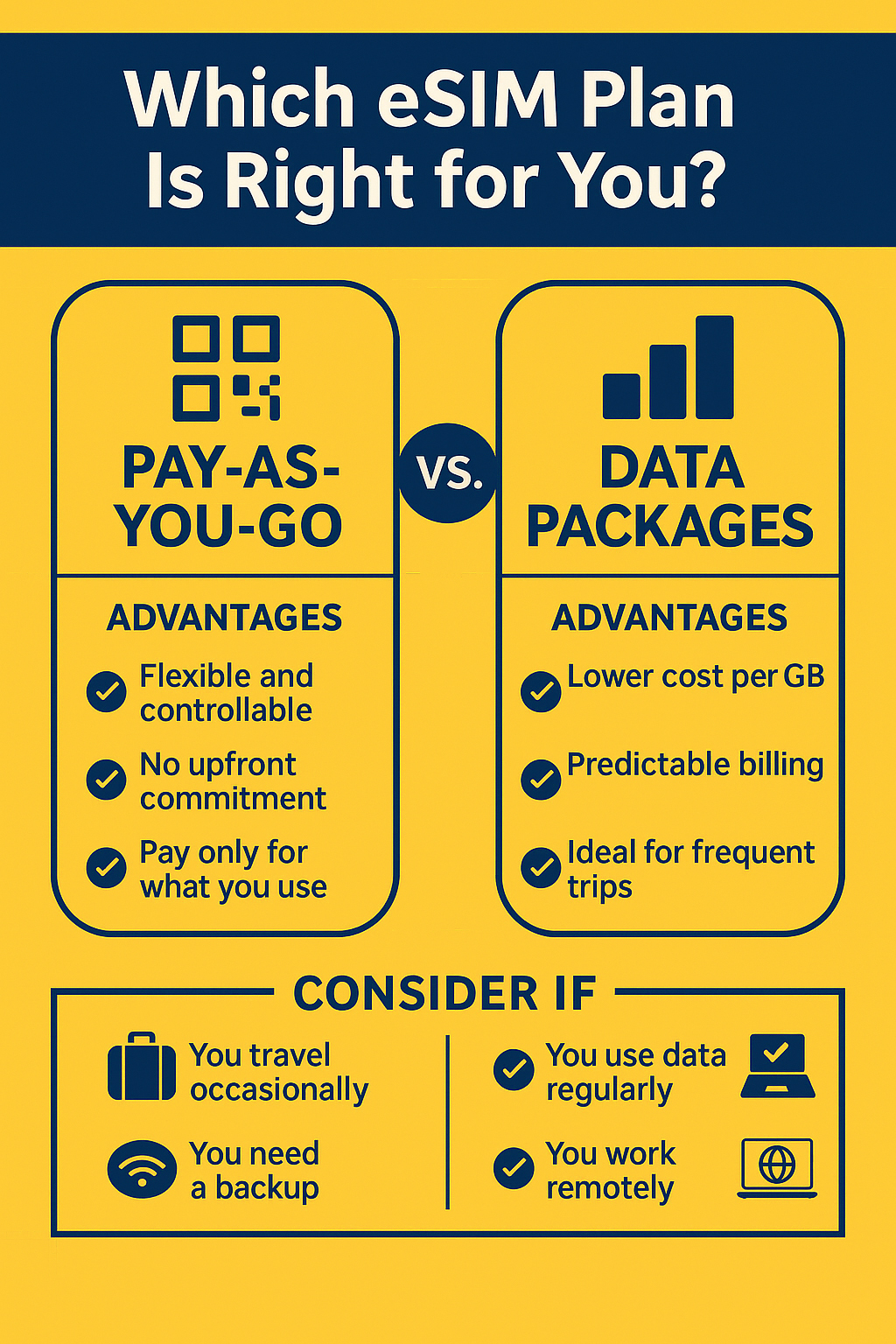
Pay-As-You-Go vs Data Package infographic for eSIM

Choosing the right travel eSIM plan can make or break your international trip. Whether you’re a weekend wanderer, a digital nomad, or a frequent flyer, your connectivity needs will differ — and so will your costs.

The two main models travelers encounter are pay-as-you-go eSIMs and prepaid data packages. Each has advantages depending on how often and how much you use data while abroad. Let’s break them down so you can make an informed decision and save money on your next journey.


Understanding eSIM Plan Pricing Models

Before you can compare eSIM data plans, it’s important to understand the three main pricing structures used by global eSIM providers.

Pay-As-You-Go Explained

With a pay-as-you-go (PAYG) eSIM, you only pay for the data you actually use. There’s no upfront commitment or monthly fee — perfect if your data needs vary from one trip to another. You can top up at any time, and your balance simply decreases as you consume data.

Advantages:

  • Great for short trips or uncertain usage

  • No wasted data or expiration pressure

  • Ideal backup for emergencies or secondary devices

Considerations:

  • Typically higher per-GB cost than bulk data plans

  • Requires active monitoring of your balance, or OneSimCard’s convenient auto-recharge option.

Prepaid Data Packages

These data packages are sold in specific sizes — for example, 1GB, 5GB, or 10GB bundles that expire after a set time (usually 7, 14, or 30 days). You pay upfront, and the eSIM provides consistent data speeds and coverage.

Advantages:

  • Much Lower cost per GB

  • Predictable spending

  • Simple to manage for longer stays

Considerations:

  • Unused data expires

  • You may need to top up before the plan ends

Subscription-Based Models

Some providers now offer monthly eSIM subscriptions, charging a flat fee for ongoing data access in one or more regions. These appeal to frequent travelers, but they often come with fixed limits or auto-renewal requirements.


✈️ When Pay-As-You-Go eSIM Plan Makes Sense

For certain travelers, PAYG eSIMs are the smartest and most flexible option.

Occasional Travelers

If you take just a few international trips a year, it doesn’t make sense to commit to recurring plans. PAYG lets you stay connected during short vacations or weekend getaways without pre-paying for unused data.

Light Data Users

Some travelers rely mostly on hotel Wi-Fi and only need mobile data for maps or ride-hailing apps. PAYG plans are perfect here — you pay a little, use a little, and avoid waste.

Backup Connectivity

Even if you primarily rely on local SIM cards or Wi-Fi, having a PAYG eSIM installed ensures you’re never stranded without data when crossing borders or losing signal from your primary SIM.

In short, PAYG equals control — perfect for those who value flexibility over volume.


When a Data Package eSIM Plan Is Better

If you’re abroad frequently or use your phone as a mobile office, data packages are the more cost-effective solution.

Long-Term Travelers and Expats

For anyone staying abroad for weeks or months, prepaid eSIM packages offer stable pricing and dependable connectivity. You can easily renew the same plan or switch to another country’s bundle through your eSIM portal.

Business Travelers

Professionals need reliability and predictability. Data packages eliminate surprise top-ups, offering a steady stream of data for email, video calls, and navigation without running out mid-meeting.

Digital Nomads and Remote Workers

If you’re working from Lisbon one week and Bali the next, having a regional eSIM plan ensures coverage across multiple countries at a flat rate. This helps simplify billing and guarantees network consistency for streaming, uploading, and video conferencing.


How to Compare Costs Between eSIM Providers

With so many global eSIM brands competing for travelers’ attention, it’s worth learning how to do an eSIM pricing comparison properly.

Example Pricing Overview (1GB in Europe)

Provider 1GB Validity Approx. Cost
OneSimCard eSIM $4.50 14 days Multi-network access
Airalo $7.50 7 days Single-network coverage
Holafly $19 Unlimited High upfront cost
Nomad $8 30 days Regional
Ubigi $9 30 days Auto top-up required

(Pricing as of 2025 – subject to change)

Effective Cost per GB

To evaluate the true value, divide your plan cost by its duration and total data. For example, a 5GB / 30-day plan for $25 costs $5 per GB, which may outperform a cheaper plan that expires after 7 days.

Look beyond the sticker price. Factors like coverage, speed, and network redundancy matter just as much as cost.


Why OneSimCard Offers the Best Balance

Choosing between pay-as-you-go and data packages doesn’t have to be all or nothing — with OneSimCard, you can mix and match both.

  • Transparent pricing: No hidden fees, surcharges, or forced subscriptions.

  • OneSimVoIP app: Add optional voice and SMS to any eSIM data plan.

  • Customizable bundles: Buy what you need — whether it’s 500MB for a weekend or 20GB for a month-long project.

  • Global reliability: Multi-network access in 200+ countries ensures your connection never drops mid-journey.

With OneSimCard, you’re not tied to a single plan type — your eSIM adapts to your travel lifestyle.


Find the Right Plan for Your Trip

Whether you’re a casual vacationer or a full-time remote worker, understanding travel eSIM plans helps you stay connected without overspending.

Pay-as-you-go gives flexibility and control; data packages offer predictable value and stability. With OneSimCard, you get the best of both worlds — coverage, clarity, and cost efficiency.

Find the Right Plan for Your Trip — Activate Your OneSimCard eSIM Now!

Troubleshooting eSIM Issues While Abroad

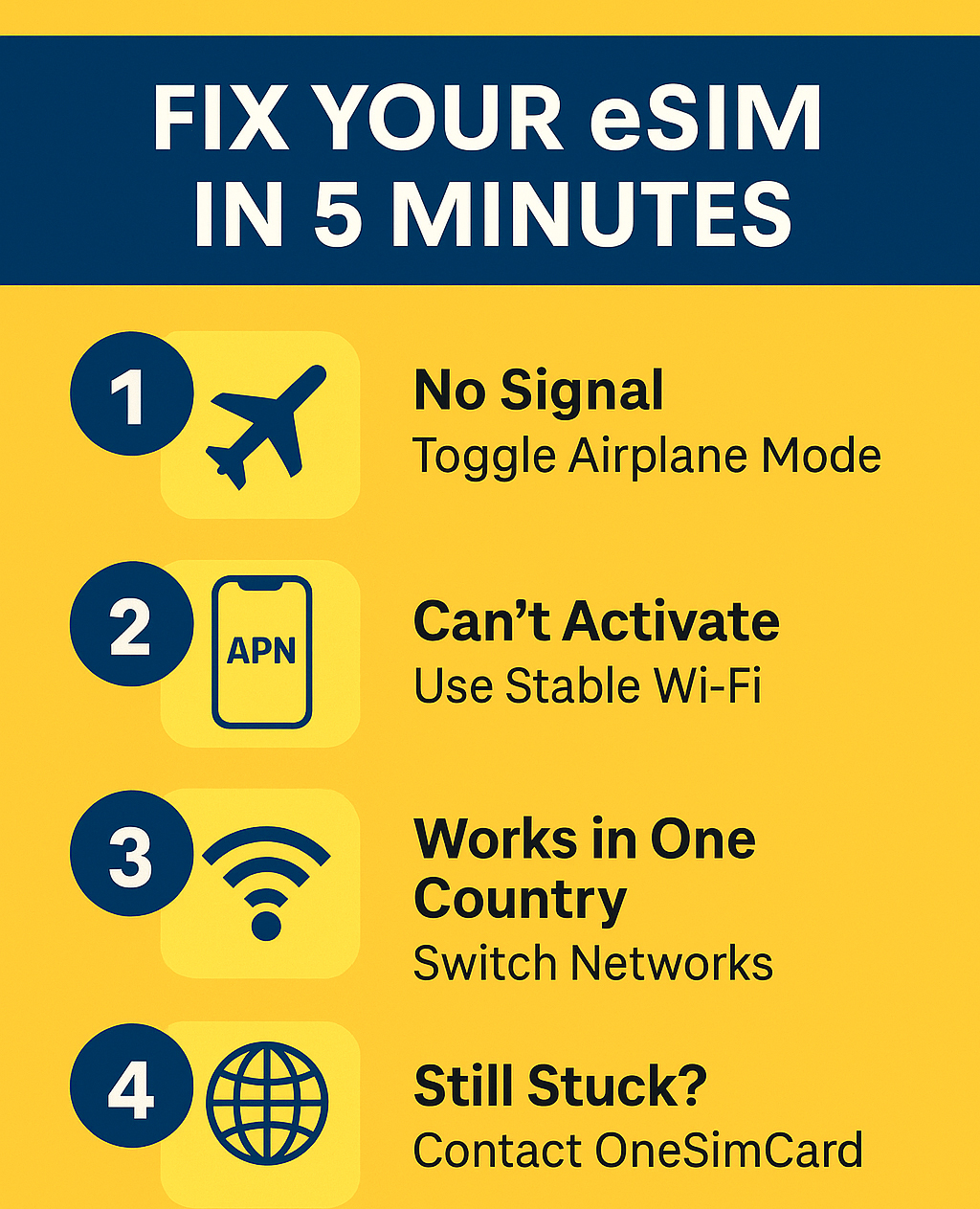
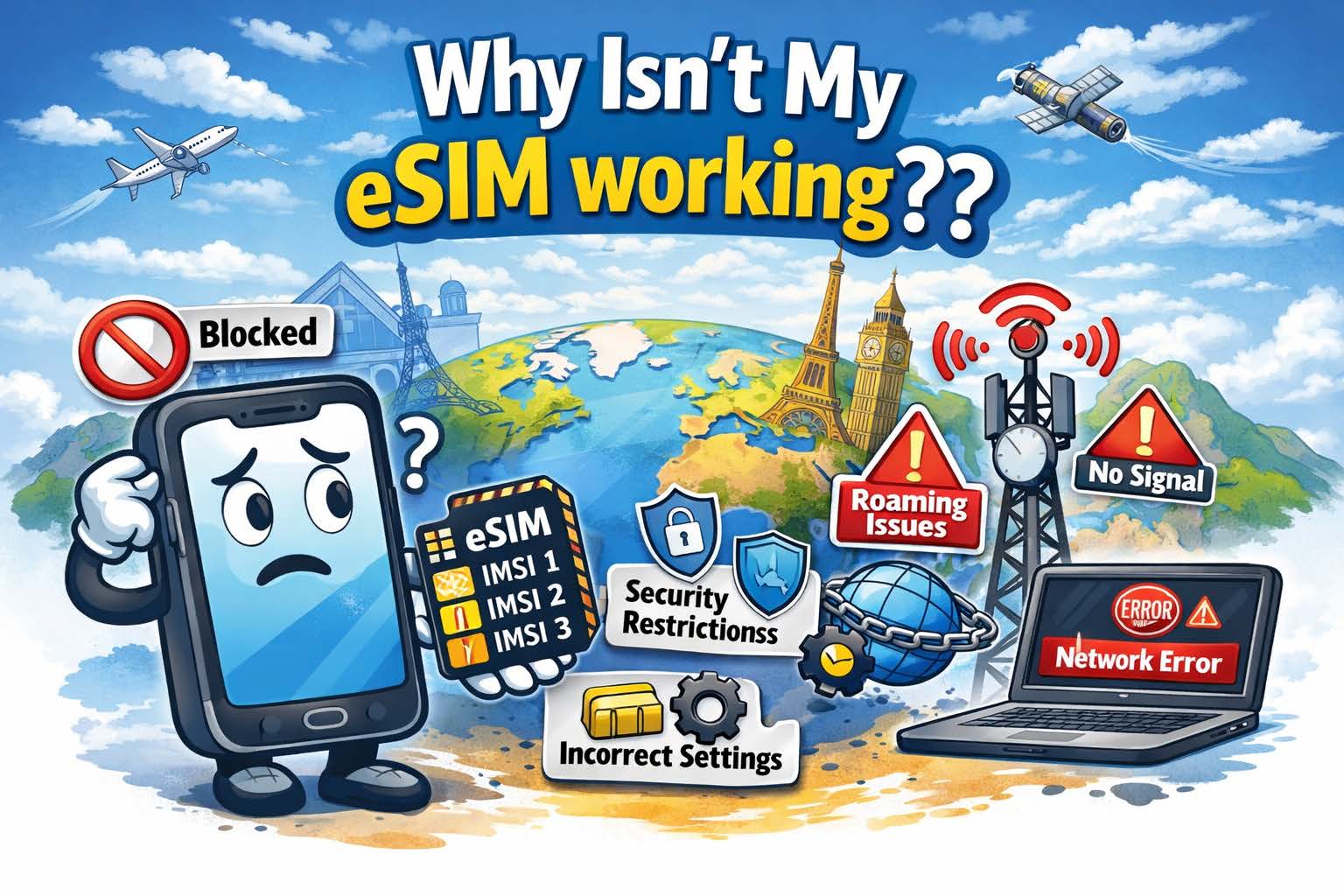
Troubleshooting eSIMsReal-World Help for Travelers: Signal Loss, APN Setup & More. Troubleshooting eSIMs is simple!

When looking for international SIM cards, eSIMs have transformed international travel. Instead of juggling physical SIM cards or paying outrageous roaming fees, travelers can now activate data plans instantly with a quick QR scan. But even though eSIMs make staying connected easier, problems can still arise — especially when hopping between countries or networks. Whether you’re in Paris, Phuket, or Patagonia, here’s a practical guide to troubleshooting eSIM issues while abroad.


1. No Signal or “No Service” After Activation

This is the most common issue travelers face after installing an eSIM. You’ve scanned the QR code, it shows as “active,” but your phone still says “No Service.”

✅ Step-by-Step Fix:

  1. Turn Airplane Mode On and Off
    Wait 30 seconds and disable it — this forces your phone to rescan for available networks.

  2. Manually Select a Network

    • Go to Settings → Cellular → Network Selection (iPhone) or Settings → Connections → Mobile Networks → Network Operators (Android).

    • Toggle Automatic off, then pick one of the listed networks manually.

    • If you’re using a OneSimCard eSIM, try selecting one of our preferred roaming partners in your country.

  3. Restart Your Device
    Simple but effective — restarting clears temporary network glitches.

  4. Check if Data Roaming is On

    • For eSIMs, roaming must be enabled to access local partner networks abroad.

    • Navigate to Settings → Cellular → eSIM Plan → Data Roaming → On.

Pro Tip: In some regions, 2G or 3G networks are no longer supported. If your phone is older or set to connect automatically, switch to 4G/LTE only for better results.


⚙️ 2. Can’t Access Mobile Data (Even with Signal)

You have bars of signal but no internet — pages won’t load, maps can’t refresh, and apps spin endlessly. This typically means your APN (Access Point Name) isn’t set up correctly.

✅ Step-by-Step Fix:

  1. Check APN Settings

    • iPhone:
      Settings → Cellular → Your eSIM Plan → Cellular Data Network

    • Android:
      Settings → Mobile Network → Access Point Names

  2. Enter the Correct APN Information

    • For OneSimCard eSIM, the APN is typically: OSC
      (unless otherwise noted in your installation email).

    • Leave Username, Password, and Proxy fields blank.

  3. Restart Data Connection

    • Turn off Mobile Data for 10 seconds, then turn it back on.

    • Reopen your browser or try a speed test to confirm connectivity.

⚠️ Common Mistake: Many travelers forget to switch the “default data line” to their eSIM.
Go to Settings → Cellular Data → Select Your eSIM to ensure data routes through the correct plan.


3. eSIM Not Downloading or Activating

If your eSIM profile fails to download or install, it could be due to poor Wi-Fi, expired QR codes, or device compatibility.

✅ Step-by-Step Fix:

  1. Ensure You Have a Stable Wi-Fi Connection
    Activation requires internet access. If hotel Wi-Fi is unreliable, use a hotspot or café connection.

  2. Scan the QR Code Again

    • Go to Settings → Cellular → Add eSIM (or Mobile Plan).

    • Re-scan your OneSimCard QR code from your email or app.

    • If it’s expired, request a fresh activation link from support. This may require getting a new eSIM.

  3. Check Device Compatibility
    Only devices with built-in eSIM support will work. See our Complete eSIM Compatibility Guide for iPhone and Android for reference.

  4. Update Your Operating System
    Outdated software can block installation. Update to the latest version of iOS or Android before retrying.


4. eSIM Plan Doesn’t Appear in Settings

Sometimes, travelers install their eSIM successfully, but it doesn’t show under “Cellular Plans” or disappears after an update.

✅ Step-by-Step Fix:

  1. Restart Your Device — this often restores the display.

  2. Check Your Primary SIM Settings
    If you’re using a physical SIM simultaneously, ensure it isn’t set to “data only” while your eSIM is disabled.

  3. Reinstall the eSIM Profile

    • Delete the current profile under Settings → Cellular Plans → Remove eSIM

    • Re-scan the QR code to reinstall it fresh.

Pro Tip: Always save a backup of your eSIM QR code before traveling — many users delete their activation email by mistake!


5. Data Works in One Country but Not Another

Multi-country eSIMs (like OneSimCard’s) are designed for roaming, but occasionally, coverage may vary due to regional network preferences or restrictions.

✅ Step-by-Step Fix:

  1. Manually Switch Carriers

    • Turn off Automatic Network Selection.

    • Try another partner network in your current country (list provided in your OneSimCard app or welcome email).

  2. Enable Data Roaming
    Even if it worked before, moving across borders sometimes resets roaming permissions.

  3. Restart Device After Crossing Borders
    This refreshes your connection with the new country’s local network.

Tip for Frequent Travelers: Enable the OneSimCard eSIM Portal to monitor live connections, toggle networks remotely, and check data balances in real-time. Also, BE PATIENT!! Sometimes when you cross boarders it takes up to 15 minutes to find the right carrier(s)!


6. Battery Draining Faster Than Usual

Using dual SIMs (physical + eSIM) can slightly increase power usage because your phone pings two networks simultaneously.

✅ Step-by-Step Fix:

  • Turn off the SIM you’re not using.

  • Disable Background App Refresh for high-data apps like Maps or Instagram.

  • Use Low Power Mode while on the go.

⚙️ eSIMs themselves don’t drain extra battery — it’s the additional background network activity that does.


7. Calls or Texts Aren’t Working

If you can access data but can’t make calls or send SMS, the issue usually lies in your phone’s “Default Voice Line” settings or VoIP configuration.

✅ Step-by-Step Fix:

  1. Set Your eSIM as the Default Line for Calls
    Settings → Cellular → Default Voice Line → Choose eSIM

  2. Check Preferred Network Type
    Switch to “4G/VoLTE Preferred.” Some regions no longer support 3G voice networks.

  3. Use OneSimVoIP App for Calls
    If your plan is data-only, you can still make and receive calls with the OneSimVoIP app — available on iOS and Android.


8. When to Contact Support

If you’ve tried all the above steps and your eSIM still isn’t working:

  • Check your plan’s data balance or expiration date in your OneSimCard account.

  • Make sure your device IMEI isn’t carrier-locked.

  • Contact OneSimCard Support with the following info:

    • Device model and OS version

    • Country you’re in

    • Signal status and network name

Our team can run a live diagnostic and often resolve issues within minutes.

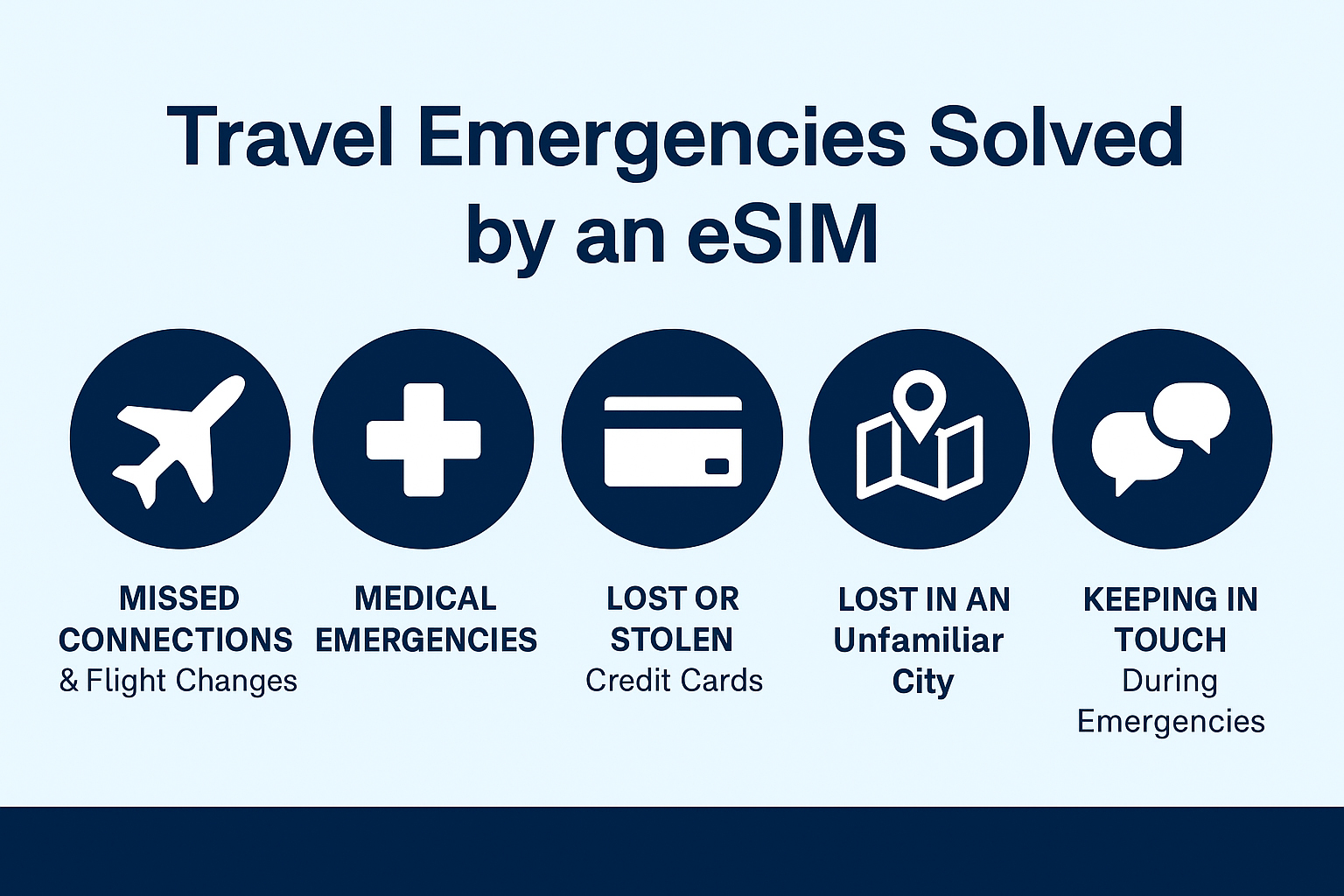
Travel Emergencies Solved by an eSIM

eSIM solving travel emergencies
Having an International eSIM Can Help with Many Emergencies

Even the most carefully planned trips can take unexpected turns. Flights get delayed, luggage disappears, and sometimes the worst happens when you’re far from home. What separates a minor inconvenience from a full-blown disaster often comes down to one thing: how quickly you can get connected.

This is where an international eSIM becomes a traveler’s secret weapon. With instant data access in over 200 countries, an eSIM from OneSimCard ensures you can navigate any emergency without missing a beat. Let’s look at some of the most common travel emergencies and how an eSIM can help you solve them on the spot.


1. Missed Connections and Flight Changes

Imagine this: your flight to Paris is delayed, causing you to miss your connecting flight to Rome. Hundreds of passengers are rushing to rebook at the airline counter, but you don’t have time to wait in line.

With a travel eSIM, you can:

  • Pull out your phone and rebook instantly through the airline’s app.

  • Use real-time flight trackers to find alternative routes.

  • Message your hotel in Rome to let them know you’ll be arriving late.

Instead of standing in a long queue, you’re already rebooked, sipping coffee at the gate, and adjusting your itinerary with zero stress.


Medical Emergencies2. Medical Emergencies Abroad

A sudden medical issue in a foreign country can be terrifying — especially if you can’t communicate quickly. Whether it’s food poisoning in Bangkok or a sprained ankle in Lisbon, time matters.

An international eSIM gives you the power to:

  • Instantly look up the nearest hospital or pharmacy.

  • Use translation apps to explain symptoms to doctors or pharmacists.

  • Call or message your insurance provider for guidance and coverage details.

  • Share your live location with travel companions or family at home.

Fast connectivity ensures that you’re not scrambling for Wi-Fi or relying on patchy roaming when you need urgent help.


Lost Credit Cards3. Lost or Stolen Credit Cards

You’ve just finished dinner in Barcelona when you realize your wallet — along with your credit cards — is missing. Panic sets in. But with an active eSIM, solutions are only a few taps away.

Here’s what you can do immediately:

  • Open your banking app and freeze your card to prevent unauthorized charges.

  • Use secure VoIP calls with OneSimCard’s app to contact your bank if you need assistance.

  • Pull up maps and ride-hailing apps to get safely back to your hotel.

  • Order an emergency replacement card delivered to your location.

Without data, you might be stuck hunting for public Wi-Fi while your stolen card racks up charges. With an eSIM, you take control instantly.


Lost in an unfamiliar city4. Lost in an Unfamiliar City

It’s easy to lose your bearings in a new city — especially at night or in a place where you don’t speak the language. A simple problem can quickly turn into a major catastrophe.

With a travel eSIM, getting back on track is simple:

  • Open maps and get step-by-step walking directions.

  • Use translation apps to ask for help or read signs.

  • Share your location with friends so they can meet you safely.

What could’ve been a frightening experience turns into a quick detour with minimal stress.


Extreme weather leading to travel disruptions5. Cancellations and Natural Disruptions

From rail strikes in Europe to sudden snowstorms in North America, travel plans can change in an instant. When services are canceled, being able to adapt fast is crucial.

With an eSIM:

  • You can rebook hotels or transportation from your phone.

  • Stay updated on real-time alerts from airlines, train operators, or local authorities.

  • Arrange alternative plans before most other travelers even know what’s happening.

Being the first to act can mean the difference between snagging the last hotel room or being stuck overnight in a terminal.


Keeping in Touch During Emergencies6. Keeping in Touch During Emergencies

Sometimes emergencies aren’t just about logistics — they’re about peace of mind. Whether you’re traveling alone or with family, staying connected is essential. It can literally be life and death.

An international eSIM allows you to:

  • Call or message loved ones back home instantly.

  • Share updates during crises (natural disasters, civil unrest, etc.).

  • Use secure messaging apps over data when SMS or voice networks are congested.

Your family knows you’re safe, and you feel supported even thousands of miles away.


Why OneSimCard eSIM Stands Out in Emergencies

Not all travel eSIMs are created equal. With OneSimCard eSIM, you get:

  • Coverage in 200+ countries and territories.

  • Instant activation with a quick QR code scan.

  • No contracts, no roaming shock — just prepaid, reliable data.

  • The option to use the OneSim VoIP app for affordable calls and texts.

  • Multi-network access in many countries, ensuring you’re not stuck on a weak carrier during an emergency.


Final Thoughts: Peace of Mind in Your Pocket

Travel is full of surprises — some magical, some stressful. But with an international eSIM, you’re never powerless in the face of emergencies. From rebooking flights to handling medical issues, protecting your finances, or simply finding your way back to safety, having instant global data can turn a crisis into a manageable inconvenience.

OneSimCard eSIM: travel smarter, safer, and always connected.

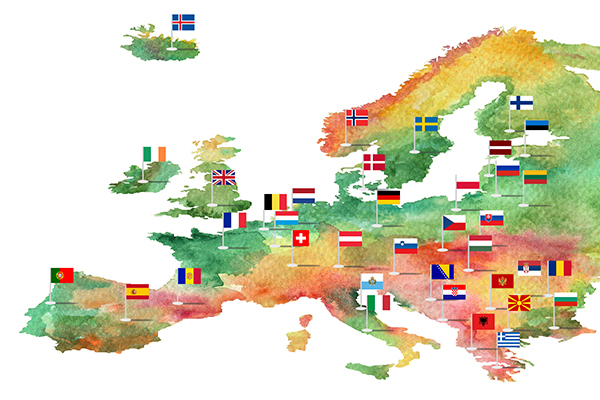
The Best Time to Visit Europe

Europe is a diverse and enchanting continent with a rich tapestry of cultures, histories, and landscapes. Deciding the best time to visit Europe depends largely on what you hope to experience. Each season offers unique experiences, and the optimal time to visit can vary by region and personal preference.

Spring (March to May)

Spring is a beautiful time to visit Europe. The weather begins to warm up, and flowers bloom, bringing life to parks and countryside. Popular destinations like Paris, Amsterdam, and London are less crowded compared to the peak summer months. Spring is ideal for exploring the outdoors, visiting gardens, and enjoying festivals like the Tulip Festival in the Netherlands or the cherry blossoms in Japan.

Summer (June to August)

Summer is the peak tourist season in Europe, and for good reason. The weather is warm, and there are numerous outdoor events, festivals, and activities. Coastal destinations such as the French Riviera, the Amalfi Coast in Italy, and the Greek Islands are at their best, offering pristine beaches and vibrant nightlife. However, be prepared for large crowds and higher prices.

Autumn (September to November)

Autumn is another excellent time to visit Europe. The weather is still pleasant, and the summer crowds have thinned out. The changing leaves create picturesque landscapes, particularly in places like Bavaria, the Loire Valley, and the Scottish Highlands. Autumn is also a fantastic time for wine enthusiasts, with many wine regions celebrating harvest festivals.

Winter (December to February)

Winter in Europe is magical, especially if you enjoy festive atmospheres and winter sports. Christmas markets in Germany, Austria, and the Czech Republic are a highlight, with charming stalls, festive lights, and seasonal treats. The Alps and Pyrenees offer world-class skiing and snowboarding. Cities like Prague, Vienna, and Salzburg are particularly enchanting with their historic architecture blanketed in snow.

Top 10 Things to Do in Europe

  1. Explore the Historic Cities of Europe Europe’s cities are treasure troves of history, culture, and architecture. Wander through the streets of Rome, where ancient ruins like the Colosseum and the Roman Forum stand as testaments to the city’s imperial past. In Paris, visit iconic landmarks such as the Eiffel Tower, Notre-Dame Cathedral, and the Louvre Museum. The medieval charm of Prague, with its cobblestone streets and Gothic architecture, offers a journey back in time.
  2. Visit the Museums and Art Galleries Europe is home to some of the world’s most renowned museums and art galleries. The Louvre in Paris, the British Museum in London, and the Vatican Museums in Rome house priceless works of art and historical artifacts. The Rijksmuseum in Amsterdam and the Prado in Madrid are also must-visits for art lovers. These institutions offer an opportunity to see masterpieces by artists such as Leonardo da Vinci, Rembrandt, and Michelangelo.
  3. Experience the Natural Wonders Europe’s natural landscapes are as diverse as its cultural heritage. The fjords of Norway, with their dramatic cliffs and serene waters, are breathtakingly beautiful. The Swiss Alps offer stunning vistas and are perfect for hiking and skiing. The Plitvice Lakes National Park in Croatia, with its cascading waterfalls and crystal-clear lakes, is a UNESCO World Heritage site that should not be missed.
  4. Indulge in Culinary Delights European cuisine is incredibly diverse and varies from country to country. In Italy, savor authentic pizza and pasta dishes, along with regional specialties like risotto and tiramisu. France is renowned for its gourmet food, from delicate pastries to fine wines and cheeses. Spain offers tapas, paella, and churros, while Belgium is famous for its waffles and chocolates. Don’t forget to try the local beverages, whether it’s German beer, Greek ouzo, or Portuguese port wine.
  5. Take a Scenic Train Ride Train travel in Europe is convenient and often offers some of the most scenic routes in the world. The Glacier Express in Switzerland takes you through the heart of the Alps, offering panoramic views of snow-capped mountains and picturesque villages. The West Highland Line in Scotland travels through rugged landscapes, past lochs and glens. The Cinque Terre Express in Italy connects the charming coastal villages of the Cinque Terre, providing stunning views of the Ligurian Sea.
  6. Relax on Beautiful Beaches Europe’s coastline is dotted with beautiful beaches that cater to all tastes. The Mediterranean coasts of Spain, Italy, and Greece boast sandy shores and crystal-clear waters, perfect for sunbathing and swimming. The Algarve in Portugal offers dramatic cliffs and hidden coves. The Baltic Sea beaches in Germany and Poland provide a different kind of coastal experience, with their unique landscapes and serene atmosphere.
  7. Discover the Castles and Palaces Europe is home to some of the most magnificent castles and palaces in the world. The Neuschwanstein Castle in Germany, with its fairy-tale appearance, inspired Disney’s Sleeping Beauty Castle. The Palace of Versailles in France is a symbol of absolute monarchy and is known for its opulent interiors and extensive gardens. In Scotland, Edinburgh Castle dominates the skyline and offers a glimpse into the country’s turbulent history.
  8. Enjoy Outdoor Adventures For outdoor enthusiasts, Europe offers a wide range of activities. In addition to skiing and snowboarding in the Alps, you can go hiking in the Scottish Highlands, kayaking in the fjords of Norway, or cycling along the Danube River. The diverse landscapes provide endless opportunities for adventure, whether you prefer mountains, forests, lakes, or rivers.
  9. Experience the Festivals and Events Europe hosts a myriad of festivals and events throughout the year. The Carnival of Venice, with its elaborate masks and costumes, is a spectacle to behold. Oktoberfest in Munich is the world’s largest beer festival, attracting millions of visitors. The Edinburgh Festival Fringe is the largest arts festival in the world, featuring thousands of performances across various genres. These events offer a unique insight into the local culture and traditions.
  10. Take a River Cruise River cruises are a relaxing way to explore Europe, offering the chance to visit multiple destinations without the hassle of packing and unpacking. The Danube River cruise takes you through several countries, including Germany, Austria, Hungary, and Romania, allowing you to explore historic cities and charming villages. The Rhine River cruise offers scenic views of vineyards, castles, and medieval towns. These cruises often include guided tours and excursions, providing a comprehensive travel experience.

In conclusion, Europe offers an abundance of experiences that cater to a wide range of interests. Whether you’re a history buff, a foodie, an outdoor enthusiast, or simply looking to relax on a beautiful beach, Europe has something for everyone. The best time to visit depends on your preferences and what you want to see and do. Whenever you choose to go, you’re sure to create lasting memories in this diverse and captivating continent. Don’t forget to pack your OneSimCard International SIM card, or download your travel eSIM before you go, so you can make all your friends and family jealous with your travels across the continent!

Summer Travel Plans? Maybe the Paris Olympics??

Go for  Gold with DataMax

Whether your international travel plans include Paris for the Summer Olympics or anywhere else in the  world, the OneSimCard DataMax eSIM and Physical 3-in-one SIM takes the gold metal for fast, reliable global roaming at unbeatable prices. Both form factors are currently on sale to save even more!

Fast Data Speeds

Our new DataMax Sim card and DataMax eSIM card are capable of 5G speeds in over 65 countries and over 115 Networks around the globe…one of the biggest footprints in the travel SIM card industry!!

4G Speeds are available in many more countries and networks worldwide. DataMax has you covered with the best speeds in almost every destination…over 200 total global destinations.

Fully Functional

While the DataMax family of SIM Cards are optimized for Global Roaming Data, you can couple our free SIM VoIP App with the blazing fast 5G DataMax to place calls to, and receive calls from, any phone in the world at a fraction of the cost of conventional roaming voice services.

What’s more, you can use the SIM VoIP app to send and receive SMS messages to any cell phone.

Phenomenal Pricing

The DataMax SIM Cards have highly competitive pricing with rates starting at $0.003USD per MB with Discount packages…less than ½ the cost of our other SIM cards. We put together discount data packages that suit the needs of every traveler regardless of the duration of their trip.

Here is an example of the potential savings:
Zone EU Plan

Plan Duration Plan Size Plan Cost
2 Weeks – 14 Days 1,000 MB $11.75
2 Weeks – 14 Days 2,000 MB $15.00
2 Weeks – 14 Days 5,000 MB $18.00
2 Weeks – 14 Days 10,000 MB $32.00
Monthly – 30 days 20,000MB $62.00

Zone EU Countries: Austria, Belgium, Bulgaria, Croatia, Cyprus, Czech Republic, Denmark, Estonia, Finland, France, Germany, Greece, Hungary, Ireland, Italy, Latvia, Liechtenstein, Lithuania, Luxembourg, Malta, Netherlands, Norway, Poland, Portugal, Romania, Slovakia, Slovenia, Spain, Sweden, Switzerland, United Kingdom, Vatican City

You can also use this eSIM with Pay-As-You-Go (PAYG) data. Simply add funds to the SIM and pay for only the data you use! All of our rates can be found on our Rates and Coverage page. Just choose your destination and choose which DataMax SIM card (DataMax or DataMax eSIM) you want, and discover the benefits of using the DataMax SIM card for your one and only Travel SIM card.

Easy Upgrade

If you already have a OneSimCard SIM, moving to the DataMax is extraordinarily simple! To start to enjoy the tremendous savings the DataMax SIM cards offer, you can upgrade your SIM card now. Just purchase the new DataMax SIM card which best suits your device requirements (traditional plastic 3-in-1, or eSIM) and you can request to move your existing balance and PEN over to the DataMax SIM.

Just like all of our SIM cards, the DataMax SIM Card and DataMax eSIM card have no contracts, no termination fees, no commitments…just use it when you need it and keep it until the next time you travel!

Check out our video to learn more about Datamax.

Exploring Finland: A Nordic Wonderland

Woman looking at aurora borealis, northern lights in Finland winter forest
Aurora Borealis, northern lights, in Finland winter forest

Introduction

Finland, often referred to as the “Land of a Thousand Lakes” or the “Land of the Midnight Sun,” is a country of unparalleled natural beauty, pristine wilderness, vibrant culture, and innovative design. Situated in Northern Europe, Finland offers travelers a unique and captivating experience year-round. We delve into the wonders of Finland, from its enchanting landscapes and cultural treasures to its rich history and modern innovations.

Geography and Climate

Finland’s geography is defined by its numerous lakes, dense forests, and a long coastline that stretches along the Baltic Sea. It shares borders with Russia to the east, Sweden to the west, and Norway to the north. The country’s geography has a profound influence on its climate, with distinct seasons.

  1. Summer: Summers in Finland are a magical time when the sun barely sets, giving rise to the phenomenon of the “Midnight Sun.” This season, lasting from June to August, is perfect for outdoor activities, such as hiking, kayaking, and enjoying the long, sunny days.
  2. Winter: Winters in Finland bring snow and ice, transforming the country into a winter wonderland. From December to February, you can experience activities like ice skating, cross-country skiing, and the awe-inspiring Northern Lights.
  3. Autumn and Spring: Autumn, from September to November, is known for vibrant fall foliage, while spring, from March to May, witnesses the gradual return of longer daylight hours.

Helsinki: The Capital City

Most journeys to Finland begin in Helsinki, the nation’s capital and largest city. Helsinki is a modern and dynamic metropolis with a rich cultural scene, stunning architecture, and a blend of Nordic and Russian influences. Some must-visit attractions in Helsinki include:

  1. Senate Square (Senaatintori): The heart of Helsinki’s neoclassical architecture, featuring the iconic Helsinki Cathedral and Government Palace.
  2. Suomenlinna Fortress: A UNESCO World Heritage Site, this sea fortress is an ideal place for a picnic and a leisurely stroll.
  3. Design District: Explore the Design District for a taste of Finnish design, including Marimekko textiles and Iittala glassware.
  4. Market Square (Kauppatori): Sample Finnish street food and browse for souvenirs at this lively market on the waterfront.
  5. Temppeliaukio Church (Rock Church): A unique church carved into solid rock, known for its impressive acoustics and architecture.

Lakes and Wilderness

With over 180,000 lakes, Finland is a paradise for nature lovers and outdoor enthusiasts. Here are some of the most enchanting natural destinations in the country:

  1. Lake Saimaa: The largest lake in Finland, Lake Saimaa is a serene and picturesque region known for its stunning landscapes, islands, and the endangered Saimaa ringed seal.
  2. Koli National Park: Located in eastern Finland, this national park offers pristine wilderness, hiking trails, and panoramic views from Ukko-Koli hill.
  3. Rovaniemi: The capital of Lapland, Rovaniemi is famous as the official hometown of Santa Claus. It’s also a gateway to the Arctic wilderness and the Northern Lights.
  4. Archipelago National Park: Explore the beautiful archipelago off the southwest coast, comprising thousands of islands and islets.
  5. Wild Taiga: In eastern Finland, the Wild Taiga region is a haven for wildlife enthusiasts, offering opportunities to spot bears, wolves, and lynx in their natural habitat.

Saunas and Cultural Traditions

Saunas are an integral part of Finnish culture, and there are more saunas than people in Finland. Experiencing a traditional Finnish sauna is a must during your visit. Some unique cultural traditions and activities to explore include:

  1. Löyly and Ice Swimming: Experience the contrast of hot sauna followed by a refreshing dip in icy waters, a Finnish tradition known as “löyly.”
  2. Midsummer Celebrations: Celebrate Midsummer, a significant Finnish holiday, by participating in bonfires, traditional dances, and the lighting of “kokko” (Midsummer bonfires).
  3. Finnish Cuisine: Sample Finnish dishes like salmon soup, Karelian pastries, and the iconic Finnish rye bread.
  4. Sami Culture: Discover the indigenous Sami culture, which includes unique handicrafts, reindeer herding, and traditional joik singing.

Adventure Sports and Activities

Finland offers a wide range of adventure sports and activities for thrill-seekers and outdoor enthusiasts:

  1. Cross-Country Skiing: Experience the joy of gliding through snow-covered forests on well-maintained cross-country ski trails.
  2. Husky Safaris: Go on a husky safari through Lapland’s snowy wilderness, with these enthusiastic dogs leading the way.
  3. Canoeing and Kayaking: Paddle along Finland’s serene lakes and rivers, exploring remote waterways and camping by the shore.
  4. Aurora Hunting: Witness the mesmerizing Northern Lights, also known as the Aurora Borealis, during clear winter nights in Lapland.

Other must-do’s

The Finnish Archipelago

Finland’s coastline is dotted with a stunning archipelago, a unique and peaceful environment. To fully appreciate the archipelago’s beauty, consider taking a ferry or a cruise to explore its islands, which vary in size and character. From the bustling island of Åland with its maritime culture to the remote wilderness of the outer archipelago, each island offers a distinct experience.

Santa Claus Village in Rovaniemi

For those seeking a magical experience, a visit to the Santa Claus Village in Rovaniemi is a must. This enchanting destination provides visitors of all ages with the opportunity to meet Santa Claus himself, send postcards from the Arctic Circle, and experience the magic of Christmas year-round.

The Northern Lights in Lapland

Lapland, the northernmost region of Finland, is one of the best places on Earth to witness the Northern Lights. Between late September and early April, the night sky often comes alive with vibrant displays of green, purple, and pink hues. Lapland’s remote and pristine wilderness, combined with its clear winter nights, makes it an ideal location for aurora hunting.

Sustainable Tourism in Finland

Finland places a strong emphasis on sustainable tourism and environmental conservation. Responsible travelers can contribute to the preservation of Finland’s pristine nature and cultural heritage by following these principles:

  1. Respect Nature: Stay on marked trails, pick up trash, and leave no trace when exploring Finland’s wilderness.
  2. Support Local: Choose eco-friendly accommodations, purchase local products, and support indigenous Sami communities.
  3. Learn About the Environment: Educate yourself about the natural surroundings and wildlife you’ll encounter to ensure you’re a responsible and informed visitor.
  4. Minimize Your Impact: Conserve resources, minimize waste, and respect the delicate balance of ecosystems.

Conclusion

Finland is a land of natural wonders, cultural treasures, and memorable experiences. Whether you’re exploring the vibrant streets of Helsinki, venturing into the wilderness of Lapland, or simply enjoying the tranquility of the Finnish archipelago, this Nordic wonderland offers something for every traveler. Embrace the unique seasons, cultural traditions

To stay in touch with friends and family while in Finland, don’t forget to pack or download your OneSimCard International Roaming SIM card. Our data packages start at less than 1¢ per MB. This will let you upload lots of photos, use our OneSim VoIP app and email your friends about what a great time you are having for next to nothing!

Scotland, The Land of Lochs and Legends

Edinburgh, Scotland
Aerial view from Calton Hill, Edinburgh, Scotland

Scotland is a beautiful and culturally rich country, with many fascinating things to see and do. From stunning landscapes to fascinating history and culture, there is something for everyone in Scotland.

Scotland is divided into 32 Administrative units know as council areas. Glasgow City is the largest council area in terms of population, but the Highlands is the largest in terms of land area. The total population of Scotland is about 5.4 million.

Summer is certainly the best time of the year to visit Scotland, but it rarely gets “hot” even in the heart of the Summer months (July and August). Average highs in the Summer are 66 degrees F (19C). It also doesn’t get extremely cold with average lows in the Winter of 33.8 degrees F (1C). Locals often say that you can experience all four seasons in one day in Scotland, and you should be prepared!

Here are the top 5 most interesting things to do in Scotland:

  1. Visit Edinburgh

Edinburgh is the capital city of Scotland and is a must-visit destination for anyone traveling to Scotland. The city is steeped in history and culture, and there are many things to see and do here. The most iconic attraction in Edinburgh is Edinburgh Castle, which sits atop an extinct volcano and offers stunning views of the city. Other must-see attractions in Edinburgh include the Royal Mile, the National Museum of Scotland, and the Palace of Holyroodhouse.

  1. Explore the Scottish Highlands

The Scottish Highlands are some of the most breathtakingly beautiful landscapes in the world, and exploring them is an unforgettable experience. There are many ways to explore the Scottish Highlands, from hiking to cycling to driving. One of the most popular routes is the North Coast 500, which is a 500-mile loop that takes you through some of the most stunning scenery in the country.

  1. Visit Loch Ness

Loch Ness is a large freshwater loch located in the Scottish Highlands, and it is famous for being the home of the legendary Loch Ness Monster. Whether or not you believe in the monster, Loch Ness is a beautiful destination to visit. You can take a boat tour of the loch, visit the Loch Ness Centre and Exhibition, or simply enjoy the stunning scenery.

  1. Tour Whisky Distilleries

Scotland is famous for its whisky, and touring a distillery is a must-do activity for any whisky lover. There are over 120 whisky distilleries in Scotland, and many of them offer tours and tastings. Some of the most popular distilleries to visit include the Glenlivet Distillery, the Macallan Distillery, and the Talisker Distillery.

  1. Attend a Highland Games

The Highland Games are a traditional Scottish event that take place throughout the summer months. These games feature a variety of events, including caber tossing, hammer throwing, and tug-of-war. The games are a great way to experience Scottish culture and tradition, and they are a lot of fun to attend.

Scotland is a beautiful and culturally rich country with many fascinating things to see and do. Scotland has something to offer whether you are interested in history, culture, or natural beauty. The top 5 most interesting things to do in Scotland are to visit Edinburgh, explore the Scottish Highlands, visit Loch Ness, tour whisky distilleries, and attend a Highland Games.

Remember to pack appropriately for the changing weather, and pack your OneSimCard International Roaming SIM so you can stay connected and share all of the memories with friends and family!

Discover the Majesty of Switzerland & Share with Your Switzerland SIM Card

Lauterbrunnen Alps
Lauterbrunnen Valley and Alps

Switzerland is known worldwide as one of the most beautiful places on earth. It is no wonder why with the towering Alps, lush green valleys, sapphire blue lakes, and varied cultures. Switzerland is an international destination for people with varied interests.

Introduction

Switzerland is also (and officially) known as the Swiss Confederation. It is made up of 26 Cantons, with Federal offices located in Bern. The population of Switzerland is ~8.2 million, with ~1/4 of the population being expats from other (mostly European) countries. This makes Switzerland the country with the most foreign population.

The climate of Switzerland is as varied as its population. There are three main geographies of Switzerland. The Alps, the Swiss Plateau, and the Jura mountains. Most of the population reside on the Plateau where all of the major cities are located. The climate is temperate, but ranges wildly depending on the locality. You will find year-round snow and glaciers in the mountains, but also palm trees in the southern plateau.

Regions

The Alps

The Alps are among the highest and most rugged mountains in the world. The highest peak is Dufourspitze. It is the second highest in Western Europe at 4,736m and is a challenge for any climber. They were formed by the collision of the African and European plates, and continue to grow.

Besides climbing, the Alps are home to a myriad of winter sports like skiing (alpine and cross-country), sledding, snowboarding, and summer sports like para-gliding and skydiving.  For the less active, the valleys in the Alps offer absolutely stunning vistas and easy hikes. One of the favorites is the Lauterbrunnen valley. Lauterbrunnen is home to the highest railroad in Europe (Jungfrau Railway), taking you to the peak of Jungfraujoch at 3,454m.

The Plateau

The Plateau is where you will find all of the major cities and beautiful lakes. With Zurich and Basel in the north, Bern centrally located and Geneva in the South, the Plateau is a collection of rolling hills, lakes, rivers and culinary delights like cheese and chocolate. (We recommend a trip to the picturesque town of Gruyere where the cheese is king and the views are stunning. kick back and enjoy some fondue!)

Gruyere
The cobblestone streets of Gruyere


Lake Geneva is easily the most famous of the large lakes, but Lakes Zurich, Lucerne, and the twin lakes of Brienz & Thun are all equally beautiful. If you visit the twin lakes, stay in Interlaken and you will have easy access to both lakes! You can enjoy swimming, boating and hikes around the lakes.

The Jura

The Jura mountains aren’t as famous as the Alps, but that doesn’t mean they aren’t worth visiting. It is the demarcation between France and Switzerland. The Jura aren’t as tall and rugged as the Alps, but there is still lots of great opportunities for hiking, climbing, skiing, and cycling. This region is also known for its watchmaking industry. You can even be an “Apprentice for a day” and build your own watch!

The people of Switzerland are as varied as its geography. The landlocked country boarders France, Italy, Germany, Austria and Liechtenstien. This mixing of cultures creates a diversity in language as well as food, Local dishes are pulled from all of these countries and tend to align country to which that canton is closest. For example, one of our favorite lasagnas was enjoyed in the south, closer to Italy, while in Zurich we had fantastic bratwurst closer to Germany. This melding of cultures also shows in languages spoken, and traditional dress.

Getting Around

When travelling to Switzerland from international origina you will typically Fly into Geneva or Zurich. You may also find flights into Bern, but this is smaller international airport, and is typically used on a regional basis. Once you are in country, the train system is a fantastic way to get around. The trains run remarkably on schedule and are always clean and modern. You will find that the local trains are also used by schools to transport their students, so don’t be surprised to share the ride with lots of kids.

Speaking of trains, we recommend the GoldenPass Line for sightseeing. The GoldenPass trains are designed with huge windows  so you won’t miss a bit of scenery. There are 3 main lines: 1) Montreaux > Zweissimmen, 2) Zweissimmen > Interlaken Ost, & 3) Interlaken Ost > Lucerne. You can break up the trips stopping for a night or two in certain areas (we highly recommend the Lauterbrunnen Valley) and enjoy what these localities have to offer. You can also join an organized tour who will handle all of the bookings and activities along the way.

Summary

Switzerland is a truly majestic country with varied geography and cultures. There are many, many activities to enjoy year-round for people of all ages and physical abilities. We recommend travelling in June or July for the best weather. So grab your passport, pack your binoculars to make sure to see all of the stunning vistas and don’t forget your OneSimCard eSIM World or standard global roaming SIM card (the Switzerland SIM card we recommend is the Universal card) because you will want to stay connected to share all of your memories!