

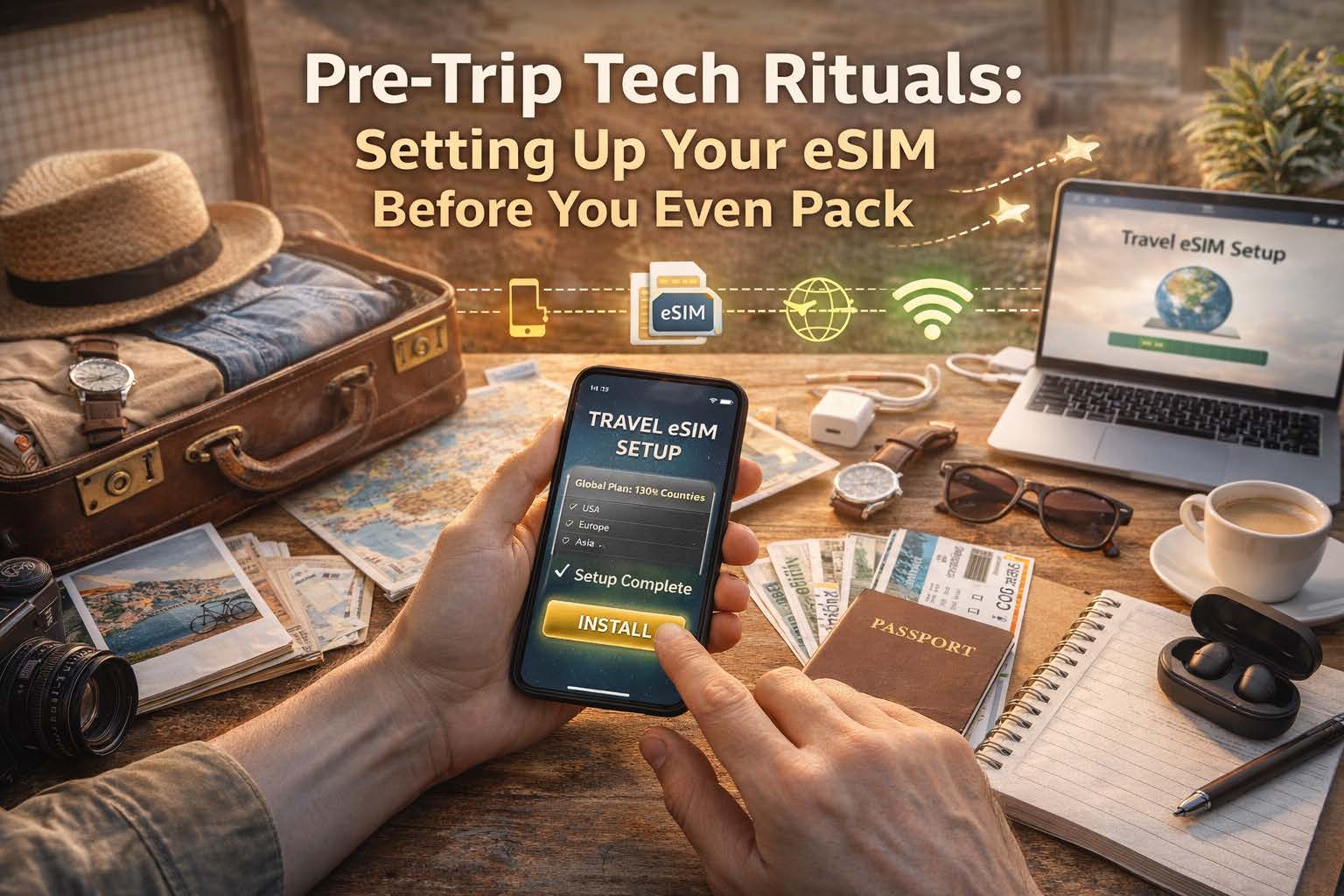
Because the smartest travelers connect before they even zip their suitcase
There’s a moment before every trip that feels like a quiet launch sequence.
The suitcase is open. Clothes are half-folded. Tabs are open on your laptop. A passport sits nearby like a small, powerful artifact. You haven’t left yet, but the journey has already begun.
Most travelers focus on what to pack. The seasoned ones focus on what to prepare.
And increasingly, one of the most important pre-trip rituals doesn’t involve clothing, toiletries, or even documents.
It’s setting up your eSIM.
Because in modern travel, connectivity isn’t something you figure out when you land. It’s something you design before you depart.
The New Travel Ritual: Connect Before You Go
There was a time when landing in a new country meant entering a brief digital blackout.
You’d search for Wi-Fi. Hunt for SIM cards. Try to decode telecom kiosks after a long flight. Maybe even wait until you reached your hotel just to get online.
Now imagine skipping all of that.
You step off the plane, turn off airplane mode, and your phone simply works.
Maps load. Messages send. Your ride is already booked.
That’s the power of setting up your eSIM before you even pack.
Step One: Choose Your Destination Coverage
Before you download anything, think about your route.
Are you visiting one country or several? Staying in cities or moving between regions?
Travel eSIM plans often vary in scope:
- Single-country plans for longer stays
- Regional plans for multi-country trips
- Global plans for maximum flexibility
Choosing the right coverage is like choosing the right adapter. It determines how smoothly everything else will work.
This is your first ritual: align your connectivity with your itinerary.
Step Two: Check Your Device Compatibility
Not all devices support eSIM, though most modern smartphones do.
Before your trip, confirm:
- Your phone supports eSIM
- Your device is unlocked
- Your operating system is up to date
This step takes minutes, but skipping it can lead to unnecessary stress later.
Think of it as checking your passport expiration date. Small detail, big consequences.
Step Three: Purchase and Install Your eSIM
Here’s where things start to feel futuristic.
Instead of buying a physical SIM card, you purchase a digital plan. Within moments, you receive a QR code or activation instructions.
You scan. You install. You name your plan something like “Travel Data” or “Europe eSIM.”
And just like that, your phone gains a second identity.
No tools. No trays. No tiny plastic cards.
Just a clean, digital setup.
Step Four: Configure Before You Leave
Installing your eSIM is only part of the ritual. Configuring it properly is what makes the experience seamless.
Before your trip:
- Set your eSIM as the default for data
- Keep your primary SIM active for calls/texts if needed
- Enable data roaming for the eSIM profile
- Turn off automatic switching if you want control over usage
This ensures your phone behaves exactly how you want it to when you arrive.
No surprises. No confusion.
Step Five: Test the Setup
Here’s a pro move many travelers skip.
Test your eSIM before you leave.
While you may not fully activate it until arrival, you can confirm:
- The profile is installed correctly
- Your phone recognizes the plan
- Settings are configured properly
This step turns uncertainty into confidence.
Because nothing beats knowing your connection is ready before you even leave home.
The Packing Table Becomes a Command Center
At some point during this process, your packing area transforms.
It’s no longer just a place for folding clothes. It becomes a staging ground for your entire trip.
On the table:
- Your phone, now equipped with global connectivity
- Your laptop, syncing travel documents
- Your boarding passes, ready to scan
- Your suitcase, slowly filling with essentials
And quietly, in the background, your eSIM setup is already doing its job.
It’s the invisible item on your packing list.
Why This Ritual Changes Everything
Setting up your eSIM before your trip does more than save time.
It changes your entire arrival experience.
Instead of:
- Searching for Wi-Fi
- Comparing SIM card options
- Navigating unfamiliar kiosks
You:
- Walk off the plane connected
- Navigate instantly
- Communicate without delay
Travel shifts from reactive to proactive.
You’re no longer solving problems as they appear. You’re preventing them before they exist.
The Psychological Advantage
There’s also a mental shift that comes with being prepared.
Travel can be unpredictable. Flights change. Plans evolve. Environments shift.
But when you know your phone will work the moment you land, a layer of uncertainty disappears.
You feel:
- More confident navigating new places
- More comfortable arriving late at night
- More capable of handling unexpected changes
It’s not just about data.
It’s about control.
The First Five Minutes After Landing
These minutes define your arrival experience.
With a pre-configured eSIM, those first moments look different.
You land.
You disable airplane mode.
Signal appears.
In seconds:
- Your maps app shows your location
- Your ride is booked
- Your hotel directions are clear
- Messages from home go out instantly
There’s no gap between arrival and action.
Just movement.
Common Mistakes to Avoid
Even with the simplicity of eSIMs, a few common mistakes can disrupt the experience.
Avoid these pitfalls:
- Waiting until arrival to install your eSIM
- Forgetting to enable data roaming on the eSIM profile
- Leaving your primary SIM as the default data line
- Not checking coverage for all destinations
Each of these can be avoided with a few minutes of preparation before departure.
The Evolution of Travel Preparation
Packing used to be physical.
Clothes. Shoes. Toiletries. Documents.
Now, part of your preparation is digital.
Apps. Downloads. Reservations. Connectivity.
Your eSIM is part of that evolution. It’s a tool that exists entirely in software, yet impacts every moment of your journey.
It doesn’t take up space. But it creates space.
Space to move freely.
Space to adapt quickly.
Space to focus on the experience instead of the logistics.
The Ritual That Travels With You
Once you’ve done it once, setting up an eSIM becomes second nature.
It becomes part of your pre-trip rhythm, like checking your passport or charging your devices.
A quiet, efficient step that ensures everything else runs smoothly.
And unlike most items you pack, this one follows you everywhere without adding weight.
Before You Zip Your Suitcase
There’s a small moment right before you close your bag.
You double-check everything.
Passport? Check.
Wallet? Check.
Chargers? Check.
Now add one more:
Connection? Already handled.
Because the smartest travelers don’t just pack for where they’re going.
They prepare for how they’ll stay connected when they get there.
And that preparation begins before the suitcase is even closed. ✈️




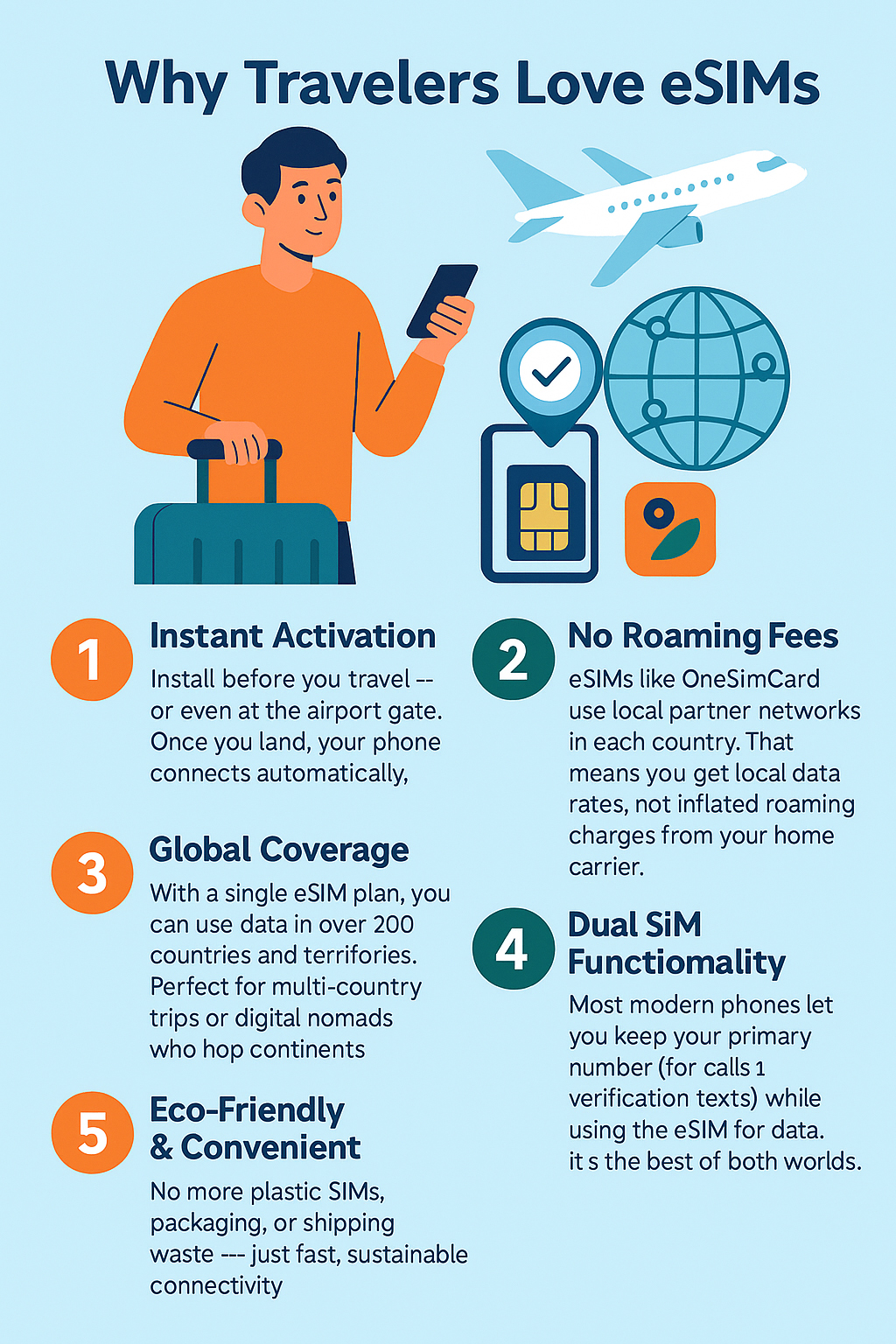

 Europe is one of the top regions where an eSIM outshines local SIMs. A traveler hopping from Paris to Rome to Berlin would otherwise need to buy separate SIM cards in each country — or face the headache of EU carrier restrictions.
 Japan is famous for its high-tech infrastructure, but buying a local SIM can be surprisingly complicated. Many kiosks require proof of residency, and English support can be limited.
 Brazil has strict rules around SIM card registration — often requiring a national ID (CPF). For international visitors, this makes buying a local SIM nearly impossible.
 India offers affordable mobile data, but buying a local SIM involves passport verification, paperwork, and waiting for activation — often up to 24 hours.
 Australia’s vast geography means coverage varies widely between carriers. Buying a local SIM locks you into one provider, which can be risky if you’re traveling outside big cities.
 In the UAE, buying a prepaid SIM requires passport scans and sometimes hotel confirmations. Lines at airport kiosks can be long, especially during peak travel seasons.
 Local SIMs in South Africa require in-person registration with ID verification. Availability can also be limited in smaller towns or rural areas which makes an eSIM with multiple network access critical.
 Turkey has strict telecom rules — local SIM cards often deactivate unless tied to a Turkish ID. For tourists, this makes local SIMs impractical.
 Visitors to the U.S. often struggle with high roaming charges and confusing prepaid plans. Many local SIMs are tied to contracts or require a U.S. address for setup. This can make local SIMs impossible.
 Buying a local SIM in China can be challenging for foreigners, requiring passport verification and sometimes long registration delays. Plus, certain services (like Google Maps or WhatsApp) are restricted on local networks.