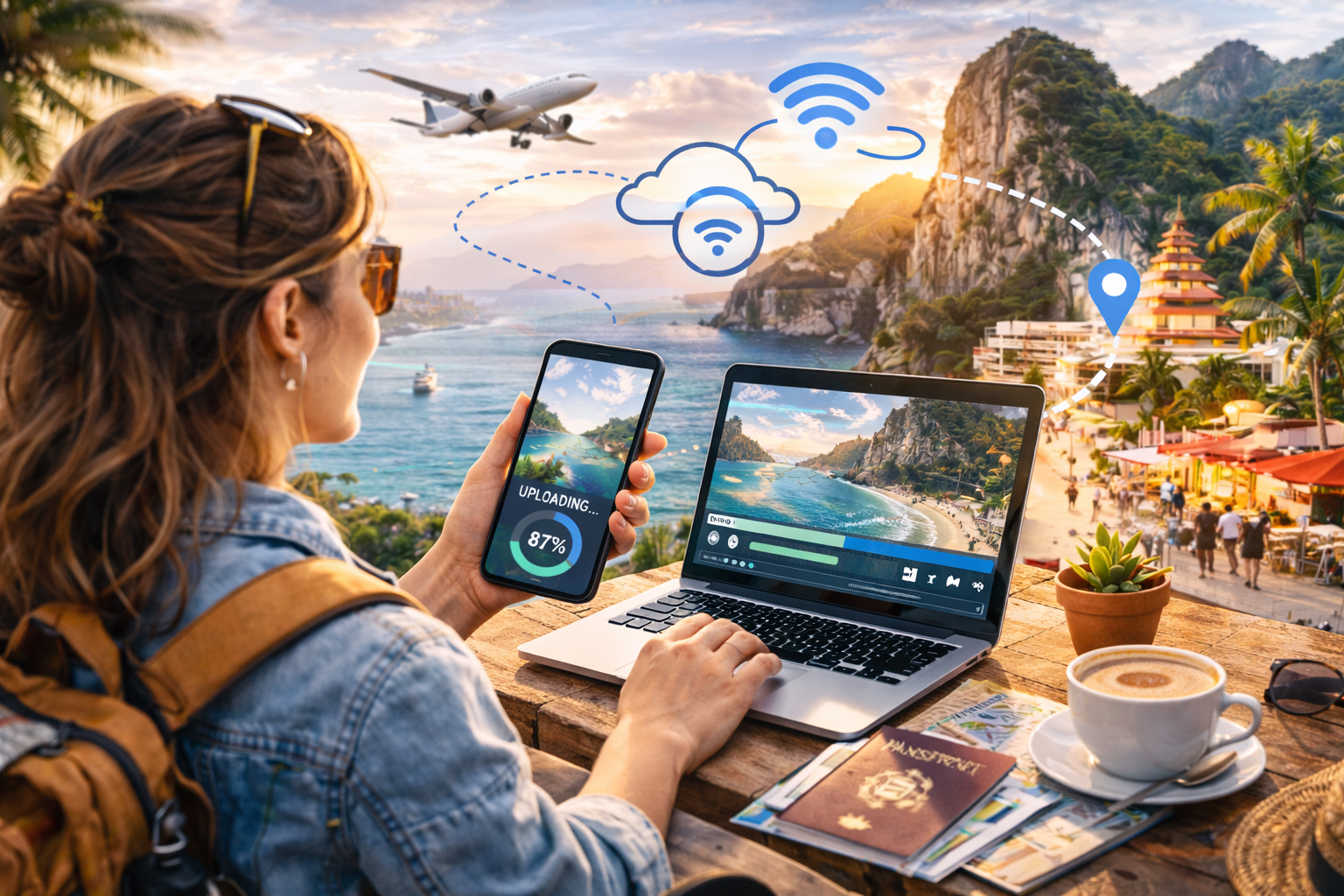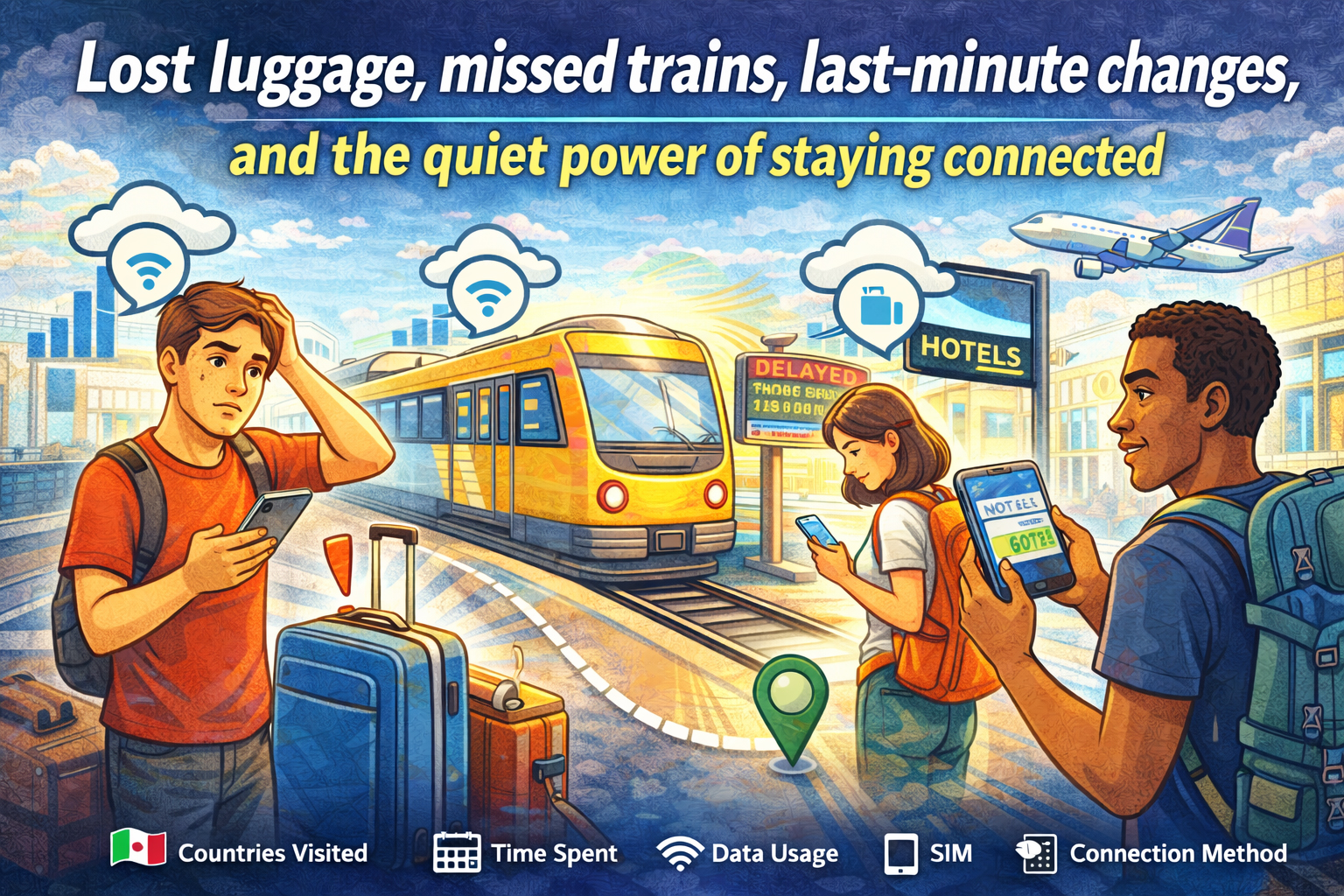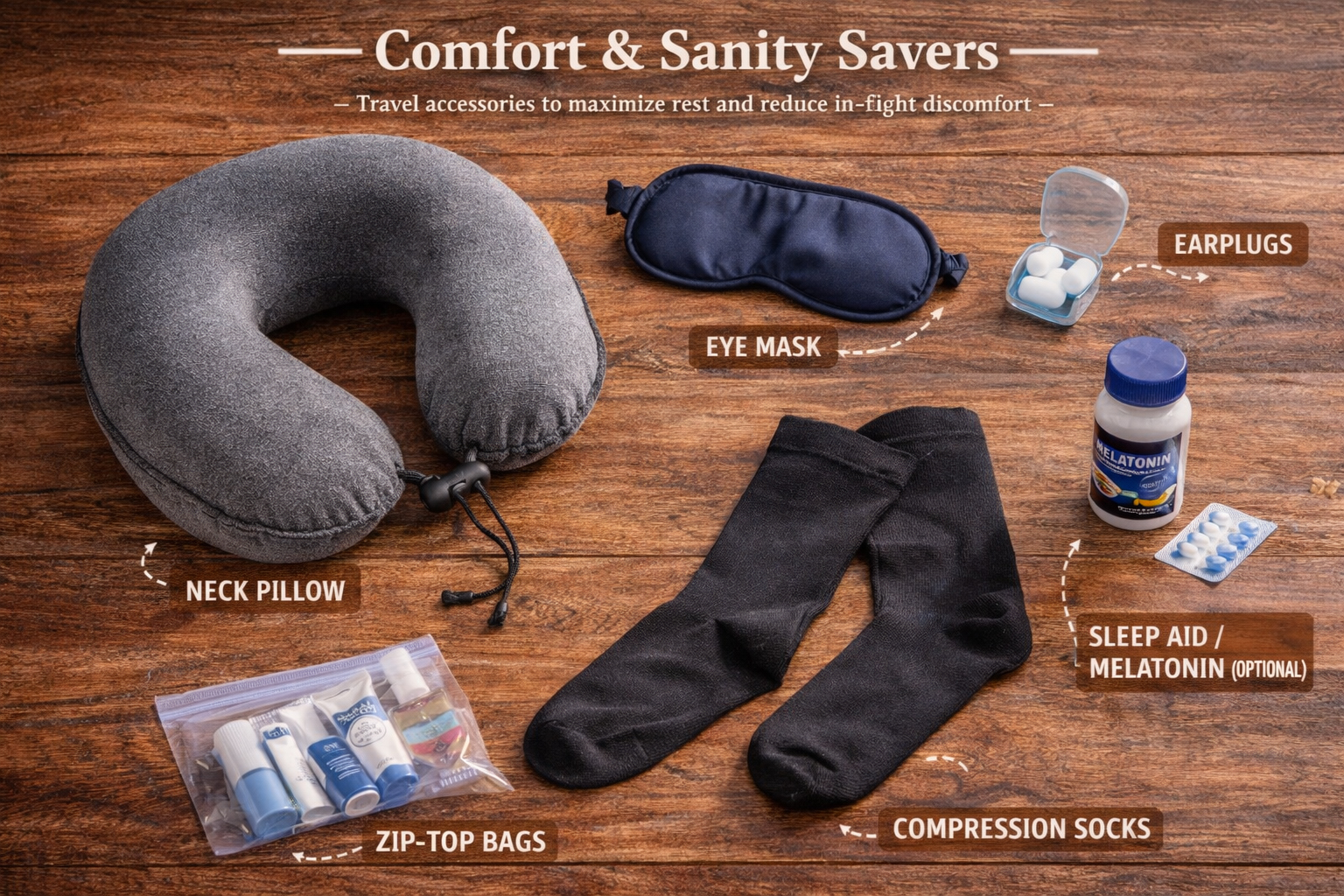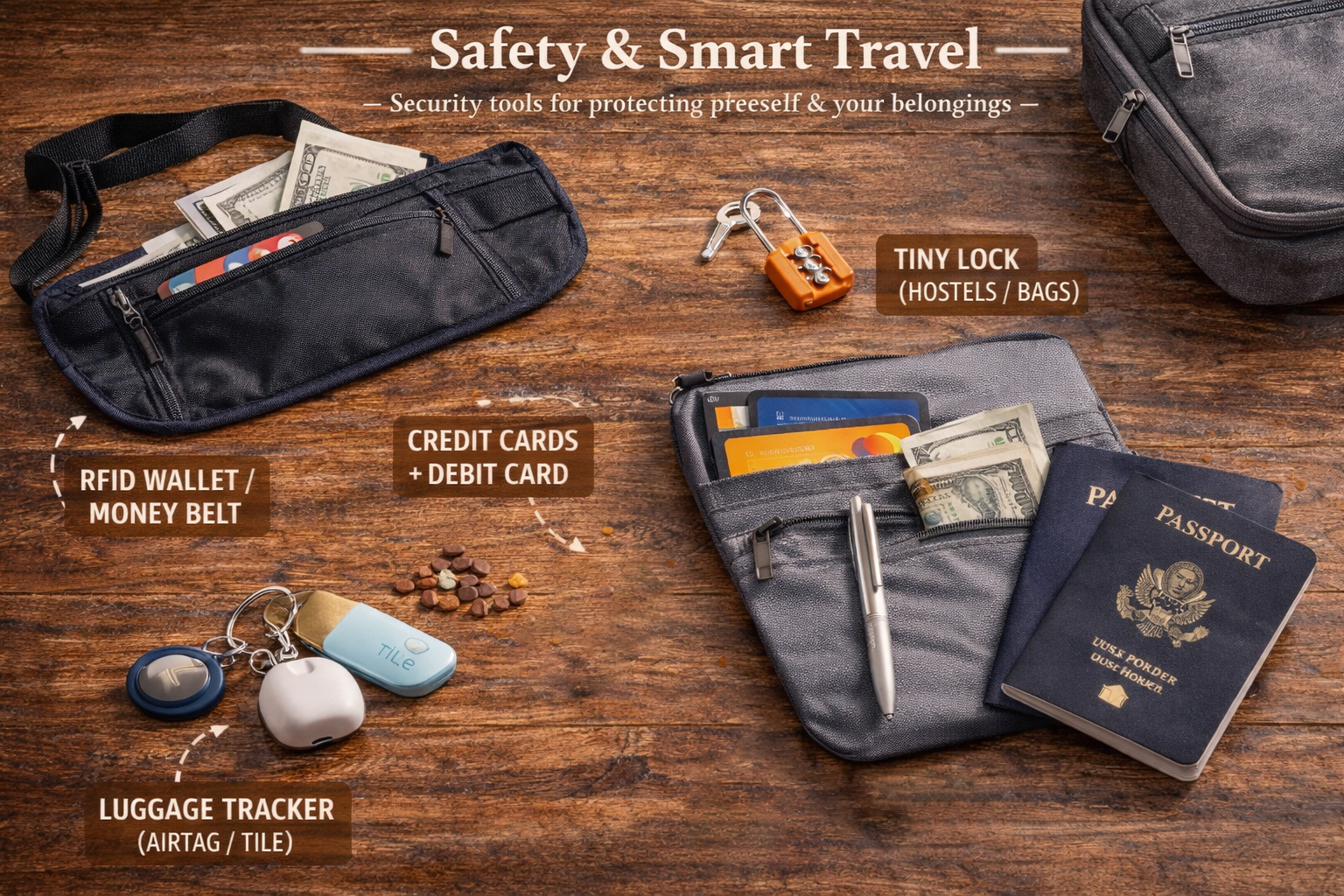

Summer is just around the corner (believe it or not!) and no doubt you are thinking about where your summer vacation will take you. If you are thinking of an international trip we prepared a “packing list” of things you may want to keep in mind to bring along.
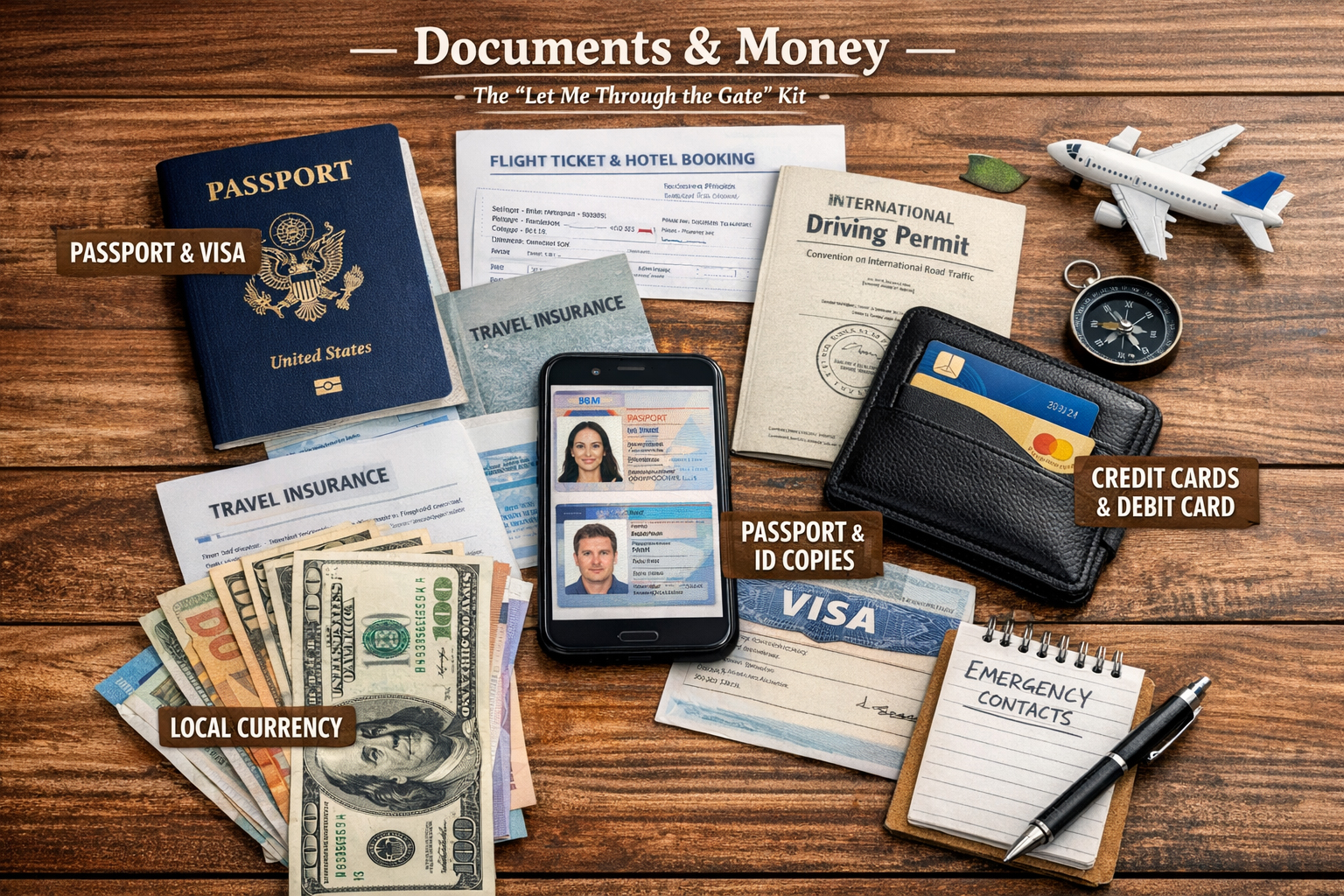
Documents & Money (The “Let Me Through the Gate” Kit)
Passport (valid 6+ months, blank pages)
Visa (if required)
Photocopies / digital scans (passport, ID, insurance)
Travel insurance details
Flight, hotel, and tour confirmations
Driver’s license / International Driving Permit
Credit cards + debit card
Local currency (small bills)
Emergency contacts
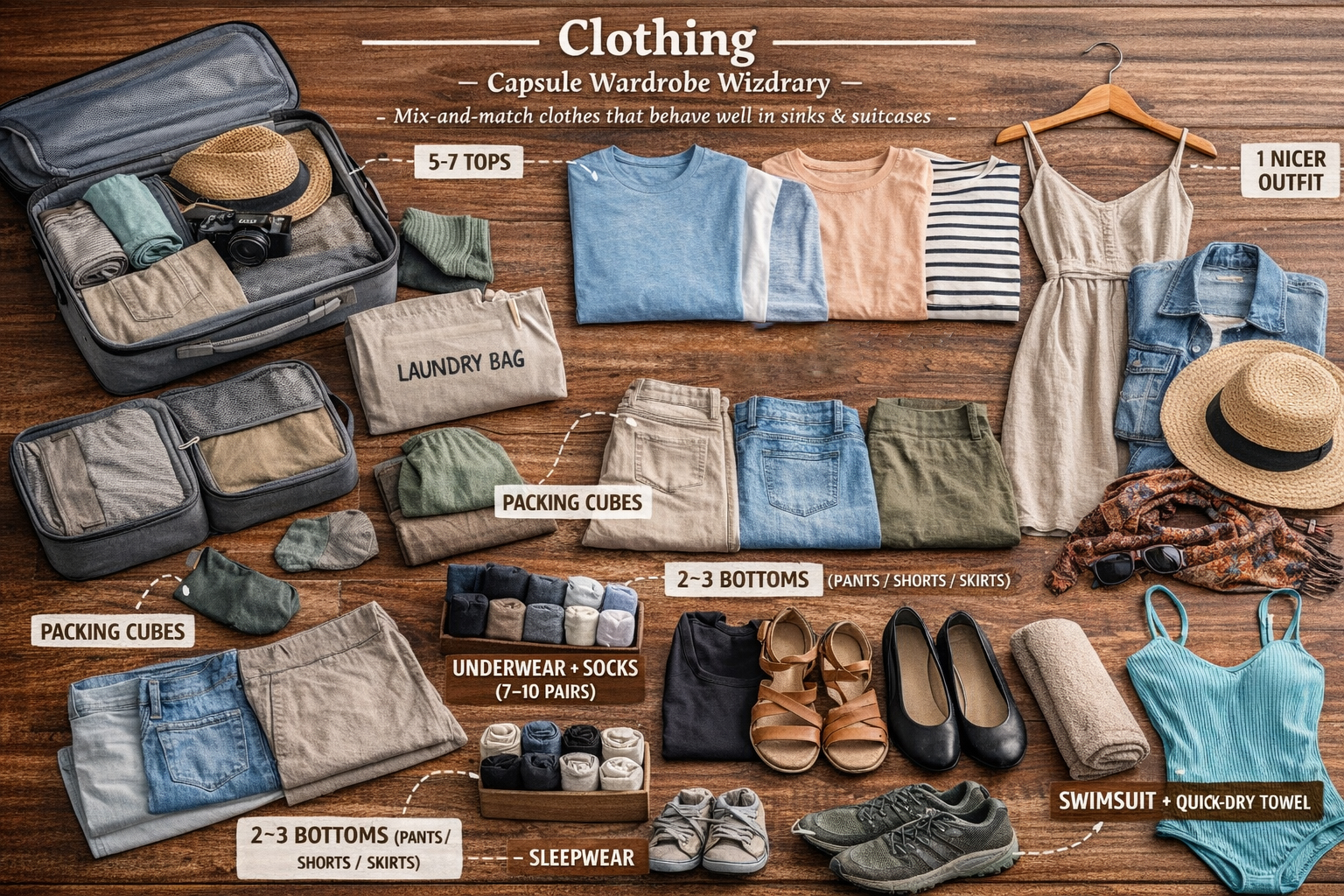
Clothing (Capsule Wardrobe Wizardry)
Aim for mix-and-match pieces that behave well in sinks and suitcases.
5–7 tops
2–3 bottoms (pants/shorts/skirts)
1 nicer outfit
Light jacket / sweater
Sleepwear
Underwear + socks (7–10 pairs)
Comfortable walking shoes
Dress shoes / sandals
Swimsuit + quick-dry towel
Hat / scarf (sun + style + warmth = triple agent)
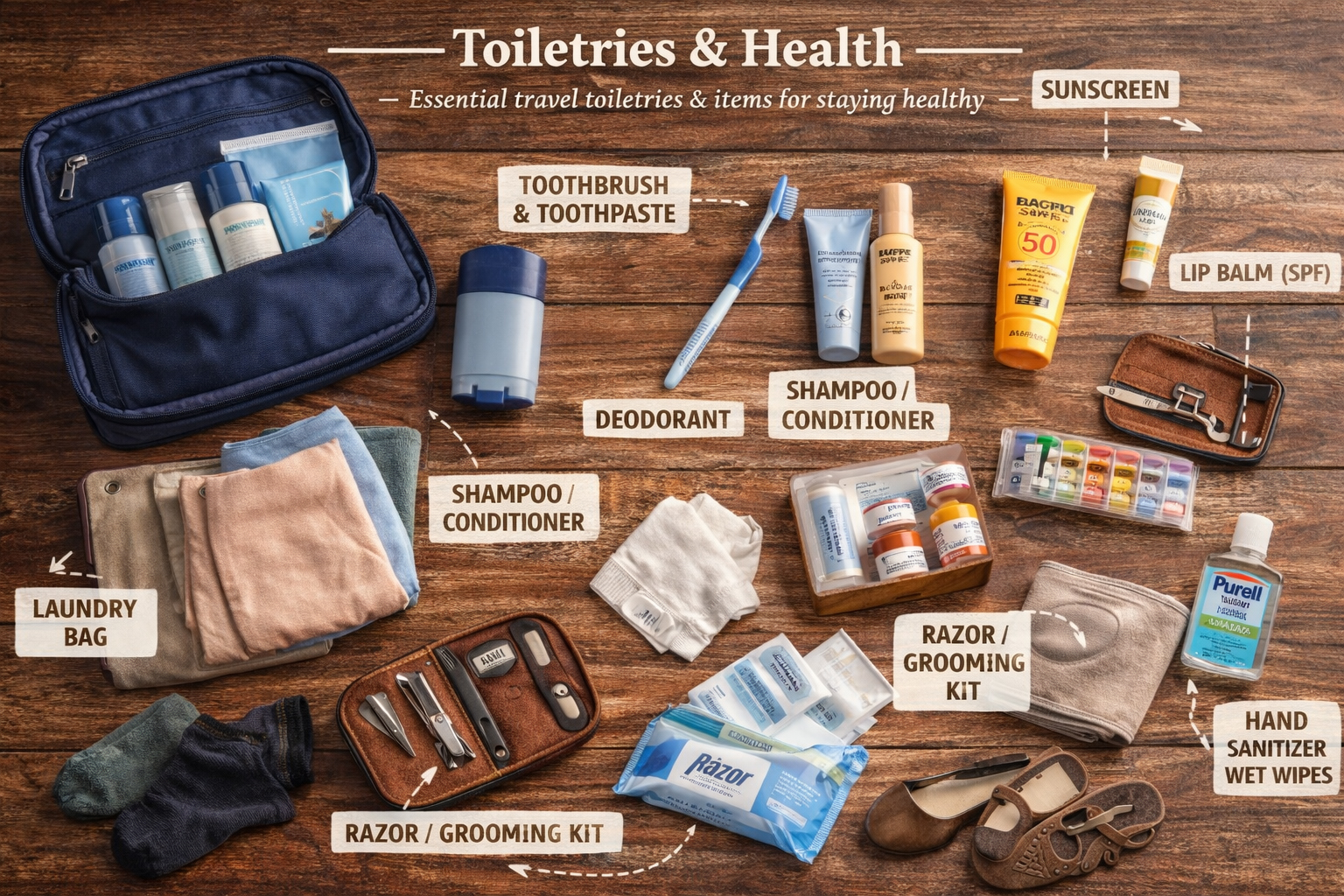
Toiletries & Health
Toothbrush + toothpaste
Deodorant
Shampoo / conditioner (travel size)
Face wash / moisturizer
Sunscreen
Lip balm (SPF)
Razor / grooming kit
Medications + prescriptions
Small first-aid kit (band-aids, pain reliever, motion sickness tabs)
One empty space in your bag (for souvenirs and stories)
Whether you are planning a trip to Paris or Paraguay, Berlin or Beijing, OneSimCard has you covered. If it is our traditional plastic SIM or our newer DataMax eSIM, we have been helping travelers like you stay connected for over 30 years, and we would love the opportunity to keep you connected on your next journey!
Don’t have an eSIM yet?
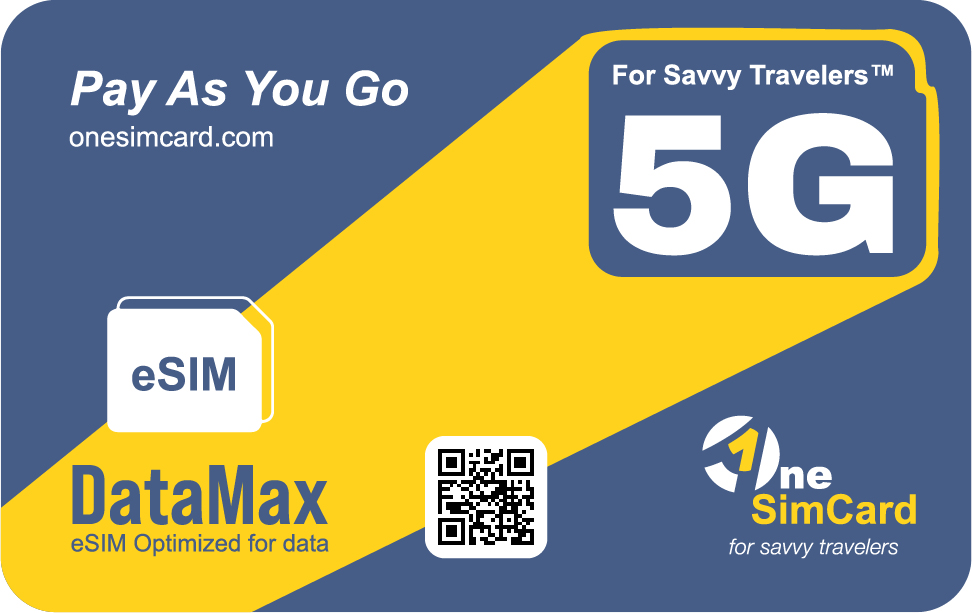
We make it simple to get our latest eSIM optimized for data connectivity. Our DataMax eSIM is available for download (first time download is free with the purchase of a data plan) with our eSIM app available for iOS and Android devices:
A traveler’s guide to Europe, Asia, and Latin America
International travel used to come with a familiar ritual: land, scramble for Wi-Fi, hunt for a SIM kiosk, and hope the tiny plastic card doesn’t vanish into the airport carpet.
Today, a travel eSIM turns that whole routine into a quiet little magic trick: you activate digitally, connect instantly, and keep moving.
Not every destination feels equally “effortless,” though. The smoothest eSIM experiences tend to happen in countries with strong mobile infrastructure, multiple carrier partners, reliable 4G/5G coverage, and travel-friendly connectivity.
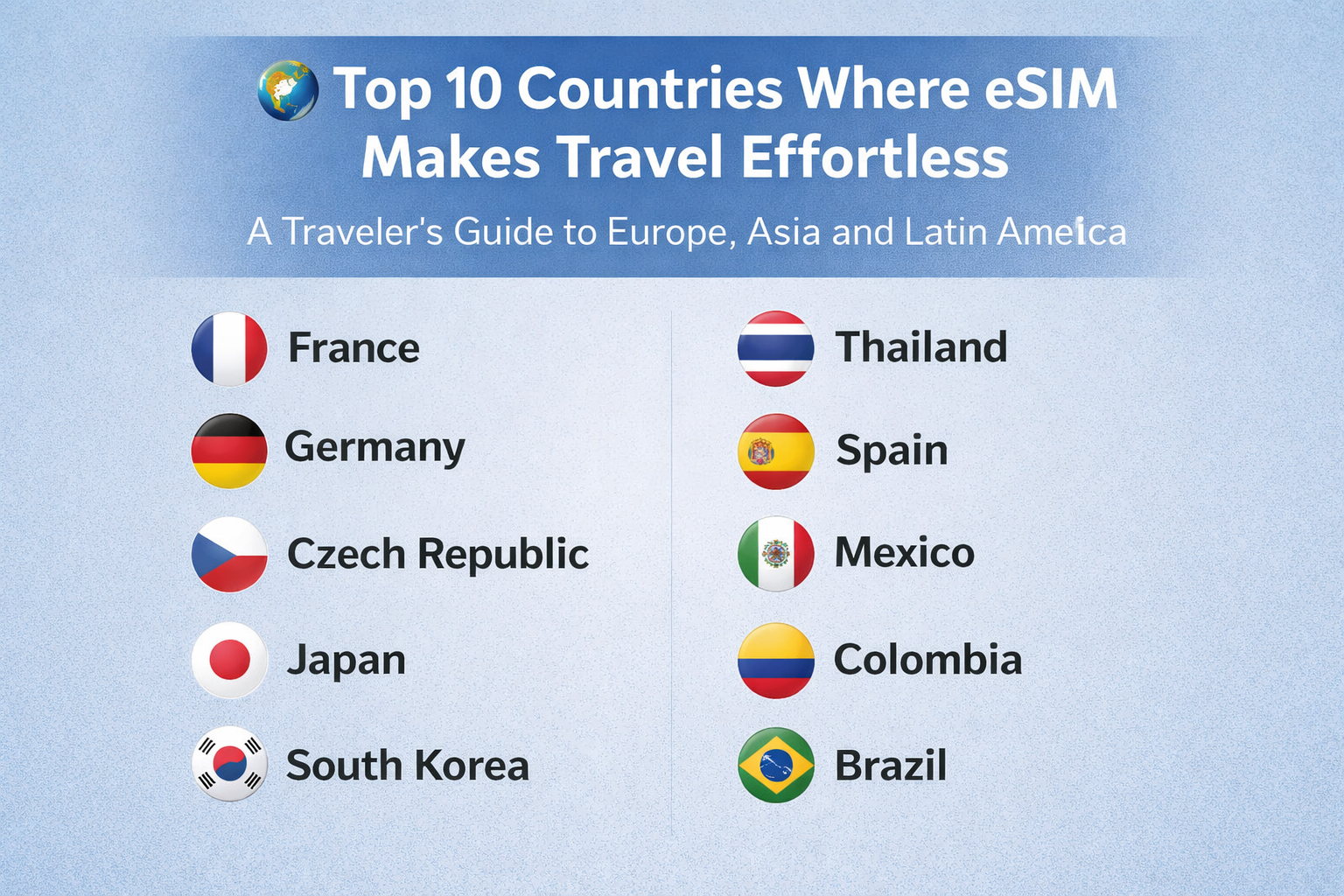
Below are 10 countries where eSIM travel feels particularly friction-free, with a focus on Europe, Asia, and Latin America.
Tip: For the smoothest start, install your eSIM before you fly (on Wi-Fi), then enable Data Roaming on the eSIM line when you arrive.
1. France
Why it’s eSIM-friendly: Excellent nationwide coverage, fast LTE and 5G in major areas, and a travel-ready network environment.
France is the kind of destination where eSIM travel feels almost invisible. You can step off the plane in Paris, disable airplane mode, and immediately pull up transit routes,
reserve museum tickets, message your hotel, and navigate the city without bargaining with a SIM vendor. Connectivity stays reliable beyond the capital too, which is a big win
for travelers heading to the Loire Valley, Normandy, or the lavender-scented lanes of Provence.
Best for: City breaks, food-and-culture itineraries, rail travel.
2. Germany
Why it’s eSIM-friendly: Strong infrastructure, multiple carrier options, and excellent connectivity along major transit routes.
Germany is built for movement: ICE trains, efficient city transit, and road trips that turn into spontaneous detours. A travel eSIM shines here because you can stay connected
through big hubs like Berlin, Munich, and Frankfurt while also keeping dependable data for navigation in smaller towns. If you’re crossing borders into Austria, the Czech Republic,
or beyond, eSIM convenience compounds fast: fewer plan changes, fewer “why isn’t this working” moments.
Best for: Multi-country trips, business travel, train-heavy itineraries.
3. Czech Republic
Why it’s eSIM-friendly: Excellent coverage in tourist areas, strong urban speeds, and easy connectivity for short stays.
The Czech Republic is compact, traveler-friendly, and wonderfully walkable, which makes it a perfect match for eSIM convenience. In Prague, you’ll likely use data constantly:
tram schedules, restaurant reservations, translation, tickets, and maps for wandering Old Town and beyond. With an eSIM, your phone stays reliably connected without requiring any
SIM swapping, even if your trip includes day trips or onward train travel into neighboring countries.
Best for: Weekend escapes, cultural tourism, rail routes from Western Europe into Central Europe.
4. Japan
Why it’s eSIM-friendly: Advanced mobile networks, dense coverage, and eSIM convenience that avoids the “SIM counter puzzle” for visitors.
Japan is a dream for connected travel: precise transit, cashless options, and helpful apps for everything. It’s also a place where visitors often want data immediately to navigate
stations, translate menus, and coordinate reservations. A travel eSIM is ideal because you can install before departure and land with a working connection, no airport line required.
Whether you’re riding the Shinkansen, exploring Tokyo neighborhoods, or mapping out Kyoto temples, eSIM connectivity keeps the trip flowing.
Best for: First-time Asia travelers, solo travel, city exploration.
5. South Korea
Why it’s eSIM-friendly: Fast data speeds, strong coverage, and a tech-forward travel experience that depends on mobile connectivity.
South Korea makes “always connected” feel normal. Travelers use mobile data for navigation, translation, food delivery, ride-hailing, and on-the-fly planning. With a travel eSIM,
you can keep your trip moving smoothly from Seoul’s neighborhoods to coastal escapes like Busan. If you create content, you’ll appreciate the stability for uploads and messaging.
If you’re traveling for business, you’ll appreciate the reliability for calls and meetings.
Best for: Tech-forward travel, remote work, content creators.
6. Thailand
Why it’s eSIM-friendly: Strong networks in tourist corridors, reliable data in major cities, and a travel style that benefits from instant activation.
Thailand is a favorite for a reason: it’s welcoming, vibrant, and surprisingly connected. Whether you’re navigating Bangkok, booking ferries to islands, or working from Chiang Mai,
data is the backbone of a smooth trip. A travel eSIM helps you skip the airport SIM shuffle and keeps you connected as you hop between regions. It’s also perfect for travelers who
rely heavily on maps and messaging while moving day-to-day.
Best for: Backpackers, island hoppers, digital nomads.
7. Spain
Why it’s eSIM-friendly: Strong 4G/5G coverage in major destinations, excellent transit connectivity, and effortless multi-city travel.
Spain is built for roaming the fun way: Barcelona to Madrid, Seville to Valencia, then maybe a last-minute coastal detour. With an eSIM, you don’t have to think about connectivity
every time you move cities. You can keep your maps and bookings live, share travel updates, and coordinate plans without hunting for local SIM solutions. If your trip extends across
borders (Portugal, France), an eSIM keeps the “same phone, same flow” experience going.
Best for: Multi-city vacations, festival travel, train routes.
8. Mexico
Why it’s eSIM-friendly: Strong coverage in cities and popular destinations, great value for travelers, and easy setup without in-person SIM purchases.
Mexico is one of the best Latin American countries for eSIM travel because it combines huge traveler demand with practical connectivity. In Mexico City, mobile data is essential for
navigation, ride-hailing, and restaurant planning. In beach regions like Cancún or Playa del Carmen, travelers often bounce between Wi-Fi and mobile data, making flexible eSIM access
especially handy. An eSIM is also useful for road trips where you want dependable navigation without depending on spotty public Wi-Fi.
Best for: Beach vacations, city breaks, road trips.
9. Colombia
Why it’s eSIM-friendly: Improving networks, excellent connectivity in major cities, and a growing digital-nomad scene.
Colombia has become a hotspot for travelers who want culture, scenery, and great long-stay value. In cities like Medellín and Bogotá, reliable data makes daily travel easier:
maps, messaging, translations, and work calls. A travel eSIM removes the need to navigate local SIM rules and keeps connectivity consistent as you explore different neighborhoods
or move between destinations.
Best for: Remote workers, city explorers, longer stays.
10. Brazil
Why it’s eSIM-friendly: Strong carrier competition in major cities and a travel style that benefits from consistent connectivity across large distances.
Brazil is big, bold, and sprawling, which makes SIM swapping especially annoying if your itinerary includes multiple cities. With an eSIM, you can move between major hubs like
São Paulo and Rio while keeping your navigation, plans, and communication stable. For travelers coordinating tours, transportation, or group plans, reliable data is the difference
between smooth logistics and frantic WhatsApp scrambling.
Best for: Multi-city trips, long-distance travel, business + leisure itineraries.
Why eSIMs Make Travel Effortless in These Countries
Across Europe, Asia, and Latin America, these destinations share a few important traits that make eSIM travel feel frictionless:
Strong mobile infrastructure with reliable 4G/5G service in key travel zones
Multiple carrier partners, giving your eSIM more options to connect
Travel-ready coverage across transit routes, city centers, and popular tourist regions
Easy cross-border movement (especially in Europe) where eSIMs avoid SIM swapping hassles
Why OneSimCard Is a Great Fit for Multi-Country Trips
If your itinerary includes more than one country, the convenience of an eSIM multiplies quickly. OneSimCard is designed for travelers who want dependable connectivity without the
usual logistics headache:
Coverage in 200+ destinations
One eSIM for multi-country travel (no swapping tiny plastic cards)
No contracts or subscriptions
Free incoming SMS
Optional voice calling with the OneSimVoIP app
Multi-network access to help maintain a strong connection on the move
✈️ Final Thoughts
The best trips are the ones where your phone quietly does its job in the background: maps load, tickets appear, translations work, messages go through, and you never have to
think about SIM trays or roaming surprises. In the 10 countries above, a travel eSIM is one of the simplest upgrades you can make for smoother travel.
Privacy, Encryption, and SIM Swapping Myths — Explained
As travelers continue switching from plastic SIM cards to digital eSIMs, one question comes up again and again: “Are eSIMs secure?”
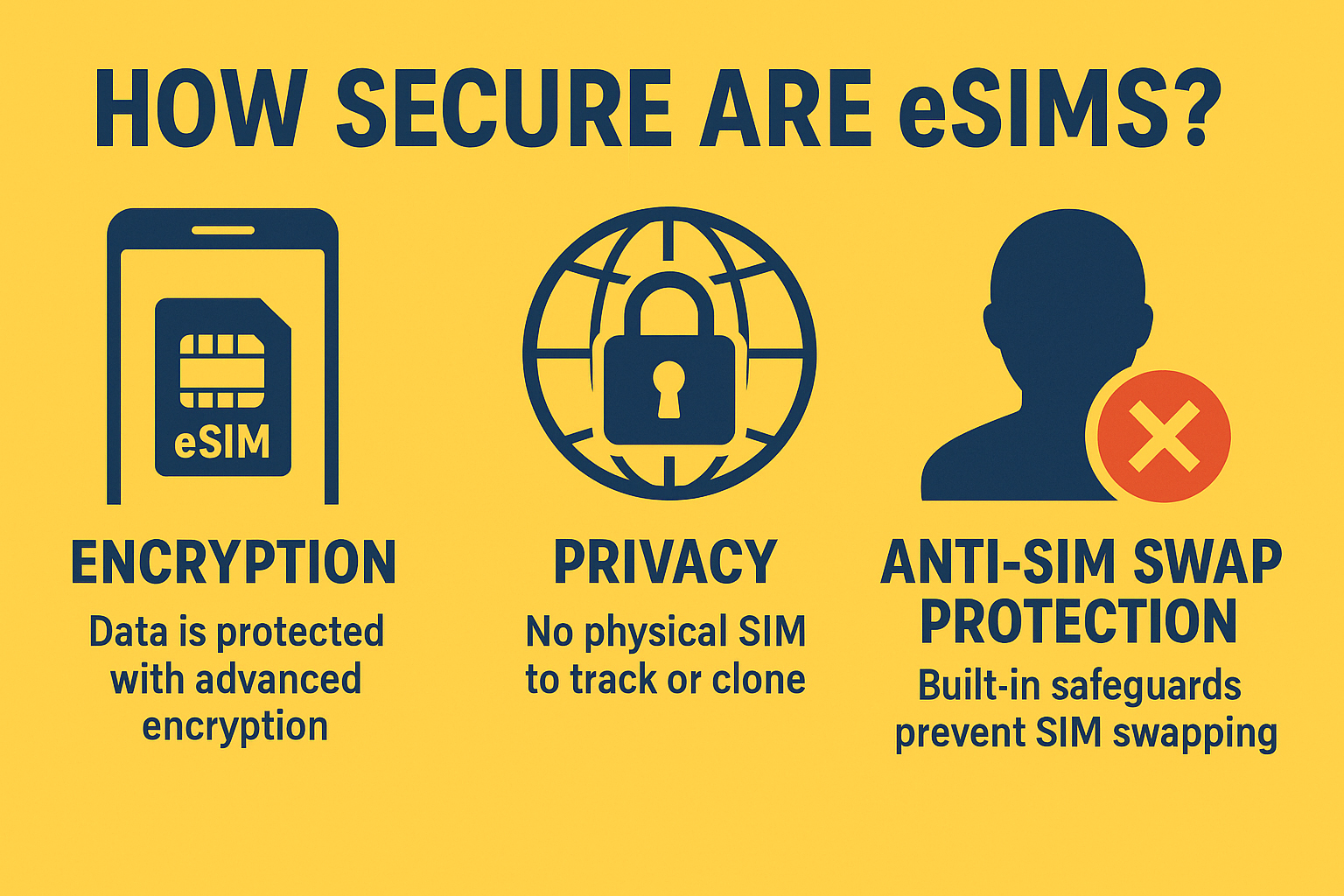
The short answer: Yes — eSIMs are not only secure, they’re significantly safer than traditional SIM cards.
But like any digital tool, understanding how eSIM security works — and what threats to look out for — is essential, especially for travelers moving between countries, Wi-Fi networks, and mobile carriers.
This guide breaks down the privacy protections, encryption technology, and myths surrounding eSIMs so you can travel smarter and stay connected with confidence.
What Is an eSIM, and Why Is It More Secure?
An eSIM (embedded SIM) is a rewritable chip built directly into your smartphone, tablet, or IoT device. Unlike a removable SIM card, an eSIM can’t be physically swapped, stolen, or cloned without your knowledge.
Instead of inserting a chip, you download a secure digital profile from your carrier or provider — like OneSimCard — and activate it instantly.
Why That Matters for Security
No physical access: Thieves can’t remove or replace your eSIM like a traditional SIM.
Encrypted provisioning: Each eSIM profile is delivered over an encrypted connection, verified by the device’s secure element.
Tamper-resistant hardware: eSIMs live inside a protected chip that’s isolated from the operating system, reducing the risk of malware access.
Carrier-verified identities: Every eSIM profile comes with a digital signature that ensures authenticity.
Essentially, an eSIM eliminates the most common source of SIM fraud — physical manipulation.
Encryption: How eSIMs Keep Your Data Private
Every time your phone connects to a network, the eSIM uses advanced encryption and mutual authentication to verify both your device and the carrier’s system.
Here’s what that means in plain English:
Mutual authentication ensures that only legitimate networks can communicate with your device — and vice versa.
128-bit or higher encryption scrambles your mobile identity and data so that it’s unreadable to outsiders.
Remote profile management happens through secure carrier channels, protected by digital certificates.
So, even if you’re on a public airport Wi-Fi or connecting through roaming networks abroad, your mobile identity and data remain encrypted.
️ Myth #1: “eSIMs Make You Easier to Track”
This is a common misconception, but eSIMs do not make you more traceable than physical SIMs.
Mobile carriers always require an identifier (IMSI) to route calls and data — that’s true for both SIM and eSIM devices. What changes with eSIM is control:
You can switch providers instantly without disclosing new personal data to multiple stores or resellers.
OneSimCard’s eSIMs use multiple international identities, minimizing the sharing of your real number across borders.
Because there’s no physical SIM, third-party data brokers or thieves can’t clone or read your SIM details.
In fact, many privacy-focused travelers prefer eSIMs because they reduce the number of entities handling your data.
Myth #2: “eSIMs Are Vulnerable to Hacking”
In reality, eSIMs have more layers of security than removable SIMs.
Traditional SIMs can be cloned, stolen, or compromised via phishing. eSIMs, by contrast, require several things to go wrong simultaneously:
Physical access to your device
Device passcode bypass
Carrier authentication override (protected by certificates)
Each of these layers includes encryption and identity verification, making successful attacks extremely unlikely.
To date, there are no known large-scale eSIM hacks. By design, eSIMs comply with stringent GSMA security standards — the same framework used by global carriers and banks for digital authentication.
Myth #3: “SIM Swapping Can Still Happen with eSIMs”
SIM swapping — where hackers trick a carrier into transferring your number to their SIM — has become a serious problem in recent years.
However, eSIM technology dramatically reduces that risk.
Here’s why:
Carriers use multi-factor verification before transferring eSIM profiles.
Every eSIM installation must be authorized from your device, often requiring biometrics or a passcode.
Profiles can’t be downloaded or duplicated without your device’s unique identifier (EID).
In other words, even if a hacker convinces a carrier to create a new eSIM profile, they’d still need your phone’s secure hardware to activate it.
For travelers, this means your mobile identity is safer in digital form than plastic form.
Real-World Travel Scenarios: How eSIMs Protect You
✈️ Airport SIM Swaps — Eliminated
In the past, travelers had to buy local SIMs from kiosks, handing over passports and personal info. eSIMs remove that exposure — everything happens securely online through trusted providers like OneSimCard.
Public Wi-Fi Attacks — Minimized
When you connect via eSIM, your cellular data bypasses unencrypted Wi-Fi risks entirely. That’s critical when checking banking apps or booking flights from airports and hotels.
Lost or Stolen Phones
Even if someone steals your device, your eSIM can’t be removed and resold. You can remotely disable or wipe the profile using Apple’s “Find My” or Android’s “Find My Device.”
Cross-Border Roaming
With OneSimCard’s multi-network redundancy, your eSIM automatically connects to the most secure available partner — no need to switch SIMs or trust local vendors.
How eSIMs Handle Personal Data
All eSIM provisioning is governed by GSMA’s Remote SIM Provisioning (RSP) standard, which defines exactly how your profile is created, stored, and deleted.
Key security principles include:
End-to-end encryption: No one — not even the carrier — can view your actual authentication keys.
Secure profile storage: eSIM data lives inside a hardware-based “secure enclave,” isolated from apps or system files.
Controlled access: Only authorized carriers can send updates or delete profiles.
When you delete a OneSimCard eSIM profile, the system erases it from both your device and the carrier database — no lingering data remains.
Traveler Tips for Maximum eSIM Security
Even with built-in protections, good digital hygiene goes a long way:
Use a reputable provider — Stick with established brands like OneSimCard that comply with GSMA and GDPR privacy regulations.
Lock your device — Enable biometric login (Face ID, fingerprint, or PIN).
Don’t share your QR code — Treat your eSIM activation code like a password.
Update regularly — Keep your phone’s OS current to ensure the latest security patches.
Avoid sketchy networks — Rely on your eSIM’s cellular data instead of public Wi-Fi when handling sensitive info.
The Bottom Line: eSIMs Are Safer Than Traditional SIMs
For travelers, eSIMs are a leap forward in both convenience and protection. The combination of hardware-level encryption, remote management, and tamper-proof provisioning makes them a powerful shield against modern threats like SIM swapping, phishing, and data theft.
When you travel with a OneSimCard eSIM, your connectivity is not just global — it’s secure by design. You control your data, your identity, and your network access from anywhere in the world.
✅ Final Takeaway
Are eSIMs secure? Absolutely. Are they safer than traditional SIMs? Without a doubt.
For travelers who value privacy and peace of mind, an eSIM offers the most secure way to stay connected across borders.
Stay Secure — Stay Connected
Your journey shouldn’t come with security compromises.
Activate your OneSimCard eSIM today and enjoy global data, privacy, and confidence — wherever you roam.
An eSIM (embedded SIM) is a digital version of the traditional plastic SIM card. Instead of inserting a physical chip, you simply download a mobile profile directly to your smartphone.
For travelers, this means you can:
Activate international data instantly without visiting a store
Switch between local and global plans in seconds
Keep multiple numbers or data profiles on one device
Avoid roaming fees and lost SIM cards
As eSIM adoption grows, most new phones from Apple, Samsung, Google, and other brands now include this feature. Let’s explore which models support it — and how to check if yours does.
Compatible Phones – Quick Reference
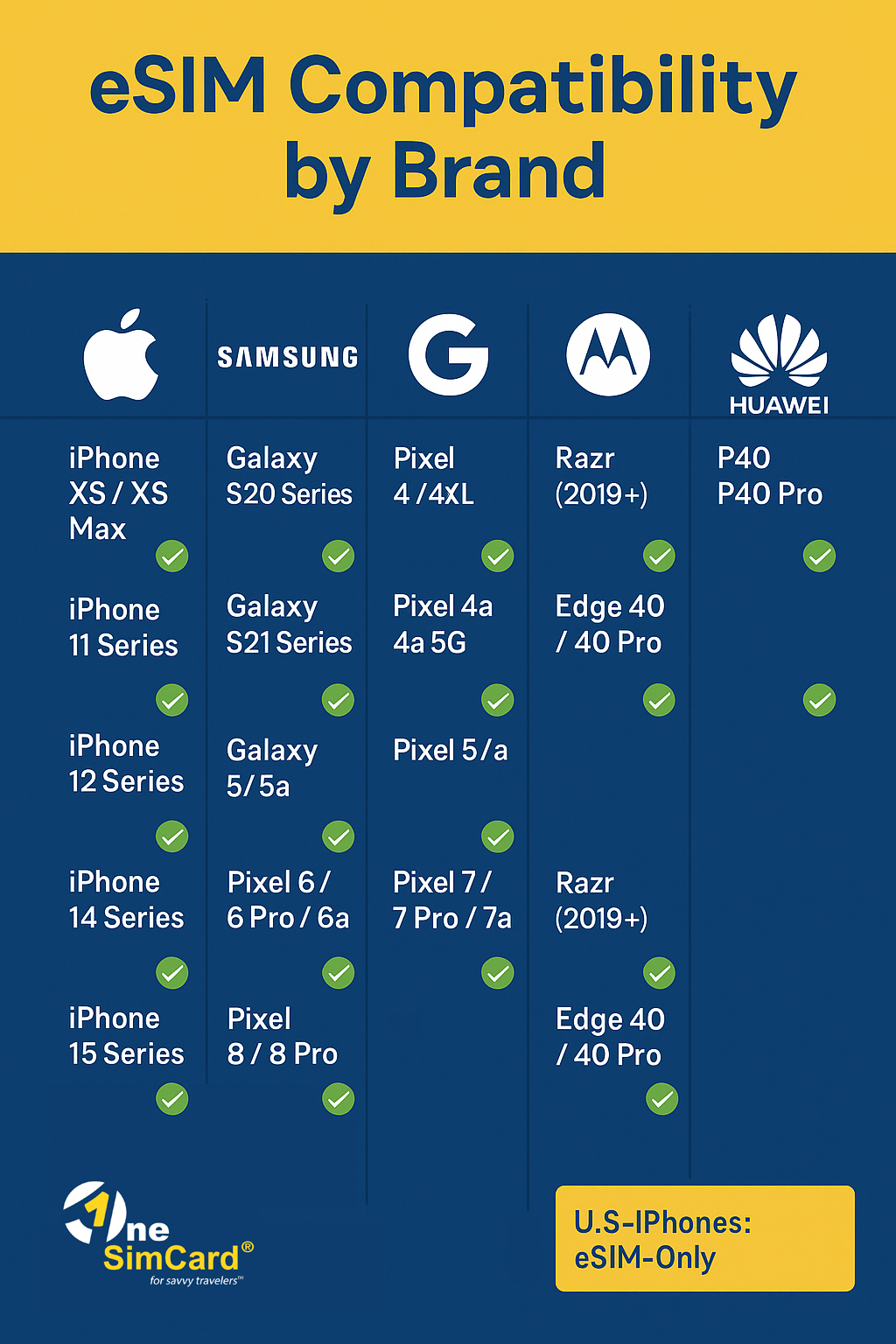
Apple iPhone eSIM Compatibility
Apple was the first major brand to push eSIM adoption, starting in 2018.
iPhone Model
eSIM Supported
Dual eSIM Capability
iPhone XS / XS Max
✅ Yes
❌ One eSIM + one physical SIM
iPhone XR
✅ Yes
❌
iPhone 11 / 11 Pro / 11 Pro Max
✅ Yes
❌
iPhone 12 / 12 mini / 12 Pro / 12 Pro Max
✅ Yes
✅ Dual eSIM supported (iOS 15+)
iPhone 13 / 13 mini / 13 Pro / 13 Pro Max
✅ Yes
✅
iPhone 14 Series
✅ Yes
✅ (U.S. models are eSIM-only)
iPhone 15 / 15 Plus / 15 Pro / 15 Pro Max
✅ Yes
✅ (U.S. models are eSIM-only)
Pro Tip: If you bought your iPhone in the U.S. (starting with the iPhone 14), it likely has no physical SIM slot — meaning you’re already using eSIM by default.
How to check your iPhone for eSIM support:
Go to Settings → Cellular (or Mobile Data)
Tap Add eSIM or Add Cellular Plan
If you see the option to scan a QR code, your phone supports eSIM.
Android eSIM Compatibility
Unlike Apple, Android phones vary more widely across manufacturers and regions. But most premium and newer mid-range devices support eSIM.
Samsung eSIM Support
Model
eSIM Supported
Notes
Galaxy S20 / S20+ / S20 Ultra
✅ Yes
Region-specific (not all carriers enable it)
Galaxy S21 / S21+ / S21 Ultra
✅ Yes
Dual SIM with eSIM support
Galaxy S22 / S22+ / S22 Ultra
✅ Yes
Global support
Galaxy S23 / S23+ / S23 Ultra
✅ Yes
Full eSIM functionality
Galaxy Z Flip / Flip3 / Flip4 / Flip5
✅ Yes
Compact dual-SIM flexibility
Galaxy Z Fold / Fold2 / Fold3 / Fold4 / Fold5
✅ Yes
Ideal for frequent travelers
Note: Some carrier-locked versions may disable eSIM — always confirm with your provider or use OneSimCard eSIM for universal activation.
Google Pixel eSIM Support
Model
eSIM Supported
Pixel 3 / 3 XL (some models)
✅ Partial
Pixel 4 / 4 XL
✅ Yes
Pixel 4a / 4a 5G
✅ Yes
Pixel 5 / 5a
✅ Yes
Pixel 6 / 6 Pro / 6a
✅ Yes
Pixel 7 / 7a / 7 Pro
✅ Yes
Pixel 8 / 8 Pro
✅ Yes
Pixels are among the most eSIM-friendly phones — they work across dozens of global networks, making them ideal for international travelers using OneSimCard eSIM.
Other Android Brands
Brand
Compatible Models
eSIM Notes
Motorola
Razr 2019+, Edge 40, Edge 40 Pro
✅ Yes, on select models
Huawei
P40, P40 Pro, Mate 40 Pro
✅ Yes, but limited Google support
OPPO
Find X3 Pro, Find X5, Reno 8 Pro
✅ eSIM support growing rapidly
Xiaomi
13 Series, 13T Pro
✅ Supported in select regions
Honor
Magic5 Pro
✅ Supported
Sony
Xperia 10 III+, Xperia 5 IV, Xperia 1 V
✅ Yes
Regional Variations to Know
Not all models sold in every market have eSIM enabled. For example:
Some Samsung phones in South America or Asia ship without eSIM activation.
iPhones purchased in China or Hong Kong may have dual physical SIM slots instead.
Pixel devices are generally universal, but activation depends on the local carrier.
✅ Always confirm your model’s eSIM capability by visiting your phone’s manufacturer support page or checking in the SIM settings menu.
Why Travelers Love eSIM
For anyone using an international eSIM like OneSimCard, compatibility means freedom:
Instant activation: Scan a QR code before your flight.
No waiting for delivery: Perfect for last-minute trips.
Switch plans anytime: Use one eSIM for Europe, another for Asia.
Stay connected: Keep your home number active while using local data.
With more than 200 countries covered, OneSimCard eSIMs work on major devices listed above — ensuring your phone stays connected whether you’re hiking in the Alps or working remotely from Bali.
Final Thoughts
eSIM technology is transforming how we travel, communicate, and stay connected. With nearly all major phones now supporting it, you can leave behind the hassle of swapping plastic SIMs — and enjoy instant, global data at your fingertips.
Whether you’re using the latest iPhone 15, Samsung Galaxy S23 Ultra, or Google Pixel 8, a OneSimCard eSIM ensures seamless connectivity across borders, at local rates, with no contracts or roaming surprises.
So before your next trip, check your phone’s eSIM settings, grab a OneSimCard eSIM with our App on Apple App Store or Google Play Store, and enjoy the freedom of truly borderless communication.
If you travel often — for work, study, or adventure — you know that staying connected across borders can be a challenge. Finding a reliable SIM card in every new country, juggling data plans, and avoiding roaming charges are all part of the old-school traveler’s struggle.
But there’s good news. Thanks to the travel eSIM technology, international travelers can now connect instantly in over 200 countries — no plastic SIM, no waiting in line, no surprises on the bill.
In this ultimate guide, we’ll break down what an eSIM is, how it works, and why OneSimCard’s global eSIM is the smartest solution for anyone exploring multiple destinations.
What Is an eSIM?
An eSIM — short for embedded SIM — is a digital version of the traditional SIM card. Instead of inserting a physical chip into your phone, you can download a mobile data plan directly onto your device.
Think of it like installing an app. You scan a QR code, your phone downloads the plan, and you’re connected.
eSIMs are built right into the latest smartphones, tablets, and even some laptops and smartwatches. Because they’re embedded at the hardware level, you can store multiple profiles, switch between carriers instantly, and manage your connectivity anywhere — all without removing or replacing a SIM card.
How an eSIM Works
While the idea sounds high-tech, using an eSIM is surprisingly simple. Here’s the step-by-step process:
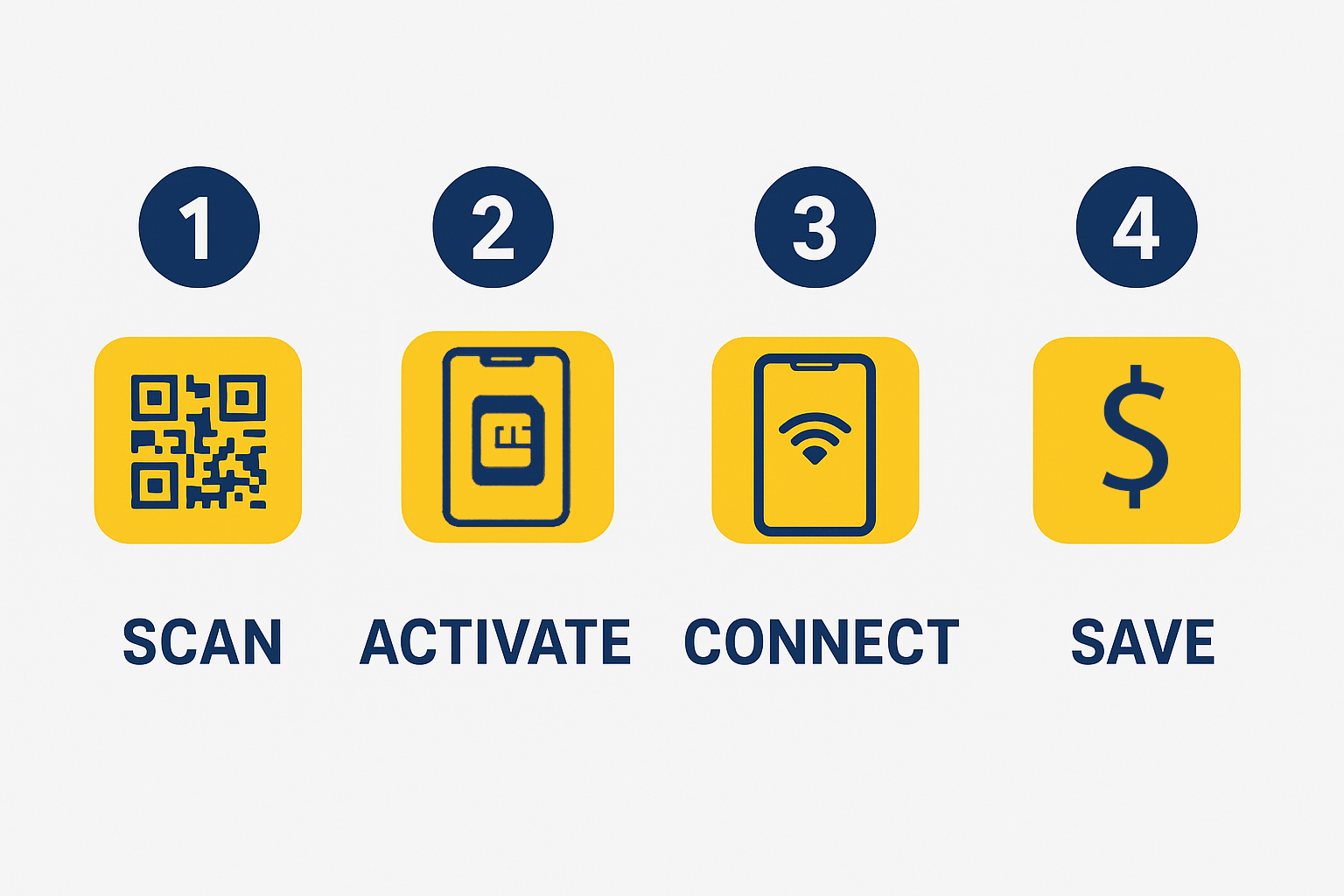
Purchase an eSIM plan online from a provider like OneSimCard.
Receive a QR code by email.
Scan the QR code using your phone’s camera or eSIM setup menu.
Activate the plan — your device connects instantly to local partner networks.
No waiting for shipping. No dealing with tiny SIM trays. No store visits or paperwork.
Under the hood, eSIMs use the same secure technology as physical SIMs. They authenticate your device with the mobile network, manage your plan settings, and handle secure connections — but they do it digitally, giving you much greater flexibility and control.
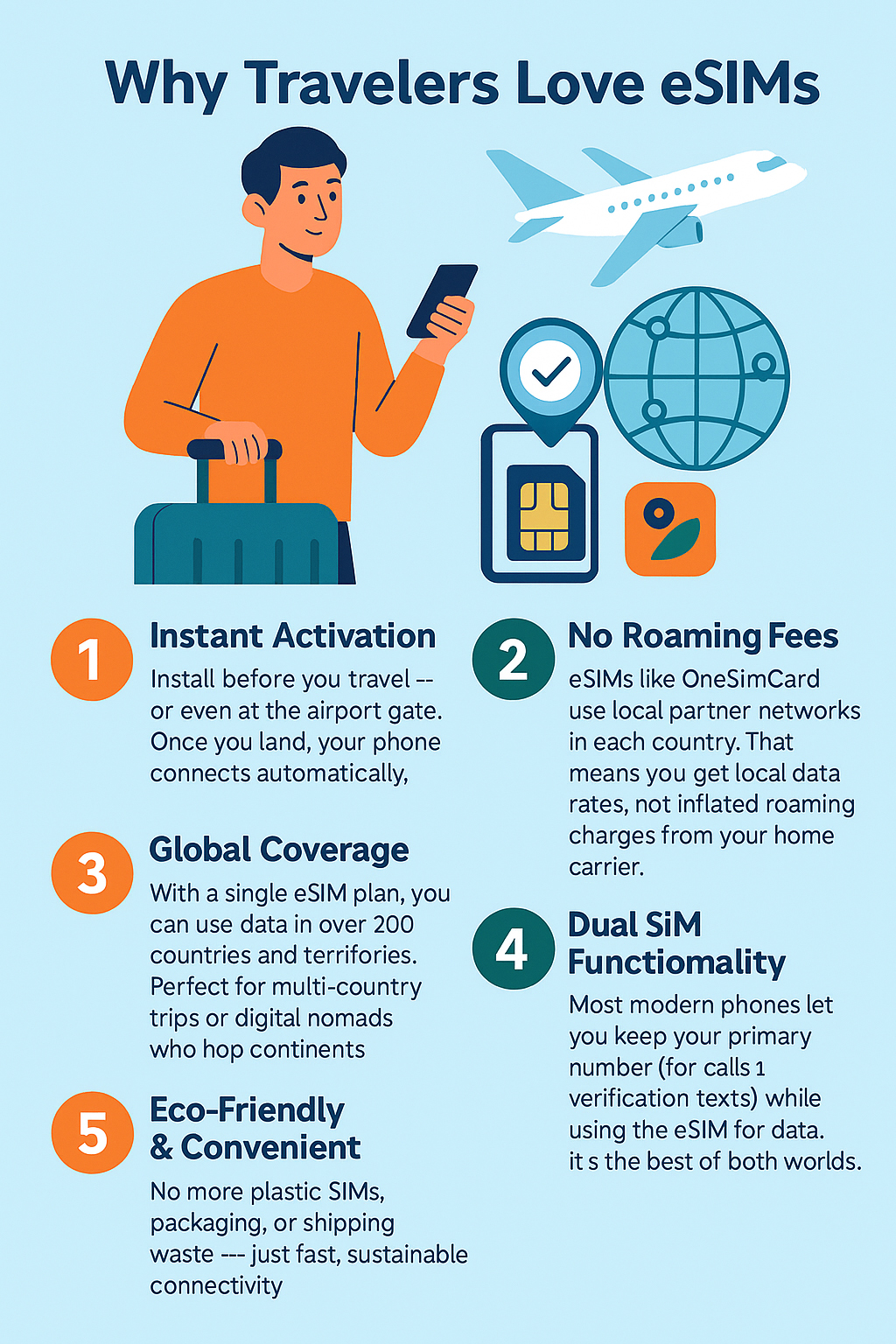
Why Travelers Love eSIMs
If you’ve ever landed in a foreign country and spent an hour trying to find Wi-Fi or buy a prepaid SIM, you already know why eSIMs are a game-changer.
Here are some of the biggest benefits for international travelers:
OneSimCard: The Traveler’s Global eSIM
While many providers now offer eSIMs, OneSimCard stands apart with 30 years of expertise in international mobile connectivity.
The OneSimCard eSIM is designed specifically for travelers who want:
Instant global data access in over 200 countries
High-speed 4G/5G connectivity
No contracts or commitments
Pay-as-you-go flexibility
Multi-network redundancy — your device connects to the strongest available signal
Let’s look at what makes it the ideal choice for frequent travelers and global professionals.
1. True Global Coverage
OneSimCard’s eSIM works in over 200 countries and automatically connects to 350+ local networks worldwide.
That means whether you’re sipping espresso in Rome, attending meetings in Tokyo, or exploring the beaches of Bali, you’ll have strong, reliable data without ever swapping SIMs.
You can even move across borders — for example, from France to Germany to Switzerland — and your eSIM will seamlessly switch networks as you travel.
2. Multi-Network Redundancy
Unlike many budget eSIMs that “steer” your device toward a preferred carrier (even if the signal is weak), OneSimCard’s eSIM uses a no-steering policy.
Your device always connects to the best available local network, ensuring strong signal, faster speeds, and fewer dropped connections.
This makes a big difference for travelers in rural areas, mountains, or regions with uneven coverage.
3. Easy Setup in Minutes
OneSimCard’s activation process is designed to be fast and frustration-free:
Purchase your eSIM on onesimcard.com.
Receive your QR code instantly by email.
Scan it using your phone’s camera.
Turn on data roaming — and you’re connected.
There’s no app to download, no physical card to insert, and no waiting period. The whole process takes under five minutes.
4. Flexible Data Plans
Every traveler’s data needs are different. That’s why OneSimCard offers multiple eSIM plan options:
DataMax eSIM – Perfect for frequent travelers who want maximum global coverage and fast data speeds.
Universal eSIM – Ideal for vacations and multi-country trips across Europe, Asia, and beyond.
Expedition eSIM – Great for extended adventures or remote work in off-grid regions.
You can also easily add top-ups online, monitor usage, and manage multiple eSIMs in your OneSimCard account.
5. Reliable Customer Support
Travel doesn’t always happen on a 9-to-5 schedule — and neither does OneSimCard’s support. Their customer service team is available worldwide to help with setup, plan management, or troubleshooting.
6. Works Seamlessly with the OneSim VoIP App
If you need to make calls or send texts over data, OneSimCard also offers the OneSim VoIP App (available for iOS and Android).
The app lets you:
Make and receive calls using your OneSimCard number.
Send and receive SMS messages globally.
Access voicemail and call forwarding features.
That means even if your phone is in eSIM-only mode, you can still stay fully connected — without worrying about roaming charges or switching SIMs.
How to Install and Activate Your OneSimCard eSIM
The setup is simple and takes less time than ordering coffee:
Scan and Install using your phone’s camera or cellular settings.
Enable Data Roaming for your OneSimCard plan.
Connect and Go — you’ll be online in seconds.
It’s that easy.
Why a OneSimCard eSIM Beats Local SIMs
While buying a local SIM might seem cheaper, it’s rarely practical for travelers visiting multiple countries.
Feature
Local SIM
OneSimCard eSIM
Setup
Requires store visit
Instant digital activation
Coverage
One country only
200+ countries
Network
Locked to one carrier
Multi-network redundancy
Data Plans
Fixed
Flexible and top-up ready
Device Swap
Physical SIM change
Digital profile switching
With OneSimCard, you get the flexibility to cross borders without losing service — and without juggling multiple cards or contracts.
The Future of Travel Connectivity
The eSIM isn’t just the future — it’s the now of travel connectivity. As airlines, airports, and global travelers embrace digital technology, eSIMs are fast becoming the standard for staying connected on the go.
By combining instant activation, global coverage, and multi-network reliability, OneSimCard’s international eSIM gives you something priceless: freedom.
Freedom from roaming fees. Freedom from local SIM hassles. Freedom to connect — anywhere, anytime.
Final Thoughts
Traveling should be about experiences, not about fighting with connectivity. With OneSimCard’s international eSIM, you can focus on what matters — exploring new places, meeting new people, and sharing your journey in real time.
Whether you’re a digital nomad working remotely, a student studying abroad, or a family on a European adventure, OneSimCard’s eSIM is your passport to seamless global connectivity.
One QR code. 200+ countries. Zero stress. That’s the OneSimCard difference.
Gone are the days of swapping tiny SIM cards, juggling multiple phone numbers, or waiting in line at a local carrier store when you travel abroad. With a OneSimCard eSIM, you can get connected in minutes — no tools, no shipping delays, no stress.
Whether you’re a digital nomad, a business traveler, or a vacationer, setting up your OneSimCard eSIM is quick and easy. In fact, the entire process — from purchase to activation — takes about five minutes.
Here’s a simple, step-by-step guide to help you install and activate your OneSimCard eSIM like a pro.
What Is an eSIM (and Why You’ll Love It)
An eSIM (short for embedded SIM) is a digital version of the traditional SIM card. Instead of inserting a physical chip into your phone, you simply download your mobile data plan directly onto your device by scanning a QR code.
That means:
No waiting for shipping or mailing delays.
No tiny SIM cards to lose or swap.
No roaming charges from your home carrier.
Instant connectivity in over 200 countries and territories.
With OneSimCard eSIM, you can stay online almost anywhere in the world — right after purchase.
Step 1: Check Your Device Compatibility
Before installing, make sure your smartphone, tablet, or device supports eSIM technology.
Most modern phones are eSIM-ready, including:
Apple: iPhone XS, XR, 11, 12, 13, 14, 15, and later (including Pro and Mini models)
Samsung: Galaxy S20, S21, S22, S23, S24 series; Galaxy Z Flip and Fold series; Galaxy Note 20+
Google: Pixel 3 and later models
Other brands: Many Xiaomi, Oppo, Motorola, and Huawei devices now support eSIM
If you’re unsure, visit your device’s Settings > Cellular or Mobile Networks > Add eSIM — if that option exists, your device is eSIM-compatible.
Pro Tip: Make sure your device is carrier unlocked, so it can accept eSIM profiles from any provider.
Step 2: Purchase Your OneSimCard eSIM
Head over to onesimcard.com . You can also download the Mobile App for iPhone and Android here:
At checkout, you’ll receive an activation email containing your QR code and setup instructions.
You can also view your activation details by logging into your OneSimCard account dashboard.
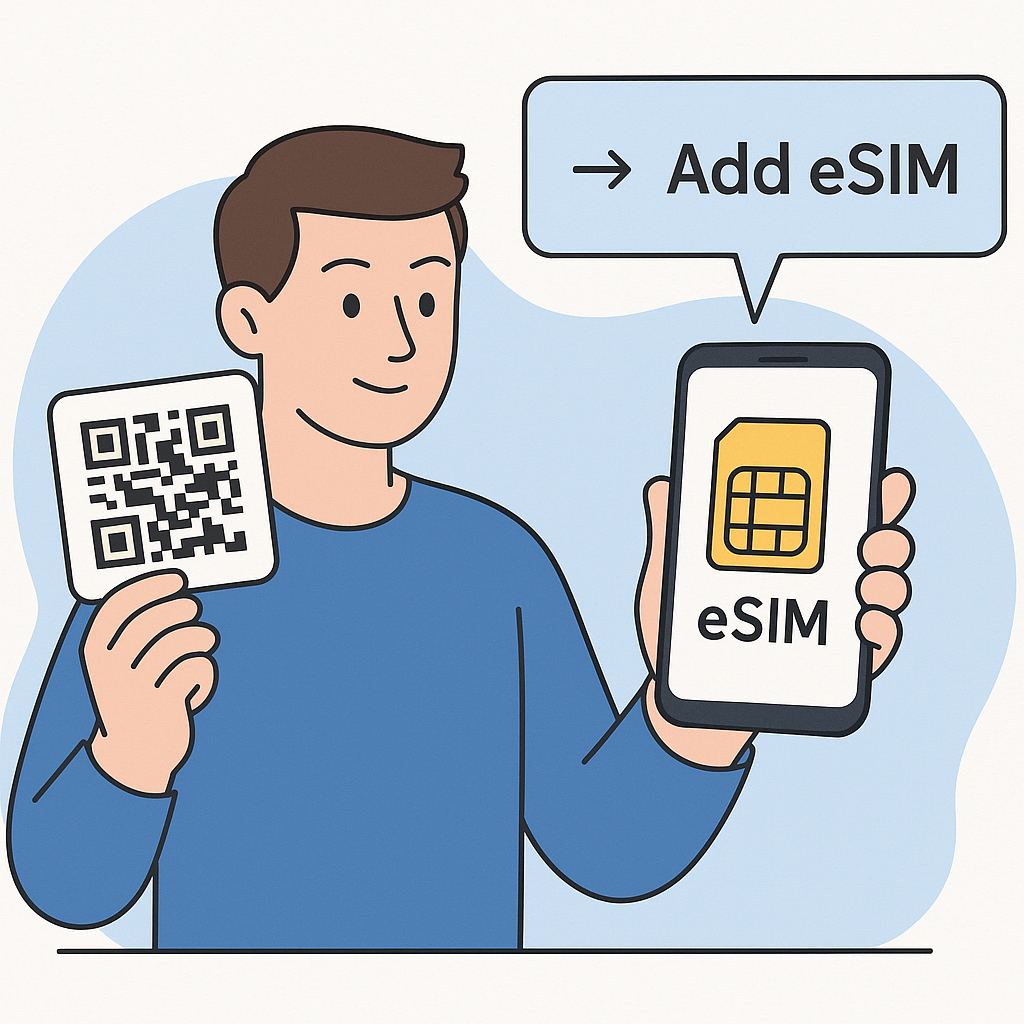
Step 3: Scan the QR Code to Install Your eSIM
This is the easiest and fastest step — your eSIM is ready to install within minutes after you receive your email.
For iPhone:
Go to Settings > Cellular (or Mobile Data).
Tap Add eSIM or Add Cellular Plan.
Scan the QR code provided in your OneSimCard activation email.
Tap Add Cellular Plan when prompted.
You can also watch a quick video hereto see how to scan the QR code without needing a second device.
For Android (Samsung or Google Pixel):
Open Settings > Connections > SIM Manager (or Network & Internet > SIMs).
Select Add eSIM or Download SIM instead.
Tap Scan QR code and point your camera at your OneSimCard QR code.
Confirm and download the profile.
You can also watch aquick video here to see how to scan the QR code without needing a second device.
Once installed, you’ll see a new OneSimCard cellular plan appear in your list of mobile networks.
Tip: You can rename the eSIM profile (for example, “OneSimCard eSIM”) to keep it easy to recognize.
Step 4: Activate Data and Configure Settings
Now that your eSIM is installed, it’s time to turn on data service.
Go to Settings > Cellular (or SIM Manager).
Make sure your OneSimCard eSIM is toggled ON.
Select Cellular Data Network and ensure Data Roaming is enabled for this plan.
Don’t worry — OneSimCard’s global data plans don’t charge “roaming fees” in the traditional sense. You’re simply using our global multi-network connectivity.
After enabling data, your phone should automatically connect to the strongest available network in your area.
If it doesn’t connect immediately, simply:
Turn Airplane Mode ON and then OFF again, or
Restart your device.
Your OneSimCard eSIM will then connect to a partner network and you’ll be online within seconds.
Step 5: Test Your Connection
Once connected, open your browser or favorite app to confirm your data is active. You can also:
Check your signal bars (you should see LTE, 4G, or 5G).
Log into your OneSimCard portal to view data usage and remaining balance.
If you want to make international calls, download and sign into the OneSim VoIP App— it lets you make and receive calls and texts using your OneSimCard number, even over data.
That’s it! You’re live in minutes.
Bonus: Manage Your eSIM Anywhere
Once installed, your OneSimCard eSIM is fully digital — meaning you can manage everything remotely:
Top-up or add data instantly from your account dashboard.
View usage and billing details in real time.
Add multiple plans for future trips (you can store several eSIMs on one device).
Pause or delete eSIMs anytime you wish.
With OneSimCard, you’re in full control of your global connectivity — without ever needing to swap a physical SIM.
Why OneSimCard eSIM Is the Smarter Choice
There are many eSIM providers out there, but OneSimCard stands apart for travelers who value coverage, reliability, and support.
Here’s why:
Global Reach: Coverage in over 200 countries and territories.
Instant Activation: Get connected in minutes, not days.
Secure Connectivity: Built-in encryption and multi-network redundancy.
Customer Support: Help when you need it, wherever you are.
Flexible Data Options: Choose by region, duration, or data volume.
Whether you’re traveling for business, study, or adventure, OneSimCard’s eSIM makes staying connected simple, affordable, and fast.
Troubleshooting Tips
If you run into any issues during setup, here are a few quick checks:
QR Code Error: Make sure your device has an active internet connection while scanning.
No Signal: Try restarting your device or toggling Airplane Mode.
Data Not Working: Confirm “Data Roaming” is enabled and “OneSimCard” is selected for cellular data.
Still Stuck? Contact OneSimCard Support via chat or email — we’re here to assist.
Final Thoughts
In a world that moves fast, your connectivity should too. Installing and activating a OneSimCard eSIM takes just a few minutes — yet gives you instant, reliable data access across the globe.
No stores. No waiting. No SIM swapping. Just scan, connect, and go.
With OneSimCard, the world is literally at your fingertips.
Stay connected. Travel smarter. Go global with OneSimCard eSIM.
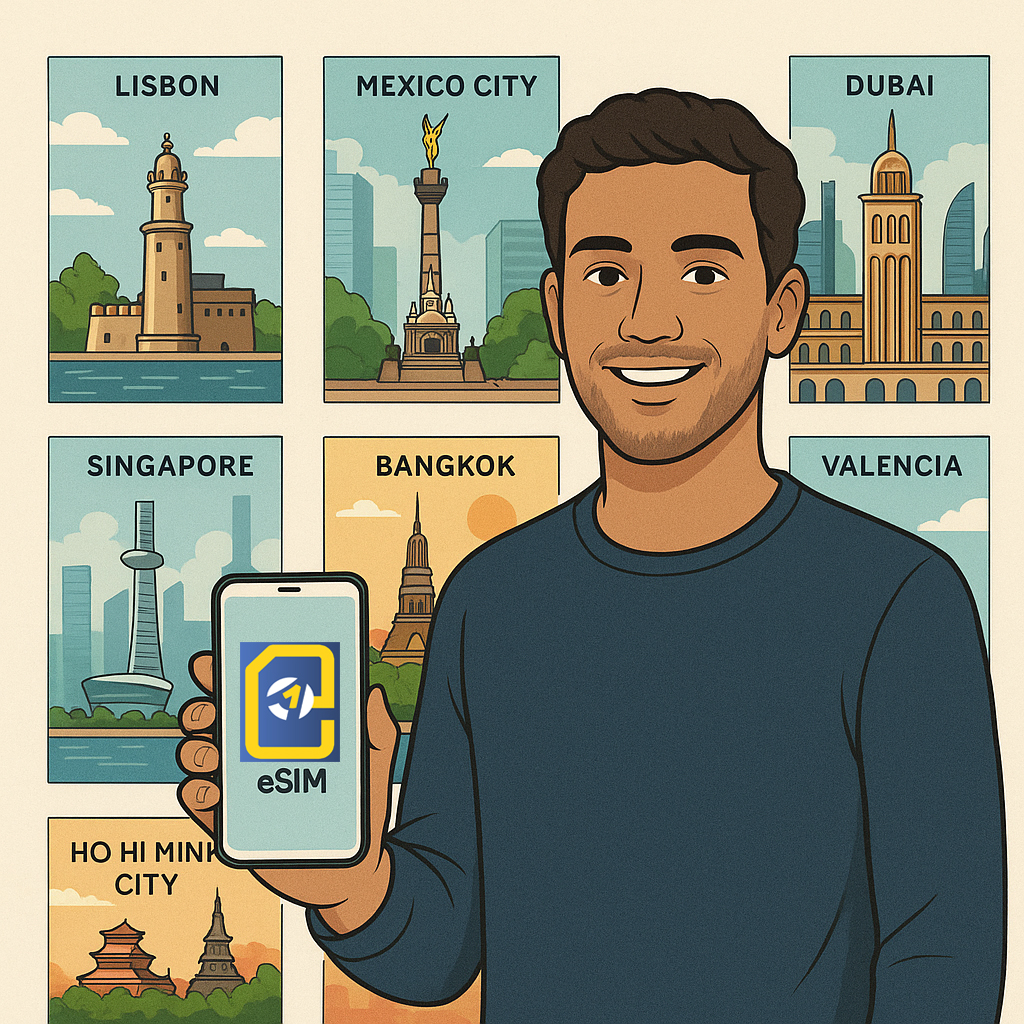
Moving abroad is equal parts logistics and leap of faith. You’re choosing a new home, navigating paperwork, sorting housing, and—crucially—making sure you can communicate from day one. Whether you’re relocating for work, lifestyle, or a fresh start, having reliable, affordable mobile data is the connective tissue that holds the whole experience together. Below are eight expat-friendly destinations that consistently rise to the top, plus why a OneSimCard international eSIM is a smart companion for each move.
1) Portugal (Lisbon, Porto, and the Silver Coast)
Portugal blends Mediterranean ease with modern infrastructure. Lisbon’s startup scene, Porto’s creative energy, and quieter coastal towns offer choices for every lifestyle. English is widely spoken in cities, healthcare is strong, and public transport is straightforward. The cost of living remains reasonable by Western European standards, especially outside downtown Lisbon.
Why OneSimCard eSIM helps here: Land at Humberto Delgado Airport, scan your eSIM QR code, and you’re online before the luggage carousel. With multi-network access across 200+ countries and territories, you can roam confidently on day trips to Spain, hop across the EU, and keep the same data service without juggling different local SIMs.
2) Spain (Valencia, Barcelona, Madrid)
Spain checks nearly every expat box: culture, climate, cuisine, and connectivity. Valencia is a sweet spot for value and quality of life; Barcelona and Madrid bring global business, arts, and nightlife. Regional diversity makes Spain feel like many countries in one, and domestic mobility is easy via high-speed rail.
OneSimCard edge: If you plan weekend escapes to France, Portugal, or the Balearic Islands, your international eSIM avoids the surprise roaming fees and number swaps. Manage usage and top-ups from your phone, so budgeting stays sane even during festival season.
3) Mexico (Mexico City, Mérida, Guadalajara)
Mexico’s expat appeal is surging thanks to its friendly culture, great food scene, varied climates, and robust flight networks to the U.S. and beyond. Mexico City is a global capital for arts and tech; Mérida offers safety and colonial charm; Guadalajara mixes tradition with innovation.
OneSimCard edge: Keep your data consistent as you explore new neighborhoods or travel frequently between states. Heading to Belize or Guatemala? The same eSIM profile keeps you connected across borders—no store runs or paperclip SIM swaps required.
4) Germany (Berlin, Munich, Hamburg)
Germany pairs high wages and world-class industry with efficient public services and strong tenant protections. Berlin is iconic for its international scene; Munich offers stability and proximity to the Alps; Hamburg’s maritime spirit and media economy are a draw.
OneSimCard edge: New job, new city, new apartment—there’s plenty to organize. Instant eSIM activation means your phone is squared away immediately, letting you set up banking apps, transit passes, and utilities appointments without gaps in connectivity. Multi-network redundancy helps keep you online in dense urban corridors and beyond.
5) United Arab Emirates (Dubai, Abu Dhabi)
The UAE attracts professionals with tax advantages, state-of-the-art infrastructure, and a truly international community. Dubai’s business and lifestyle hubs are unmatched in the region, and Abu Dhabi offers a balanced pace with top cultural institutions.
OneSimCard edge: Airport to apartment, your eSIM delivers seamless data from the first ride-hail. Business travelers appreciate keeping the same data plan when jumping to Saudi Arabia, Oman, or quick trips to Europe or Asia—no time wasted hunting for local SIM shops between meetings.
6) Singapore
Singapore is famously efficient—a gateway to Southeast Asia with top-tier healthcare, public safety, and a hyper-connected economy. It’s compact, clean, and practical for families and solo professionals alike.
OneSimCard edge: If Singapore is your regional base, your OneSimCard international eSIM shines on frequent hops to Malaysia, Indonesia, Vietnam, or Thailand. You get the freedom to move between markets while keeping one data solution, plus easy top-ups and usage monitoring.
7) Thailand (Bangkok, Chiang Mai, Phuket)
Thailand offers friendly visa pathways, excellent food, and a spectrum of lifestyles—from Bangkok’s fast-moving capital energy to Chiang Mai’s creative calm and Phuket’s island pace. Many expats enjoy a strong community network and reasonable costs.
OneSimCard edge: Thailand is a regional travel hub. With a global eSIM, you can keep your same setup when you fly to Laos, Cambodia, or Singapore—perfect for border runs, conferences, or quick beach breaks. No more juggling multiple physical SIMs in your phone and backpack.
8) Vietnam (Ho Chi Minh City, Da Nang, Hanoi)
Vietnam is dynamic and future-oriented, with young talent, a booming startup ecosystem, and increasingly modern city infrastructure. Ho Chi Minh City is energetic and entrepreneurial; Hanoi brings culture and tradition; Da Nang offers a balanced coastal lifestyle.
OneSimCard edge: If you’re building a cross-border life—say, split time between Vietnam and Thailand or Malaysia—an international eSIM lets you keep your data continuity and budgeting intact while you find your long-term rhythm.
Why an International eSIM Is a Game-Changer for Expats
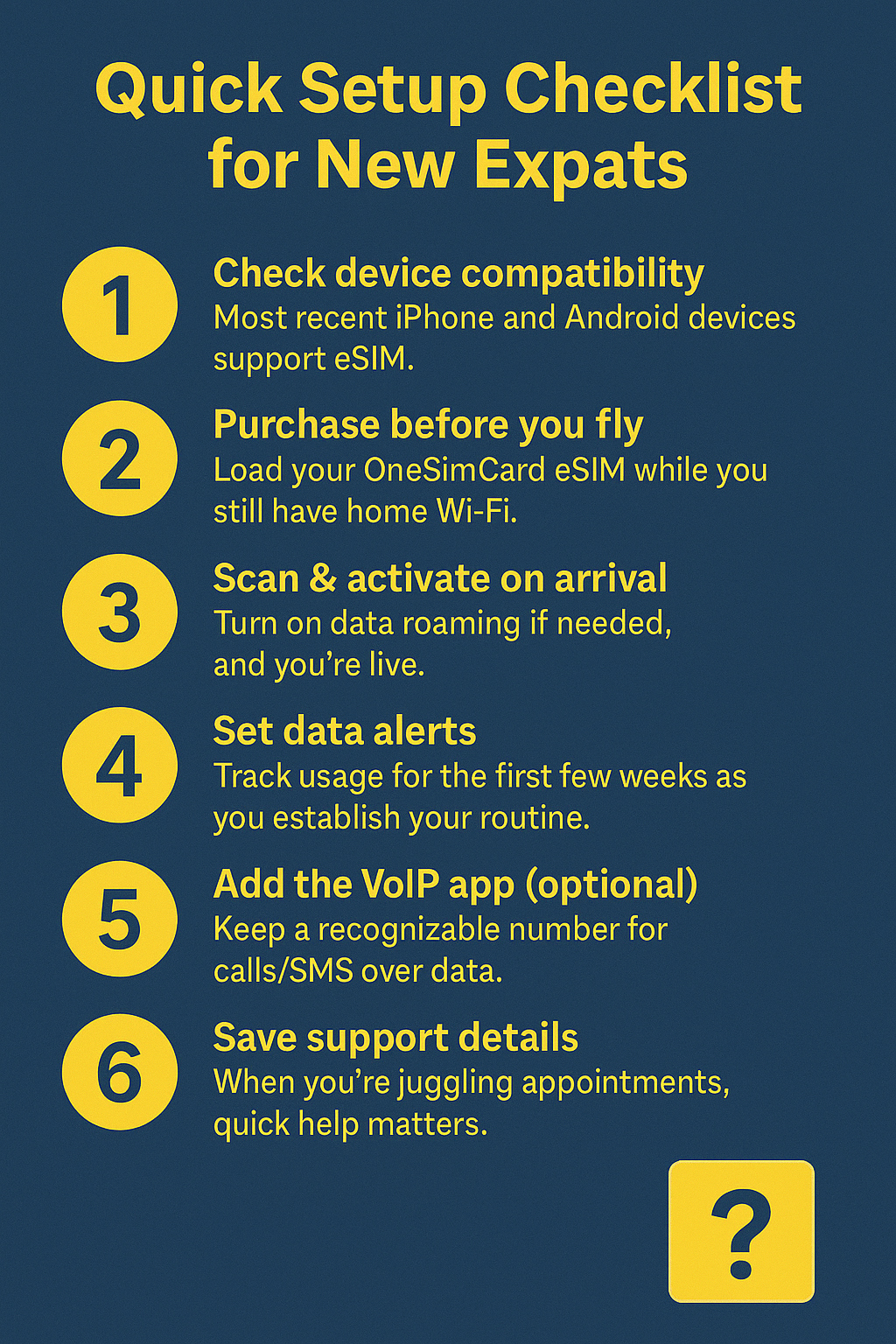
1) Day-one connectivity. Apartments, banking, and employer onboarding often require reliable mobile data. With OneSimCard’s international eSIM, you scan a QR code and go—no store visits, no shipping delays, no tools.
2) Multi-country simplicity. Expat life rarely sticks to one border. Whether you’re visiting family, taking weekend trips, or attending regional conferences, OneSimCard covers 200+ countries and territories under one roof. No more collecting a drawer of local SIMs.
3) Multi-network redundancy. In many countries, performance varies by neighborhood. OneSimCard’s access to multiple networks in-market helps you stay online if a single carrier gets congested—handy for video calls, navigation, and hotspotting when you’re house-hunting or working remotely.
4) Cost control without the drama. Roaming surprises can wreck a relocation budget. With transparent data options and self-service top-ups, you’re in control. Track usage in real time and adjust as your routine shifts.
5) Keep your communication stack flexible. If voice and SMS are key, pair your data eSIM with app-based calling and messaging—or use OneSimCard’s DataMax VoIP App to handle voice/SMS over data. You can keep business lines separate from personal messaging while your primary phone remains your daily driver.
6) Dual-SIM freedom. Most modern phones let you run a physical SIM and an eSIM together. Keep a local number for in-country services while your OneSimCard eSIM handles international data. Switch defaults on the fly without ever ejecting a tray.
7) Easy management while you settle in. Relocations are full of little errands. Managing your plan, topping up, and checking rates from your phone frees time for the bigger decisions—schools, neighborhoods, and that perfect cafe with strong Wi-Fi and stronger espresso.
The Bottom Line
Choosing the right country is about fit—values, lifestyle, and professional opportunity. Choosing the right connectivity is about freedom. A OneSimCard international eSIM gives expats fast, reliable, and flexible data from day one, then keeps working as your life expands across borders. Whether you’re strolling Lisbon’s Miradouros, commuting on Singapore’s MRT, cycling Valencia’s Turia park, or launching a startup in Ho Chi Minh City, the simplest part of your move should be staying connected.
Ready to make your move? Set up your OneSimCard international eSIM now, and step off the plane with your digital life already running.
This is how it goes: you arrive in a new country as part of the study program. Rather than running everywhere to find a SIM card or dealing with Wi-Fi at the airport, you simply scan an eSIM code on your phone and have Internet access.
That’s what a worldwide eSIM does.
It delivers mobile data to the students in a flash, no physical SIM card is required: no stores, misconceptions, or queues. Giving directions via Google Maps to get to your dorm, sending a message to your parents that you got there, or having group Zoom meetings with your classmates, an eSIM can help you remain connected.
Let’s explain why this tiny piece of tech is one of the smartest things to have while studying abroad.
What is a Worldwide eSIM, and Why Does it Matter?
A global eSIM is a digital SIM that runs within a device and allows a mobile data plan subscription without using a physical SIM. No hardware to insert, no trip to the store, and no need to juggle carriers.
Here’s why that matters for international students:
No shipping or waiting: activation is instant.
Global compatibility: works in 200+ countries.
One SIM, many destinations: no need to switch or remove anything.
According to Juniper Research, the number of global travel eSIM users is expected to rise from around 40 million in 2024 to over 215 million by 2028, a roughly 440% increase. For digital‑first students, this isn’t just data, it’s reality: eSIM is rapidly becoming the default.
How Does a Worldwide eSIM Solve Real Student Problems?
Here’s a closer look at how this technology meets the specific needs of students abroad:
Student Problem
How Worldwide eSIM Solves It
Getting connected immediately after landing
Instant activation via QR code
Expensive international roaming
Affordable prepaid data plans
Risk of losing or damaging a physical SIM
eSIM is built into the phone
Managing multiple SIMs or numbers
One profile, multiple countries
Language barriers in local SIM stores
No store visit needed at all
This isn’t just convenience but peace of mind in a foreign land.
While global connectivity and affordability are the headline features, eSIM services offer a range of perks that most students don’t even realize they’re missing until they use one.
● Local Rates Without Local Hassles
Many eSIM providers partner with regional carriers to offer local rates, so students can avoid paying inflated roaming fees. And because eSIMs are preloaded with global profiles, there’s no need to swap when crossing borders.
● Easy Top-Ups and No Surprise Charges
All payments and top-ups are done online through secure dashboards. Some services even allow auto-renewals, making data one less thing to stress about during midterms.
● Multi-Device Support
Are you in the market for data coverage on a phone, tablet, or laptop? eSIM data plans are usually sharable among various devices, and this is a fantastic idea for collaborating on any project in a group or tethering your Wi-Fi in case it stops working in your dorm.
Compatibility: Is Your Device Ready?
Most modern smartphones already support eSIM. Here’s a quick list of compatible models:
Brand
eSIM-Compatible Devices
Apple
iPhone XR and newer
Samsung
Galaxy S20 and newer
Google
Pixel 3 and newer
Motorola
Razr 5G and newer
Students should check their device’s settings under Mobile Network > Add eSIM to verify support.
How to Activate a Worldwide eSIM in 3 Easy Steps?
One of the most significant advantages is simplicity. Here’s how it works:
Select from global or regional data plans.
Sent QR code via email or displayed on screen post-purchase.
Activation takes seconds, and you’re online immediately.
No plastic. No activation delays. No physical logistics.
The Real Impact: Firsthand Experiences
A student in Spain needed to submit a research paper from a train station without public Wi-Fi. With an active worldwide eSIM, tethering to their laptop took 15 seconds. Another student in Japan used their eSIM to navigate Tokyo’s subway system in real time, avoiding the stress of buying local data or deciphering vending machine instructions in Japanese.
These are everyday stories. And they show the real-world utility of this tech.
Use Cases That Make a Difference
Let’s spell out where a worldwide eSIM excels:
During airport layovers, skip Wi-Fi logins and stay connected.
When crossing borders, stay online while changing countries.
Always have access to mobile data in emergencies, no matter where you are.
Security and Privacy
When you’re abroad, your phone is your lifeline for navigation, banking, keeping in touch with family, and everything in between. So security isn’t optional, it’s essential. eSIMs come with built-in encrypted profiles and require user authentication before activation. That means no one can grab your phone and use a new SIM card to hijack your connection. You’re also not handing over sensitive personal info to random SIM vendors in foreign airports or shady street kiosks. And unlike public Wi-Fi, a known hotspot for data theft and malware, an eSIM keeps you on a private, secure cellular network. For students, that peace of mind is a big deal.
The Future is eSIM-First.
SIM cards in a physical form will soon be relegated to the history books. Key analysts within the industry anticipate the future to be in support of the eSIM technology, and most large carriers will be predisposed by 2026. The change implies minimum inconvenience and increased flexibility for international students. Rather than wrestling with little plastic chips or trying to work around carrier-imposed limitations, now you can activate your service, change plans, and compare prices using your phone, anywhere you require.
More to the point, eSIM-first coverage will imply more sufficient coverage around the globe, more intelligent data consumption, and more competitive prices targeted towards travelers and students. It’s connectivity, not you, that will be flexible.
Final Thoughts
Studying is not about being concerned with mobile plans, but a means of exploration, development, and creating everlasting memories abroad. An eSIM is one less thing to have to wait for. You touch down and scan a QR code, and you are connected, no local shops with SIMs, no contract, and no annoying hassles. It is also trusted, safe, and affordable, making it ideal for students residing, studying, and travelling in different countries. Letting go of the enormous shroud of wires necessary to get that amazing adventure to your beautiful family, video chatting with your friends, or just exploring a new city on your own, by having an international eSIM, you can concentrate on what is essential: the experiences.
Take Action Now!
Students planning a semester abroad or summer internship overseas can explore data plans that match their itinerary, whether it’s a single country, multi-stop Eurotrip, or long-term stay. Check your device compatibility, choose a suitable plan, and activate within minutes.
Introduction: Why the Right eSIM Matters for Travelers
With the rise of eSIM technology, travelers today have unprecedented flexibility and freedom to stay connected globally. No more fumbling with tiny plastic SIM cards or waiting in airport lines. However, not all eSIM providers are created equal. Choosing the right eSIM can mean the difference between seamless roaming and a connectivity nightmare. In this guide, we compare OneSimCard eSIM with other leading providers to show why it’s the best eSIM solution for international travelers.
What is an eSIM and Why Should You Use One?
An eSIM (embedded SIM) is a digital SIM built into your device, allowing you to switch carriers or data plans without needing a physical SIM card. For global travelers, eSIMs are a game changer:
– Instant activation
– No shipping delays
– Multiple profiles (great for switching countries)
– Eco-friendly (no plastic waste)
– Secure and durable
OneSimCard eSIM: Built for Global Travel
OneSimCard’s eSIM is designed specifically with international travelers in mind. Here are key features that make OneSimCard stand out:
– Coverage in 200+ countries
– Multi-network redundancy
– Non-steering SIMs
– Instant QR code activation
– Free U.S., Canada, or U.K. number via OneSim VoIP App
– Competitive data plans starting at $1.69/GB
– 24/7 live customer support
How OneSimCard eSIM Compares to Other eSIM Providers
Here’s a comparison of OneSimCard against popular eSIM providers: Airalo, Holafly, Nomad, and Ubigi.
Top Reasons to Choose OneSimCard eSIM
True Global Coverage
Better Network Performance
Affordable, Transparent Pricing
Integrated Voice and Texting
Instant eSIM Setup
Superior Customer Service
Advanced SIM Management
What Customers Are Saying
“The OneSimCard eSIM saved my trip to Japan. Setup was a breeze, and I had better coverage than my travel partner who used another service.”
“I love that I can manage everything from the app, and the support team actually picks up the phone.”
“Best rates I’ve found for Europe. Highly recommended.”
ASO Optimization: Why OneSimCard eSIM is the Best eSIM App
When searching for an eSIM app on the App Store or Google Play, OneSimCard consistently ranks high due to:
– High user ratings and reviews
– Keywords like “eSIM for travel,” “international data SIM,” and “best eSIM app”
– Instant setup and QR code scanning features
– Compatibility with iOS and Android
– Regular app updates and security patches
Conclusion: The Best eSIM for Travelers is OneSimCard
If you’re looking for a reliable, flexible, and cost-effective eSIM for international travel, OneSimCard is the clear winner. With competitive pricing, global reach, voice & SMS integration, and unmatched network quality, OneSimCard eSIM delivers what modern travelers truly need.
Don’t settle for less. Choose the eSIM designed by travelers, for travelers.
Download the OneSimCard eSIM App today and experience the best eSIM connectivity on your next journey.
OneSimCard’s eSIM keeps you connected around the world
A missed connection, a critical email that won’t be sent, or a virtual meeting that needs strong data connection abroad, travel disruptions often begin with poor mobile connectivity. Traditional roaming plans and local SIM cards simply cannot keep up with the demands of today’s international traveler. Fortunately, there is a smarter solution, world eSIM cards.
This innovation in mobile connectivity allows users to stay online in over 200 countries and regions without physically swapping SIM cards or hunting down local carriers. Whether on business in Tokyo, backpacking through Europe, or managing remote work from Latin America, travelers can stay connected easily and affordably with a World eSIM card.
This blog explores the full potential of World eSIM cards, how they slash costs, improve coverage, and transform the way we stay connected when abroad.
Understanding the World eSIM Card
A World eSIM card is a digital SIM built into smartphones and other devices that enables remote activation of mobile plans. Unlike traditional SIM cards requiring physical handling, eSIMs are downloaded and installed using a QR code or an app interface.
World eSIM cards are specifically designed for international travelers. These eSIMs can operate across various regions, connecting to the strongest local networks without changing cards or committing to expensive roaming fees.
Travelers can activate a plan before their trip, switch providers during travel, or top up their balance instantly. These features make the World eSIM card an essential companion for modern travel.
Key Benefits of a World eSIM Card
● Seamless Global Coverage
One of the most substantial advantages of a World eSIM card is its global compatibility. It allows travelers to access the best mobile networks in each country without relying on a single carrier’s roaming agreements.
A World eSIM card typically supports over 200 countries and regions, providing access to multiple local networks. This helps maintain signal strength, data speed, and call clarity regardless of location.
● Cost Efficiency and Predictable Pricing
Traditional international roaming plans are notoriously expensive. A daily pass from a primary carrier in the United States often costs between $10 and $15 daily. This could total more than $200 in data fees for a two-week trip alone.
In contrast, World eSIM cards have flexible data packages tailored to regions or global use. Pricing can be depending on usage needs and location. Travelers can manage and monitor their data usage, add plans mid-trip, and avoid hidden fees.
● Ease of Use and Quick Activation
Setting up a World eSIM card is simple. After purchasing a plan, users receive a QR code, which can be scanned from the device’s settings menu to activate the eSIM. Alternatively, some services offer direct app integration for activation and management.
There is no need to visit a store or wait in line. This is especially valuable for short trips, layovers, or business travel where time is limited.
Additional features often include:
Switching networks if local coverage is weak
Recharging data instantly
Managing multiple numbers or plans from one device
This level of convenience is unmatched by any traditional SIM solution.
Who Should Use a World eSIM Card?
World eSIM cards are not only for frequent flyers. Their flexibility makes them ideal for a wide range of travelers.
User Type
Primary Need
eSIM Advantage
Business Traveler
Reliable high-speed internet
Premium 5G plans and access to multiple networks
Backpacker
Budget-friendly connectivity
Regional data bundles and flexible daily plans
Students Abroad
Long-term multi-country use
Long-duration plans with secure and stable data access
Cruise Passenger
Seamless port-to-port coverage
Automatic switching between networks and signal towers
No matter the purpose of travel, a World eSIM card simplifies connectivity.
Security and Device Protection
An often-overlooked benefit of eSIM technology is enhanced security. Since the eSIM is embedded within the device, there is no risk of losing it, unlike physical SIM cards, which can be removed and misused.
Many World eSIM card providers also offer features such as:
Remote deactivation if the phone is lost
Encrypted data profiles for safe browsing
Compliance with international mobile data security standards
These measures protect users from unauthorized access and data theft, adding another layer of reliability for professionals and casual users alike.
Sustainability and Environmental Impact
Every plastic SIM card generates waste, from the chip to the packaging and shipping. The environmental impact is significant, with billions of SIMs sold globally yearly.
World eSIM cards eliminate the need for physical components, reducing:
Plastic waste
Fuel consumption related to shipping
Disposal of unused SIMs
This makes the switch to eSIM not only efficient but also environmentally responsible. Travelers interested in reducing their carbon footprint can benefit by choosing a digital option over traditional alternatives.
Future Trends in eSIM Technology
The use of eSIMs is expected to grow rapidly over the coming years. Analysts project that by 2030, over 80 percent of smartphones will support eSIM functionality.
Major phone manufacturers are already releasing eSIM-only devices, signaling a shift in how mobile services will be delivered worldwide. As adoption increases, eSIM cards will likely become the standard for travel, work, and even domestic usage.
Steps to Get Started with a World eSIM Card
Travelers looking to adopt this technology can take a few simple steps to use a World eSIM card.
Check your phone
See if it works with eSIM. Most new ones do.
Pick a plan
Choose based on trip place, time, and how much data you need.
Buy and set it up
Do it while on Wi-Fi. That way, it works when you land.
Track your use
Use the app or site to see how much data you’ve used.
In Short
With a World eSIM card, you no longer must choose: price, ease, or reach, you get them all. One tool, one chip, and one phone.
As mobile technology continues to evolve, the eSIM is not simply a trend but the future of global communication. And it is here now, ready to power the next generation of travel.