

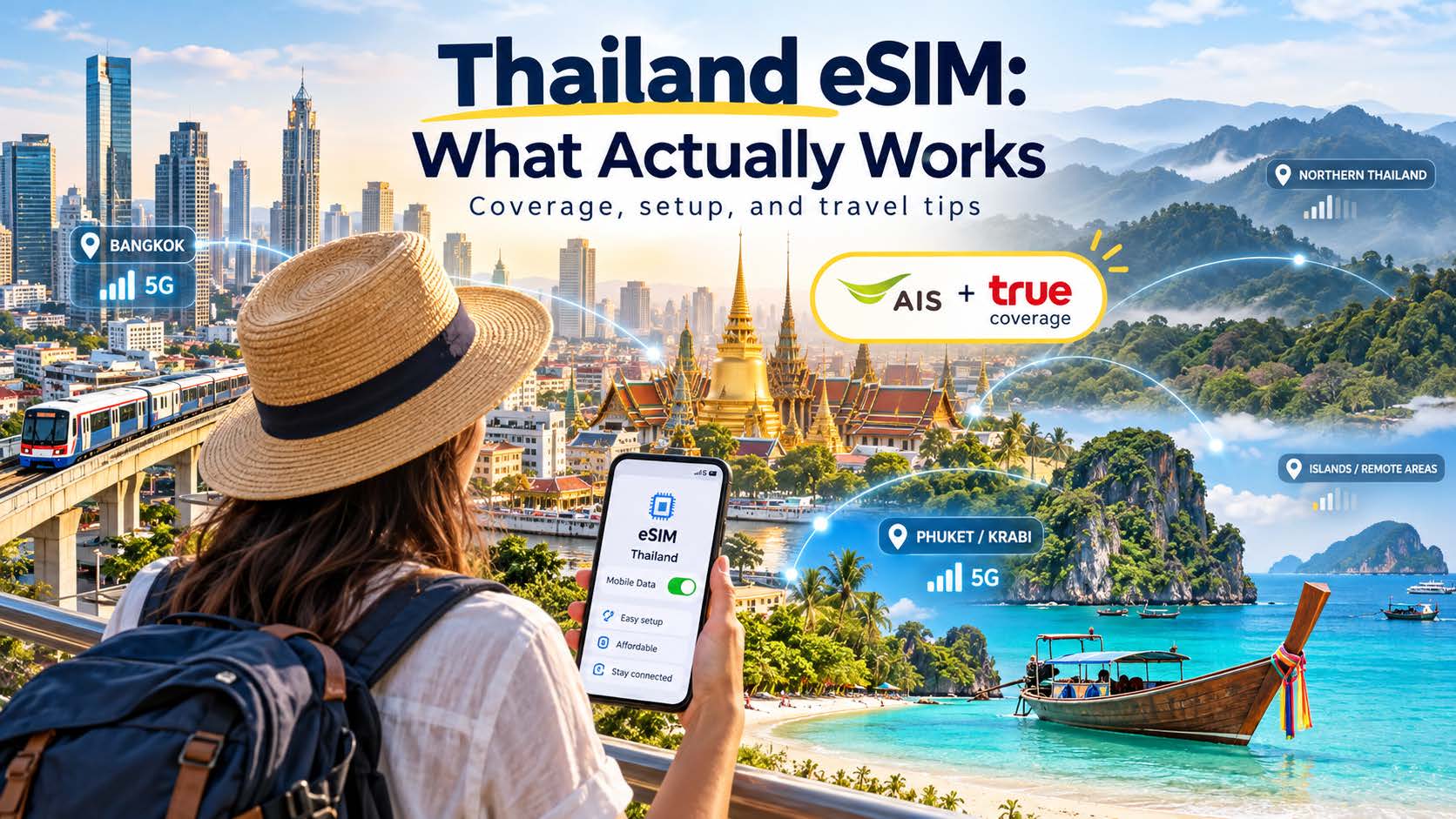
Thailand is one of the most eSIM-friendly countries in Asia, and also one where a lot of travel guides are quietly out of date. The old advice — “pick AIS, dtac, or True” — describes a market that no longer exists. Here’s the current picture, what it means for coverage on the islands and up north, and how to set up before you fly.
Does an eSIM actually work in Thailand?
Yes, and well. Coverage in Bangkok, Chiang Mai, Phuket, and the main tourist corridors is strong, 5G is widespread in the cities, and prepaid data is cheap by global standards. The only requirement on your end is the usual one: your phone needs to be eSIM-compatible and carrier-unlocked. Most iPhones from the XS on, recent Pixels, and flagship Samsungs qualify.
The part most guides get wrong: there are really only two big networks now
For years Thailand had three major operators — AIS (Advanced Info Service Public Company Limited or Advanced Wireless Network Company Limited), dtac, and True. That’s the setup almost every travel blog still describes. It’s no longer accurate.
In 2023, dtac merged with True, and the dtac brand has largely been absorbed into True Corporation. The practical result is a two-player market: AIS and True now dominate Thailand’s mobile sector, with AIS leading in revenue share while True edges ahead in subscriber numbers and 5G coverage. Together, the major operators hold roughly 97% of the market.
Why this matters to you as a traveler: both remaining networks are large, well-funded, and investing heavily in coverage, so a travel eSIM running on either AIS or True will serve you well in the places you’re most likely to go. If you see an eSIM still advertising a “dtac” network, that’s a sign the listing hasn’t been updated — the underlying network is now True.
OneSimCard DataMax eSIM combines both AIS ad True into one eSIM so you get the best of the best coverage.
Where coverage is great — and where network choice starts to matter
Excellent, on either network:
- Bangkok and every major city, including the BTS and MRT
- Chiang Mai, Phuket, Pattaya, Krabi town, Hua Hin
- The main highways and tourist routes between them
Where it gets more variable — and where the network behind your eSIM actually matters:
- The islands. Ko Samui, Ko Pha Ngan, Ko Tao, Ko Lanta, the Phi Phi islands — coverage is generally good near the main beaches and towns but thins out on remote headlands, dive boats, and the quieter far sides of each island. Signal can drop entirely once you’re a few kilometers offshore.
- The far north and northeast. Mountainous Mae Hong Son, rural Isaan, and the national parks have real dead zones. AIS has historically had the edge in rural and upcountry coverage, which is worth knowing if your trip is heavy on the north rather than the beaches.
- Jungle and trekking areas around Khao Sok and the northern hill country — plan to be offline in stretches regardless of network.
For a city-and-beach trip, either network is fine. If you’re spending serious time upcountry or island-hopping to the quieter spots, an eSIM on AIS is the safer default.
How much data do you actually need?
Thailand is awash in free wifi — hotels, cafes, malls, even many beach bars — so your eSIM mostly fills the gaps: Grab rides, maps, translation, messaging, and uploading all those photos. And with rates starting at $1.58/GB OneSimCard has you connected for less!