

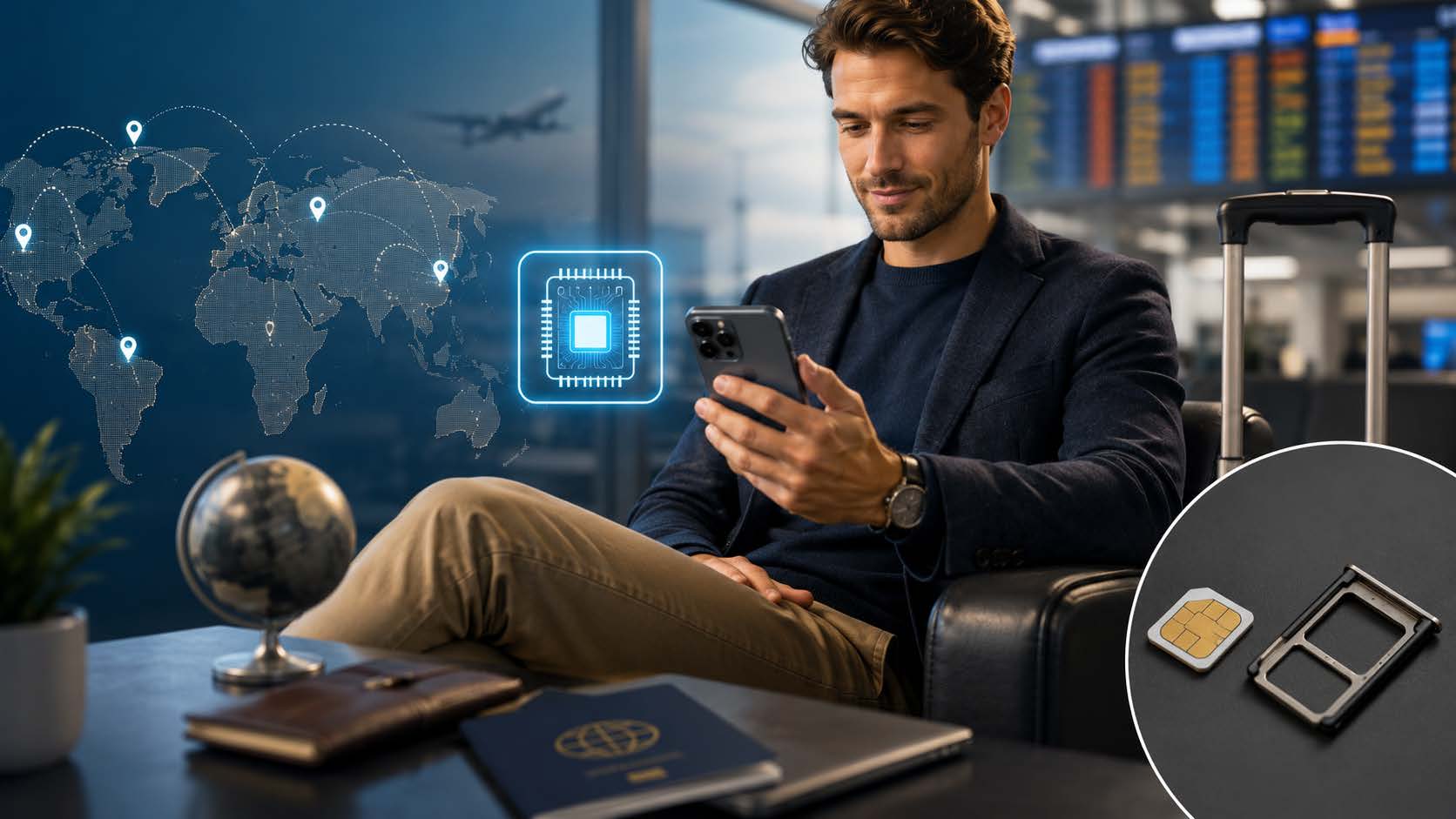
International travel has changed dramatically in recent years. Boarding passes live in mobile wallets, hotel rooms can be unlocked with an app, and travelers can translate menus or navigate unfamiliar cities from their phones.
Now, the traditional plastic SIM card is also being rethought.
More frequent international travelers are choosing eSIM because it offers a faster and more flexible way to stay connected abroad. Instead of searching for a mobile store after landing or opening a phone with a tiny SIM-ejector tool, travelers can install a mobile plan digitally and connect when they arrive.
However, physical SIM cards have not disappeared. They still offer important advantages for certain phones, destinations, and travel situations.
Understanding the differences can help travelers choose the best international connectivity option for each trip.
What Is an eSIM?
An eSIM, or embedded SIM, is a digital version of the removable SIM card traditionally inserted into a phone.
Rather than receiving a plastic card, the traveler installs an eSIM profile on a compatible device. This is commonly done by scanning a QR code, using a provider’s mobile app, or entering activation details manually.
Once installed, the eSIM functions much like a physical SIM. It connects the device to participating mobile networks and may provide data, voice, SMS, or a combination of services, depending on the plan.
Many modern smartphones can store multiple eSIM profiles, allowing travelers to keep different plans for different destinations or trips.
Why Frequent Travelers Are Switching to eSIM
1. eSIM Can Be Installed Before Departure
One of the biggest advantages of eSIM is that travelers can arrange mobile service before leaving home.
There is no need to wait for a SIM card to arrive in the mail or locate a mobile shop at the airport. The eSIM can often be installed while the traveler still has reliable Wi-Fi and time to review the activation instructions.
This can make arrival much smoother. Instead of standing in an airport kiosk line, the traveler can turn on the appropriate eSIM and connect to a supported network.
For someone who travels internationally several times a year, those saved minutes begin to add up.
2. There Is No Tiny Card to Lose
Physical SIM cards are small, delicate, and remarkably talented at disappearing into luggage.
Travelers who replace their home SIM with a local SIM must store the original card safely until the end of the trip. Losing it can create problems when returning home, particularly when the original number is used for banking, authentication, or business calls.
An eSIM remains digitally installed on the phone. There is no tray to open and no plastic card to keep in a folded receipt, wallet pocket, or mysterious corner of a carry-on bag.
3. Travelers Can Keep Their Primary SIM Active
Many eSIM-compatible phones support dual-SIM functionality. This may allow the traveler to use an international eSIM for mobile data while keeping the primary physical SIM or eSIM active for calls and messages.
For frequent travelers, this can be particularly valuable. They may continue receiving texts sent to their regular number while using a separate travel plan for affordable data.
The exact dual-SIM capabilities vary by device, carrier, and plan, so travelers should review their phone settings and roaming charges before departure.
4. Switching Between Plans Is Easier
Frequent travelers rarely visit the same destination every time. One trip may involve France and Spain, while the next includes Japan, Thailand, and Singapore.
A phone that supports multiple stored eSIM profiles can make it easier to manage different travel plans. Travelers can label profiles by region, destination, or provider and activate the one needed for the current trip.
Some international eSIM products are also reusable, allowing customers to add a new data package to an existing eSIM rather than installing a completely new profile for every journey.
That turns the phone into a small connectivity passport, with less plastic and fewer airport-store negotiations.
5. eSIM Offers Greater Flexibility During a Trip
Travel plans change. A two-country vacation may unexpectedly become a three-country adventure. A short conference may be extended, or a traveler may use more data than expected.
With eSIM, it may be possible to purchase additional data or activate another plan without finding a retail location. This is especially useful during late arrivals, long layovers, rail journeys, or visits to places where mobile stores are difficult to reach.
The ability to manage connectivity online gives travelers more control over how and when they purchase service.
6. eSIM Works Well With Travel Apps
Modern international trips rely heavily on mobile data.
Travelers use their phones for:
- Maps and navigation
- Airline and train apps
- Hotel reservations
- Ride-hailing services
- Translation tools
- Messaging and video calls
- Mobile payments
- Restaurant research
- Digital tickets and confirmations
An eSIM can provide access to these services shortly after arrival, helping the traveler avoid unsecured public Wi-Fi or expensive roaming charges from a domestic carrier.
Why Some Travelers Still Choose a Physical SIM Card
Despite the convenience of eSIM, a physical international SIM card can still be the better choice in some situations.
The Phone May Not Support eSIM
Not every device is eSIM-compatible. Some older phones, entry-level models, and devices sold in certain markets may only accept physical SIM cards.
Even when a phone model generally supports eSIM, regional variations or carrier restrictions can affect compatibility.
Travelers should always verify that their exact device model is unlocked and supports the type of eSIM being purchased.
Physical SIM Cards Can Be Moved Between Devices
A physical SIM can usually be removed from one compatible unlocked device and inserted into another.
This can be useful when a traveler carries a backup phone, mobile router, hotspot, tablet, or other connected device. If the primary phone is damaged, the SIM may be transferred to another device without reinstalling a digital profile.
An eSIM is typically tied more closely to the device on which it was installed. Moving it may require a transfer process or assistance from the provider.
Setup May Feel More Familiar
Some travelers simply prefer the certainty of inserting a card into a SIM tray.
A physical SIM does not require scanning a QR code, navigating cellular settings, or understanding which SIM should handle mobile data. For travelers who are less comfortable adjusting phone settings, the traditional approach may feel more straightforward.
Physical SIMs Remain Useful for Longer Trips
Travelers staying abroad for several months may want a local number, local voice service, or access to a domestic carrier plan that is only available through a physical SIM.
In these cases, buying a local SIM after arrival may still make sense, particularly when the traveler will remain in one country for an extended period.
eSIM vs. Physical SIM: Which Is Better for International Travel?
Neither option is automatically best for every traveler.
An eSIM may be the stronger choice when the traveler:
- Has an unlocked, eSIM-compatible phone
- Wants to arrange service before departure
- Visits several countries during one trip
- Travels internationally frequently
- Wants to keep a primary SIM active
- Prefers not to handle or store plastic SIM cards
- Needs fast access to mobile data upon arrival
A physical SIM may be preferable when the traveler:
- Uses a phone without eSIM support
- Wants to move the SIM between devices
- Needs service in a hotspot or mobile router
- Prefers a traditional installation process
- Plans to purchase a long-term local mobile plan
- Wants a physical backup connectivity option
Some frequent travelers use both. They keep a reusable international eSIM on their phone for convenient data access and carry a physical SIM as a backup or for use in another device.
What Travelers Should Check Before Buying
Before choosing either an eSIM or physical SIM, travelers should confirm:
- Device compatibility: The phone must support the selected SIM type. Use our compatibility checker HERE.
- Carrier unlocking: A locked phone may not accept another provider’s SIM or eSIM.
- Destination coverage: Check which countries and networks are included.
- Plan duration: Make sure the package remains valid for the entire trip.
- Data allowance: Consider navigation, streaming, hotspot use, and video calls.
- Voice and SMS availability: Some travel eSIMs provide data only.
- Dual-SIM settings: Understand which SIM will be used for data, calls, and texts.
- Roaming settings: Incorrect settings may prevent service or create unexpected charges.
Installing and testing the service before departure, when permitted by the provider, can prevent a small technical issue from becoming an arrival-day headache.
The Future of Travel Connectivity Is More Flexible
Travelers are choosing eSIM because it removes many of the small obstacles traditionally associated with international mobile service.
It can be purchased remotely, installed digitally, activated quickly, and managed directly from a compatible phone. For people who cross borders frequently, that convenience is difficult to ignore.
Physical SIM cards still have an important role, especially for older devices, transferable service, backup phones, and long-term local plans. The most practical solution is not necessarily choosing one format forever. It is having access to the right format for each destination and device.
As travel becomes increasingly digital, the best connectivity options will be the ones that give travelers flexibility. Whether that means an eSIM, a physical SIM, or a combination of both, the goal remains the same: reliable mobile service without allowing connectivity logistics to take over the journey.