eSIM for China — What Actually Works

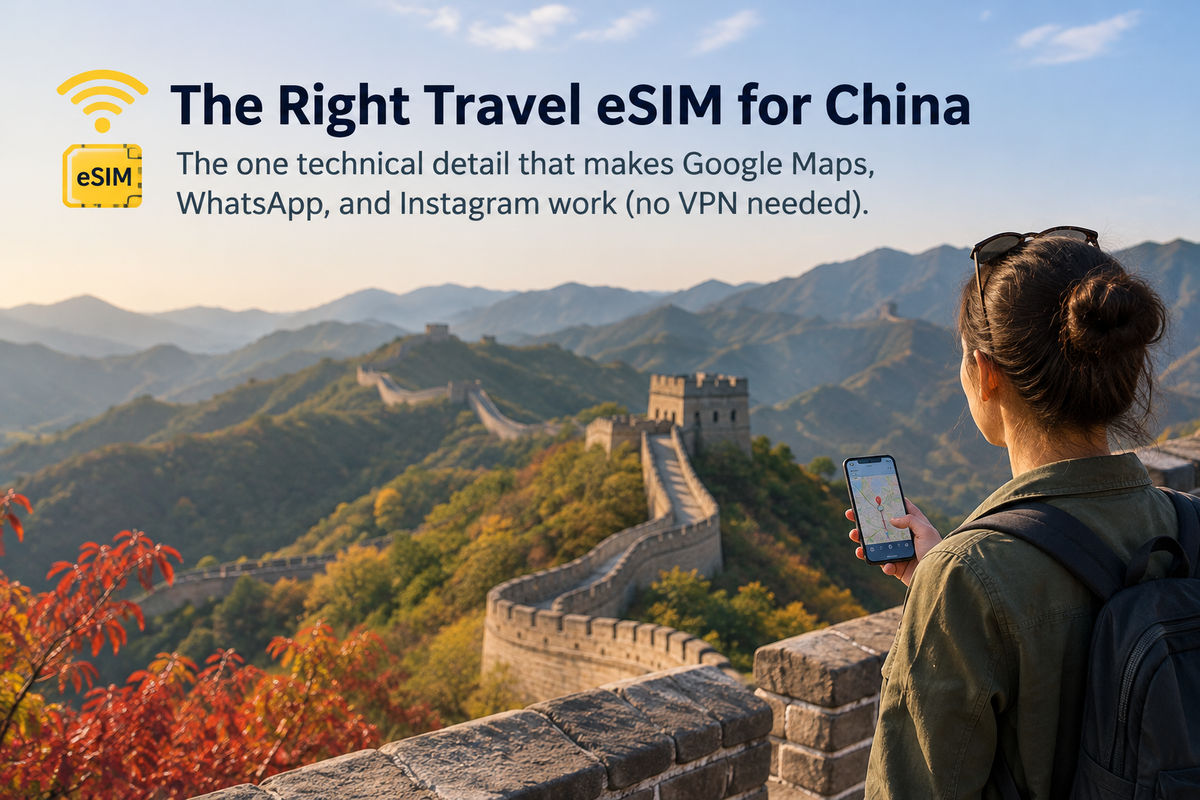
China eSIM China is the one country where picking the right travel eSIM isn’t about price or coverage — it’s about one technical detail most travelers don’t know to ask about. Get it right and Google Maps, WhatsApp, and Instagram just work the moment you land. Get it wrong and you’re staring at spinning wheels with a dead VPN. Here’s what actually matters.

The one thing that matters: does your eSIM route outside China?

China’s Great Firewall blocks most of the apps a traveler relies on — Google (Search, Maps, Gmail), WhatsApp, Instagram, Facebook, YouTube, X. The workaround that actually holds up in 2026 isn’t a VPN. It’s your choice of eSIM. Here’s the mechanism, because it’s the whole story: a roaming travel eSIM connects to a Chinese cell tower for signal, but routes your actual data through a foreign exit point — typically Hong Kong or Singapore — so the request never passes through the Great Firewall. The result is that Google, WhatsApp, Instagram, YouTube, and Gmail work normally, with no VPN app to install or get blocked. The critical distinction, and the one most guides blur: the local radio network and the internet exit point are two different things. You want an eSIM whose data exits outside mainland China. Most international roaming eSIMs do this; some budget plans route through a Chinese network and don’t. This is the single question to confirm before you buy. OneSimCard’s DataMax eSIM is built for exactly this. It routes your data outside mainland China, so Google Maps, WhatsApp, Gmail, and Instagram work the moment you land — no VPN to install, nothing to configure. Your phone connects to a local network for speed, but your traffic exits the country, which is what gets you past the firewall.

The trap: a local SIM and hotel wifi do NOT get you around it

This is where travelers get burned. A local Chinese SIM — including the ones sold at airport counters — is a Chinese network, so it does not bypass the firewall. Google and WhatsApp still won’t open without a VPN. The same goes for hotel wifi, cafe wifi, and every other local internet connection — they all route through the Great Firewall. So the cheap airport SIM that looks like a bargain leaves you with exactly the problem you were trying to solve. And VPNs have become unreliable in China through 2026 — they’re actively targeted, and the free ones mostly don’t work. A correctly-routed travel eSIM sidesteps the whole fight.

One honest caveat: this isn’t the same as a VPN

Worth being straight about, since it builds trust rather than overselling: the firewall bypass here comes from international routing, not encryption. The connection is not encrypted the way a VPN’s is. For normal travel — maps, messaging, social, email — that’s irrelevant and the eSIM is the better, more stable option. If you specifically need encrypted traffic for sensitive work, you’d still layer a VPN on top. For the vast majority of visitors, the eSIM alone is all they need.

Does an eSIM even work in China? (device check)

Yes — an international travel eSIM works in mainland China on an unlocked, eSIM-compatible phone. Most iPhones from the XS on, recent Pixels, and flagship Samsungs qualify. One China-specific quirk worth knowing: phones bought in mainland China often have eSIM disabled by local rules, but that doesn’t affect you — a phone bought in the US, UK, Europe, or most other markets works fine. The requirement is the usual one: unlocked and eSIM-ready.

Coverage and networks

Coverage is excellent. China has three carriers — China Mobile, China Unicom, and China Telecom — and 4G/5G blanket the cities, high-speed rail, and tourist regions. Roaming travel eSIMs commonly run on China Unicom or China Telecom. For a normal trip — Beijing, Shanghai, Xi’an, Chengdu, Guilin, and the rail lines between them — coverage won’t be your concern. The thin spots are the usual remote ones: deep in Tibet, far western Xinjiang, and high mountain areas, where signal gets patchy regardless of carrier.

Payments: WeChat and Alipay are the other essential

China’s equivalent of “the one app your data must handle” is really two: WeChat and Alipay. China is close to cashless, and a traveler who can’t pay by QR code is genuinely stuck — many places don’t take cash or foreign cards at all. Both apps now let foreign visitors link an overseas card. They work on any connection, but you need reliable data for them to load when you need them, which your eSIM covers. Set up Alipay or WeChat Pay before you fly.

Activate before you fly — this one’s non-negotiable

Everywhere else, setting up at home is a convenience. For China it’s close to essential, because if you land without a working eSIM, you can’t easily download one — the app stores and setup pages you’d need may be behind the very firewall you’re trying to get around. So install your eSIM at home, on wifi, days ahead, and confirm it shows up in your phone’s cellular settings. When you land, you switch it on and you’re through the firewall before you reach the taxi rank.

Keep your home number for texts and calls

An eSIM runs alongside your physical SIM, so you can keep data on the travel eSIM and your home number live for calls and the SMS verification codes your bank and apps send. Set the travel eSIM as your data line and turn off data roaming on your home number so you don’t get a surprise bill.

Bonus: Hong Kong and Macao are a different world

If your trip includes them, know that Hong Kong and Macao operate under “One Country, Two Systems” and have no Great Firewall — Western apps work normally there with no eSIM trick or VPN needed. Many regional eSIM plans cover all three, but check that mainland China is included, since it’s the only one of the three where the routing matters.

The bottom line

    • The only spec that really matters: confirm your eSIM routes data outside mainland China
    • Skip the airport SIM — a local Chinese network doesn’t bypass the firewall, and nor does hotel wifi
    • Don’t count on a VPN as your plan A; they’re unreliable in China now
    • Set up WeChat Pay or Alipay before you travel — China is effectively cashless
    • Install and activate the eSIM at home, because you may not be able to download one once you’ve landed
    • Keep your home number live for SMS codes
Get the routing right and China goes from the world’s most frustrating connectivity destination to one of the easiest. OneSimCard’s DataMax eSIM handles the routing for you — so you can land, switch it on, and open Google Maps like you never left.


eSIM for Thailand — What Actually Works

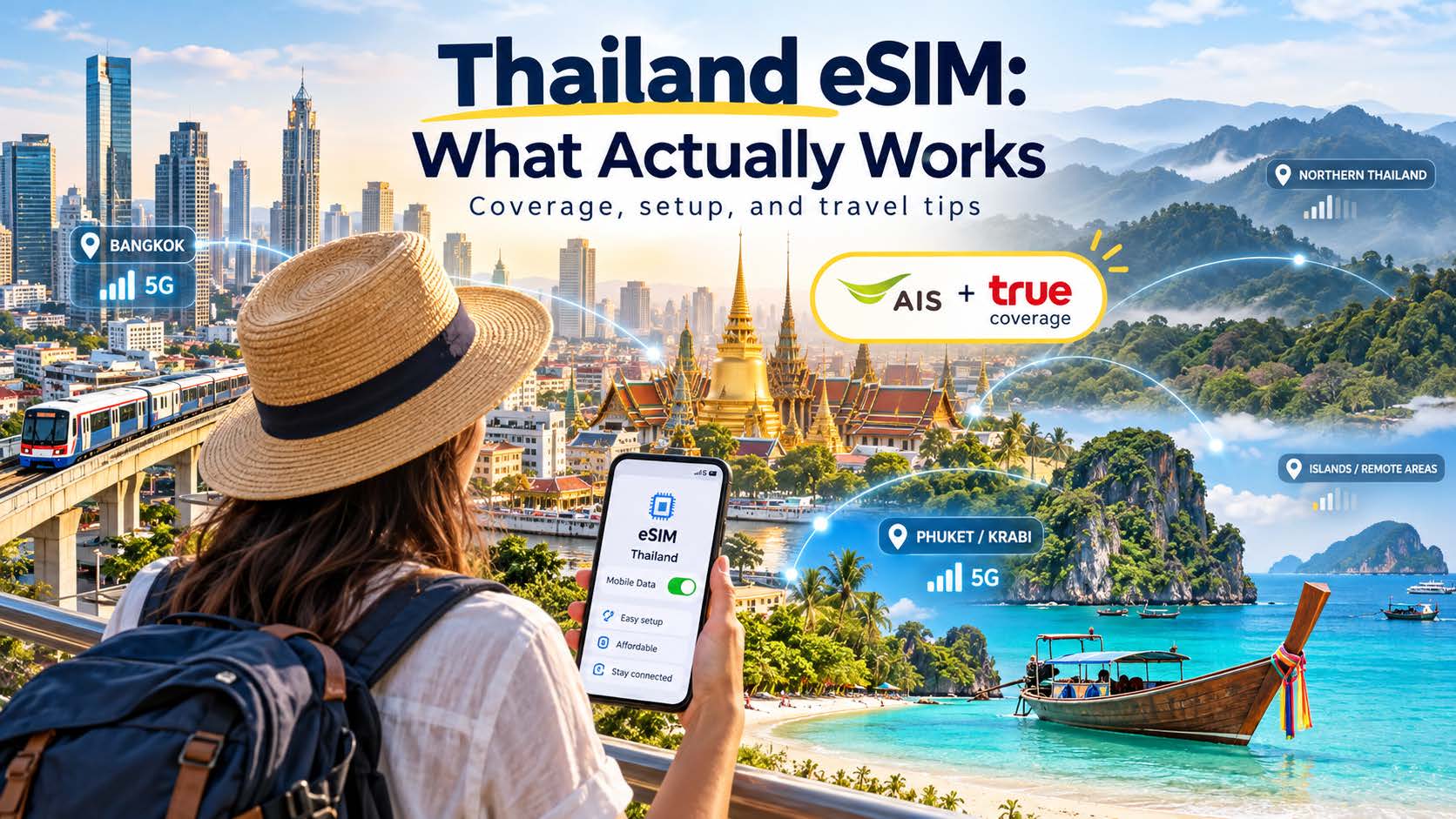
Female traveler using eSIM in Thailand

Thailand is one of the most eSIM-friendly countries in Asia, and also one where a lot of travel guides are quietly out of date. The old advice — “pick AIS, dtac, or True” — describes a market that no longer exists. Here’s the current picture, what it means for coverage on the islands and up north, and how to set up before you fly.

Does an eSIM actually work in Thailand?

Yes, and well. Coverage in Bangkok, Chiang Mai, Phuket, and the main tourist corridors is strong, 5G is widespread in the cities, and prepaid data is cheap by global standards. The only requirement on your end is the usual one: your phone needs to be eSIM-compatible and carrier-unlocked. Most iPhones from the XS on, recent Pixels, and flagship Samsungs qualify.

The part most guides get wrong: there are really only two big networks now

For years Thailand had three major operators — AIS (Advanced Info Service Public Company Limited or Advanced Wireless Network Company Limited), dtac, and True. That’s the setup almost every travel blog still describes. It’s no longer accurate.

In 2023, dtac merged with True, and the dtac brand has largely been absorbed into True Corporation. The practical result is a two-player market: AIS and True now dominate Thailand’s mobile sector, with AIS leading in revenue share while True edges ahead in subscriber numbers and 5G coverage. Together, the major operators hold roughly 97% of the market.

Why this matters to you as a traveler: both remaining networks are large, well-funded, and investing heavily in coverage, so a travel eSIM running on either AIS or True will serve you well in the places you’re most likely to go. If you see an eSIM still advertising a “dtac” network, that’s a sign the listing hasn’t been updated — the underlying network is now True.

OneSimCard DataMax eSIM combines both AIS ad True into one eSIM so you get the best of the best coverage.

Where coverage is great — and where network choice starts to matter

Excellent, on either network:

  • Bangkok and every major city, including the BTS and MRT
  • Chiang Mai, Phuket, Pattaya, Krabi town, Hua Hin
  • The main highways and tourist routes between them

Where it gets more variable — and where the network behind your eSIM actually matters:

  • The islands. Ko Samui, Ko Pha Ngan, Ko Tao, Ko Lanta, the Phi Phi islands — coverage is generally good near the main beaches and towns but thins out on remote headlands, dive boats, and the quieter far sides of each island. Signal can drop entirely once you’re a few kilometers offshore.
  • The far north and northeast. Mountainous Mae Hong Son, rural Isaan, and the national parks have real dead zones. AIS has historically had the edge in rural and upcountry coverage, which is worth knowing if your trip is heavy on the north rather than the beaches.
  • Jungle and trekking areas around Khao Sok and the northern hill country — plan to be offline in stretches regardless of network.

For a city-and-beach trip, either network is fine. If you’re spending serious time upcountry or island-hopping to the quieter spots, an eSIM on AIS is the safer default.

How much data do you actually need?

Thailand is awash in free wifi — hotels, cafes, malls, even many beach bars — so your eSIM mostly fills the gaps: Grab rides, maps, translation, messaging, and uploading all those photos. And with rates starting at $1.58/GB OneSimCard has you connected for less!

Exploring the Timeless Charm of Vietnam: Top 10 Things to Do

Photo by Vo Thuy Tien

Introduction

Vietnam, a country that beautifully blends its rich history, stunning landscapes, and vibrant culture, has become an increasingly popular travel destination in recent years. With its diverse regions offering a plethora of experiences, Vietnam has something to offer every type of traveler. From bustling cities to serene countryside, from historical treasures to natural wonders, Vietnam promises an unforgettable journey. In this article, we’ll delve into the top 10 things to do when traveling to Vietnam, showcasing the nation’s unique allure.

1. Explore the Bustling Streets of Hanoi

Vietnam’s capital, Hanoi, is a mesmerizing blend of ancient traditions and modern influences. Start your journey by exploring the Old Quarter, where narrow streets are filled with local markets, street food vendors, and historic temples. Don’t forget to visit the Hoan Kiem Lake and Ngoc Son Temple, which are beautifully illuminated at night, creating a romantic atmosphere for an evening stroll.

2. Cruise Through the Halong Bay

A UNESCO World Heritage Site, Halong Bay is a natural wonder that will leave you awestruck. Embark on a cruise to explore its emerald waters, towering limestone karsts, and hidden caves. The bay’s ethereal beauty makes it a photographer’s dream, and you can choose from various cruise options, ranging from budget to luxury.

3. Get Lost in the Ancient Town of Hoi An

Hoi An, with its well-preserved architecture and lantern-lit streets, transports you back in time. This charming town boasts an array of tailor shops, making it a great place to get custom-made clothing. Explore its markets, dine on exquisite Vietnamese cuisine, and be sure to visit the historic Japanese Covered Bridge.

4. Immerse Yourself in the Cu Chi Tunnels

Venture into the historic Cu Chi Tunnels near Ho Chi Minh City (formerly known as Saigon). These underground tunnels served as a strategic base during the Vietnam War and offer a glimpse into the country’s wartime history. You can even crawl through a section of the tunnels to experience the cramped conditions faced by soldiers.

5. Marvel at the Temples of Angkor

Sunrise at Angkor Wot
Photo by Lukas Kloeppel

While not technically in Vietnam, the nearby Angkor Wat complex in Cambodia is an absolute must-visit for travelers exploring Southeast Asia. These stunning temples are a testament to the grandeur of the Khmer Empire and can be easily reached from Ho Chi Minh City via a short flight. Witness the sunrise at Angkor Wat and explore the intricately designed temples in the surrounding area.

6. Savor Vietnamese Cuisine

Vietnamese food is renowned worldwide for its fresh ingredients and bold flavors. From street food stalls to upscale restaurants, you’ll find an array of delicious dishes to try. Don’t miss out on iconic dishes like pho (noodle soup), banh mi (Vietnamese sandwich), and fresh spring rolls. Each region in Vietnam has its own unique culinary specialties, so be sure to explore the local cuisine wherever you go.

7. Trek Through the Sapa Terraces

For nature enthusiasts and adventure seekers, Sapa offers some of Vietnam’s most breathtaking scenery. Trek through terraced rice fields, mist-covered mountains, and traditional Hmong villages. The beauty of this region is unparalleled, and interacting with local ethnic minorities adds a cultural dimension to your journey.

8. Visit the Imperial City of Hue

Hue, located in central Vietnam, was once the imperial capital of the Nguyen Dynasty. Explore the UNESCO-listed Imperial City, a vast complex of palaces, temples, and gates. The Perfume River, which flows through Hue, offers picturesque boat rides and an opportunity to visit ancient pagodas.

9. Relax on Phu Quoc Island

For those seeking sun and sand, Phu Quoc Island is an idyllic destination. With its pristine beaches, lush jungles, and luxury resorts, it’s a perfect place to unwind. Explore the island’s fish sauce factories, pepper plantations, and vibrant night markets. Don’t forget to watch the mesmerizing sunset at Long Beach.

10. Learn About the War Remnants in Ho Chi Minh City

Gain a deeper understanding of Vietnam’s tumultuous history by visiting the War Remnants Museum in Ho Chi Minh City. This thought-provoking museum exhibits war artifacts, photographs, and stories that shed light on the country’s painful past. It’s a poignant reminder of the resilience and strength of the Vietnamese people.

Conclusion

Vietnam is a country of incredible diversity, offering travelers a wide range of experiences. From the bustling streets of Hanoi to the serene beauty of Halong Bay, from the historical richness of Hue to the culinary delights found across the nation, Vietnam is a destination that will captivate your heart and soul. So, pack your bags and embark on a journey to discover the timeless charm of this beautiful country. Vietnam welcomes you with open arms and a promise of unforgettable memories.

Also, don’t forget to download the OneSimCard Universal SIM card for your trip to Vietnam. With the Universal SIM card, you can get 3000MB of data for $39.00 for 30 days. You can also use our 1SIM VoIP app to make and receive calls while traveling. The 1SIM VoIP app allows you to call virtually any phone number in the world for less cost than traditional cellular voice. You can see our blog post about the comparison of traditional cellular voice roaming and 1SIM VoIP voice. We hope you enjoy the wonders of Vietnam!

New Specialty “Asiana” eSIM Now Available

The Asiana eSIM is a specialty eSIM that is focused on 30+ Asia and Oceania countries, with other destinations included as well.

As of July 12, 2021 the list of destinations is:

Australia, Bahrain, Bangladesh, Cambodia, Canada, Chile, China, East Timor, Egypt, India, Indonesia, Iran, Japan, Kenya, Kuwait, Kyrgyzstan, Laos, Macau, Malaysia, Mexico, Moldova, Morocco, New Zealand, Philippines, Qatar, Russia, Saudi Arabia, Singapore, South Africa, South Korea, Taiwan, Tanzania, Thailand, Tunisia, UAE, USA, & Uzbekistan. Rates in many of these destinations will be significantly less than our current eSIM or other SIM cards.

This card also provides several inexpensive plans (1000mb, 3000mb & 5000mb) for these destinations: Australia, Cambodia, China, Egypt, India, Indonesia, Japan, Macau, Malaysia, New Zealand, Philippines, Saudi Arabia, Singapore, South Korea, Taiwan, Thailand, UAE, USA, Uzbekistan

This eSIM is a great supplement to our current eSIM offering, and can be used as a second eSIM on your device when traveling to the listed destinations to potentially save on Voice, Data and SMS charges.

Buy Asiana eSIM

China Data Plan is now Asiania Data Plan. 12 Countries Added.

OneSimCard Asiania Data Plan

If you travel to destinations in Asia, Oceania or both, we have great news for you. You can now save even more money on 4G data!

Effective August 8, 2019 Zone China Data Plan on the Universal and Plus SIM cards has been expanded and renamed to Zone Asiania.

The new data plan covers 13 countries in Asia and Oceania including Australia, China, India, Macau, New Zealand, Indonesia, Malaysia, Singapore, Taiwan, Thailand, Vietnam, Japan and Hong Kong.

The plan offers 3000 MB of blazing-fast 4G LTE data for 30 Days and costs only $39.00 USD. If no 4G connection is available, the data will automatically fall back to the next available fastest option. It’s that convenient (and affordable).

How to Order

You can add Zone Asiania to your OneSimCard Universal or Plus SIM at any time from your OneSimCard web account. In addition to data, both international SIM cards offer calling and texting in all Asiania countries as well as hundreds of other destinations around the globe.

Who knows, we may have just invented a new geographic region?! Well, you decide. One thing is for sure. No matter where you travel, OneSimCard can help you stay connected and save money.

Welcome to Asiania! Enjoy your trip!